


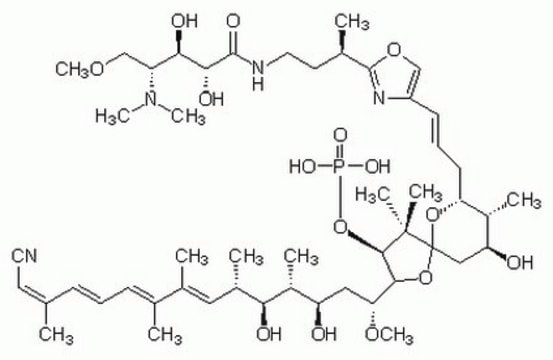

This material is soluble in DMSO up to 371 mg/mL. Stock solutions prepared in dimethyl sulfoxide and stored at 22–24 °C have been reported to retain tissue culture activity for up to three months.
C8273

Cytochalasin D
From Zygosporium mansonii, ≥98% (TLC and HPLC), actin polymerization inhibitor, powder
Cytochalasin D
Sinonimo/i:
Lygosporin A, Zygosporin A
Autenticati per visualizzare i prezzi organizzativi e contrattuali.
Scegli un formato
Cambia visualizzazione
| A voi/SKU | Disponibilità | Prezzo |
|---|---|---|
1 mg | Per informazioni sulla disponibilità, contatta il Servizio Clienti. | 192,00 € |
5 mg | Per informazioni sulla disponibilità, contatta il Servizio Clienti. | 678,00 € |
10 mg | Per informazioni sulla disponibilità, contatta il Servizio Clienti. | 1090,00 € |
Informazioni su questo articolo
Formula empirica (notazione di Hill):
C30H37NO6
Numero CAS:
Peso molecolare:
507.62
NACRES:
NA.77
PubChem Substance ID:
UNSPSC Code:
12352200
EC Number:
244-804-1
MDL number:
Beilstein/REAXYS Number:
1632828
Assay:
≥98% (TLC and HPLC)
Form:
powder
192,00 €
Per informazioni sulla disponibilità, contatta il Servizio Clienti.
Servizio Tecnico
Hai bisogno di aiuto? Il nostro team di scienziati qualificati è a tua disposizione.
Permettici di aiutartiNome del prodotto
Cytochalasin D, from Zygosporium mansonii, ≥98% (TLC and HPLC), powder
biological source
Zygosporium mansonii
Quality Segment
assay
≥98% (TLC and HPLC)
form
powder
solubility
DMSO: soluble, ethanol: soluble
antibiotic activity spectrum
fungi
mode of action
DNA synthesis | interferes
storage temp.
−20°C
SMILES string
[H][C@@]12[C@H](C)C(=C)[C@@H](O)[C@@H]3\C=C\C[C@H](C)C(=O)[C@](C)(O)\C=C\[C@@H](OC(C)=O)[C@@]13C(=O)N[C@H]2Cc4ccccc4
InChI
1S/C30H37NO6/c1-17-10-9-13-22-26(33)19(3)18(2)25-23(16-21-11-7-6-8-12-21)31-28(35)30(22,25)24(37-20(4)32)14-15-29(5,36)27(17)34/h6-9,11-15,17-18,22-26,33,36H,3,10,16H2,1-2,4-5H3,(H,31,35)/b13-9+,15-14+/t17-,18+,22-,23-,24+,25-,26+,29+,30+/m0/s1
InChI key
SDZRWUKZFQQKKV-JHADDHBZSA-N
General description
Cytochalasin D is a cell-permeable fungal toxin. It disrupts actin microfilaments and activates the p53-dependent pathways causing arrest of the cell cycle at the G1-S transition. Cytochalasin D inhibits smooth muscle contraction and insulin-stimulated but not basal transport of glucose.
Cytochalasin D (CytoD) is commonly used to inhibit actin dynamics and study its role in cellular processes. This fungal-derived small organic compound acts as an inhibitor of the interaction between G-actin and cofilin by binding to G-actin. Additionally, CytoD inhibits the binding of cofilin to F-actin and reduces the rate of actin polymerization and depolymerization in living cells.
Application
Cytochalasin D has been used:
- to treat H9c2 cells to study the relationship between cell stiffness and the F-actin cytoskeleton
- as inhibitor of receptor-mediated endocytosis to treat oligodendrocyte precursor cells (OPCs) to investigate the effect of inhibiting specific extracellular vesicle (EV) uptake pathways
- in in vitro embryo culture to artificially activate oocytes
Biochem/physiol Actions
Potent inhibitor of actin polymerization; disrupts actin microfilaments; activates the p53-dependent pathways; inhibits smooth muscle contraction; inhibits insulin-stimulated glucose transport.
1 of 1
Questo articolo | |||
|---|---|---|---|
| description from Zygosporium mansonii, ≥98% (TLC and HPLC), powder | description from microbial, ≥94% (TLC) | description Ready Made Solution, from Zygosporium mansonii, 5 mg/mL in DMSO | description Calyculin A, CAS 101932-71-2, is a cell-permeable inhibitor of protein phosphatase 2A (IC50 = 0.5-1 nM) and protein phosphatase 1 (PP1; IC50 = 2 nM). |
| form powder | form powder | form ready-to-use solution | form crystalline (powder) |
| assay ≥98% (TLC and HPLC) | assay ≥94% (TLC) | assay - | assay ≥98% (HPLC) |
| Quality Level 300 | Quality Level 200 | Quality Level 300 | Quality Level 100 |
| storage temp. −20°C | storage temp. 2-8°C | storage temp. −20°C | storage temp. −20°C |
| solubility DMSO: soluble, ethanol: soluble | solubility ethanol: soluble, clear to hazy | solubility - | solubility ethanol: 2 mg/mL, DMSO: soluble |
| antibiotic activity spectrum fungi | antibiotic activity spectrum fungi, yeast | antibiotic activity spectrum fungi | antibiotic activity spectrum - |
Still not finding the right product?
Explore all of our products under Cytochalasin D
signalword
Danger
hcodes
Hazard Classifications
Acute Tox. 2 Oral
Classe di stoccaggio
6.1A - Combustible acute toxic Cat. 1 and 2 / very toxic hazardous materials
wgk
WGK 3
ppe
Eyeshields, Faceshields, Gloves, type P3 (EN 143) respirator cartridges
Scegli una delle versioni più recenti:
Possiedi già questo prodotto?
I documenti relativi ai prodotti acquistati recentemente sono disponibili nell’Archivio dei documenti.
-
Could you provide the maximum solubility in DMSO (mg/mL)?
1 risposta-
Utile?
-
-
What is the time frame for the effect to take place in the culture media for all three products? How long will the effect last? What is the duration for which the cell can survive or tolerate the effect?
1 risposta-
The time frame for the effect to take place in the culture media, the duration of the effect, and the cell's ability to survive or tolerate the effect can be found in the following articles:
How long does it take for the product to take effect in the culture media?
J Cell Biol. 1974 May;61(2):481-500. doi: 10.1083/jcb.61.2.481.
Action of cytochalasin D on cells of established lines. I. Early events
PMID: 4208074How long will the effect last?
Cell Motil Cytoskeleton. 1989;13(3):127-44. doi: 10.1002/cm.970130302.
Latrunculins--novel marine macrolides that disrupt microfilament organization and affect cell growth: I. Comparison with cytochalasin D
PMID: 2776221How long can the cell survive/tolerate?
J Biol Chem. 1999 Feb 12;274(7):4259-65. doi: 10.1074/jbc.274.7.4259.
Actin stabilization by jasplakinolide enhances apoptosis induced by cytokine deprivation
PMID: 9933626Utile?
-