

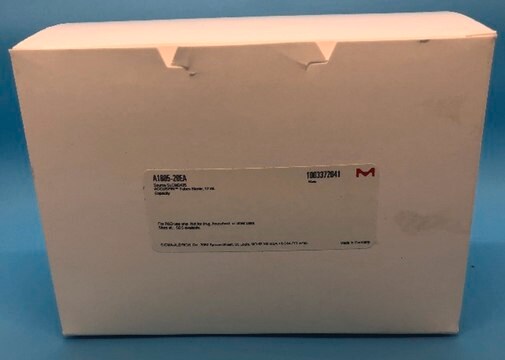
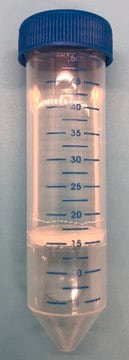


Accuspin tubes are obtained from an outside supplier. Their exact dimensions are not available but should approximate the dimensions of a standard 50 ml centrifuge tube. Standard dimensions are generally 29.1 mm in diameter X 114.4 mm long.
A2055

Provette sterili ACCUSPIN™, capacità 50 mL
radiation sterilized tube fitted with a high density polyethylene barrier
Autenticati per visualizzare i prezzi organizzativi e contrattuali.
Scegli un formato
Cambia visualizzazione
| A voi/SKU | Disponibilità | Prezzo |
|---|---|---|
10 ea | Per informazioni sulla disponibilità, contatta il Servizio Clienti. | 130,00 € |
Informazioni su questo articolo
NACRES:
NA.75
UNSPSC Code:
12352207
130,00 €
Per informazioni sulla disponibilità, contatta il Servizio Clienti.
Servizio Tecnico
Hai bisogno di aiuto? Il nostro team di scienziati qualificati è a tua disposizione.
Permettici di aiutartiQuality Segment
sterility
sterile; irradiated
form
tubes
application(s)
hematology
histology
storage temp.
15-25°C
General description
Le provette ACCUSPIN™sono provette in polipropilene, sterilizzate mediante radiazione, dotate di una barriera in polietilene ad alta densità. Ogni provetta può contenere 15 mL di mezzo a gradiente di densità.
Application
Le provette sterili ACCUSPIN™ da 50 mL sono destinate all′impiego con il mezzo di separazione a gradiente di densità Histopaque™ -1077:
- nell'isolamento di linfociti e di altre cellule mononucleate.
- nell'isolamento delle cellule progenitrici endoteliali dal sangue di cordone ombelicale.[1]
- nell'isolamento di uno strato di cellule mononucleate da campioni di midollo osseo.
- sono adatte per la purificazione di aspirati di midollo osseo umano per analizzare il valore terapeutico degli inibitori delle proteine BET nella leucemia mieloide acuta.
Biochem/physiol Actions
Dopo l'aggiunta di Histopaque-1077 allaprovetta ACCUSPIN, una breve centrifugazione posizionaHistopaque-1077 sotto la fritta. Il campione di sangue puòessere aggiunto alla camera superiore della provetta senza il rischio chesi misceli con Histopaque-1077 nella camera inferioreal di sotto della fritta. Alla successiva centrifugazione, tutto ilsangue attraversa la fritta ed entra in contatto conHistopaque-1077. Gli elementi a densità maggiorespiazzano un volume di Histopaque-1077 al di sopra della frittacausando una separazione netta dei componenti del sangue. Glieritrociti si aggregano e i granulociti diventanoleggermente ipertonici, aumentando il loro tasso di sedimentazione,con conseguente accumulo sotto forma di pellet sul fondo dellaprovetta ACCUSPIN. I linfociti e le altre cellule mononucleate, per es.i monociti, rimangano a livello dell'interfacciaplasma/Histopaque-1077. Questa banda densa di cellule mononucleate puòessere recuperata versando il contenuto della camera superioreo per mezzo di una pipetta. La contaminazione con eritrocitiviene evitata dalla barriera tra lecamere.
Preparation Note
Confezione da 10 provette
Legal Information
Accuspin is a trademark of Sigma-Aldrich Co. LLC
1 of 1
Questo articolo | |||
|---|---|---|---|
| sterility sterile; irradiated | sterility sterile; irradiated | sterility aseptically filled | sterility aseptically filled |
| form tubes | form tubes | form solution | form solution |
| Quality Level 200 | Quality Level 200 | Quality Level 400 | Quality Level 400 |
| storage temp. 15-25°C | storage temp. 15-25°C | storage temp. 2-8°C | storage temp. 2-8°C |
| application(s) hematology | application(s) hematology | application(s) hematology | application(s) hematology |
signalword
Danger
hcodes
Hazard Classifications
Resp. Sens. 1 - Skin Sens. 1
Classe di stoccaggio
10 - Combustible liquids
flash_point_f
Not applicable
flash_point_c
Not applicable
Scegli una delle versioni più recenti:
Possiedi già questo prodotto?
I documenti relativi ai prodotti acquistati recentemente sono disponibili nell’Archivio dei documenti.
-
Liebes Team, sind die Abmessungen (AußendurchmesserxHöhe) der Röhrchen bekannt? Liebe Grüße!
1 risposta-
Utile?
-
-
How should a 4-20% sucrose gradient be used to reduce platelet contamination, as recommended in the user manual?
1 risposta-
Sucrose exerts an osmotic pressure of 300 mOsm at a concentration of about 0.25M, which is iso-osmotic with the contents of most mammalian cells. This concentration is approximately 81.25 grams/L or 8.125%, as per protocols used to remove platelets. Recommended procedures for removing platelets:
Perform Procedure 1077 or 1077/1119.
Collect the cell band and layer it over a second gradient.
A. Bottom layer = 1077-1
B. Top layer = 8.125% sucrose solution (prepared in deionized water).
C. Layer the cell suspension on top of the gradient formed in steps 1-2.
D. Use a 300 g spin for 10-15 minutes.
E. Depending upon the original volume of the cell suspension, times and speed may have to be adjusted to maximize cell recovery.
F. Use separate tubes for mononuclear and polymorphonuclear cells.Utile?
-
-
Is Accuspin (A2055) suitable for use with canine blood?
1 risposta-
The suggestion is to make a decision based on individual circumstances.If currently using a plain centrifuge tube for collecting PBMCs from canine blood using a single density gradient, the Accuspin Tubes can be used for the same collection, provided that the G force does not exceed 1000G and a single density gradient is used.
Utile?
-
-
Does the Accuspin Tubes Product #A2055, which are prefilled with a frit, also contain EDTA or another anticoagulant?
1 risposta-
None of the Accuspin spin tubes (filled or unfilled) contain any anticoagulant. It is expected that when blood is drawn, it is typically drawn into a vacuum tube that already contains an anticoagulant or it is necessary to add anticoagulant immediately after the blood draw is completed. The most common anticoagulants used are EDTA and Heparin.
Utile?
-
-
Are Accuspin tubes compatible with blood that has been anticoagulated with ACD-A?
1 risposta-
Certainly, Accuspin tubes are suitable for use with any blood containing an anticoagulant, with fresher blood being preferable. Regardless of the anticoagulant used, the anticoagulant is essentially washed away during the steps to remove the density gradient from the collected white blood cells. With ACD-A, the cell band is wider at the interface and the cells are more dispersed over a larger area, possibly due to the dextrose/glucose in the formulation. When using ACD-A, a somewhat unusual cell band is produced after the tubes are removed from the centrifuge. In comparison, cell bands with heparin, EDTA, sodium citrate, and other typical anticoagulants typically provide a rather narrow cell band when viewed from the side of the Accuspin tube.
Utile?
-
-
Can I remove the Frit after collecting the mononuclear cells to recover the granulocytes?
1 risposta-
When using the Accuspin System to collect Peripheral Blood Mononuclear Cells (PBMCs), there is no expectation that the neutrophils can be recovered. Although it is possible to dislodge the frit, some granulocytes will be suspended in the lower layers of the density gradient. The remaining granulocytes will appear as a gray layer on top of the packed red blood cells.
In theory, the end-user may be able to collect this buffy coat that sits atop the packed red blood cell layer. It is recommended to either perform a lysis step to lyse the red blood cells, or run the cells back over another density gradient - such as Histopaque 11191 that has a density of 1.119 g/ml.
Instead of performing this 2-step procedure that has not been validated, the more logical option would be to simply run the whole peripheral blood over a 2-step discontinuous gradient. Currently, Histopaque 10771 and Histopaque 11191, are offered. The Histopaque 11191 instructions for use are available in the DOCUMENTATION section in the 'More Documents' tab of the product detail page:
https://www.sigmaaldrich.com/product/sigma/a2055#product-documentation
https://www.sigmaaldrich.com/deepweb/assets/sigmaaldrich/product/documents/193/872/a2055pis.pdfUtile?
-