Saltar al contenido
Merck

E006

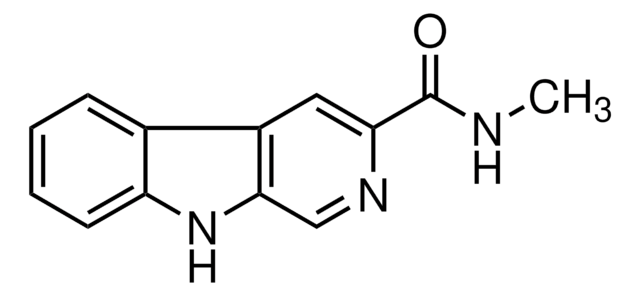
β-Carboline-3-carboxylic acid N-methylamide

Benzodiazepine receptor inverse agonist, solid

Sinónimos:

β-CCA methylamide, FG-7142, N-Methyl-β-carboline-3-carboxamide

Iniciar sesión para ver los precios por organización y contrato.

Seleccione un Tamaño

En este momento no podemos mostrarle ni los precios ni la disponibilidad

Acerca de este artículo

Fórmula empírica (notación de Hill):
C13H11N3O
Número CAS:
Peso molecular:
225.25
Número MDL:
Código UNSPSC:
12352106
ID de la sustancia en PubChem:
NACRES:
NA.77

Saltar a

Servicio técnico
¿Necesita ayuda? Nuestro equipo de científicos experimentados está aquí para ayudarle.
Permítanos ayudarle

Nombre del producto

β-Carboline-3-carboxylic acid N-methylamide,

Formulario

solid

Nivel de calidad

color

light tan

solubilidad

DMSO: >10 mg/mL
H2O: insoluble

cadena SMILES

CNC(=O)c1cc2c(cn1)[nH]c3ccccc23

InChI

1S/C13H11N3O/c1-14-13(17)11-6-9-8-4-2-3-5-10(8)16-12(9)7-15-11/h2-7,16H,1H3,(H,14,17)

Clave InChI

QMCOPDWHWYSJSA-UHFFFAOYSA-N

Información sobre el gen

human ... BZRAP1(9256)

¿Está buscando productos similares? Visita Guía de comparación de productos

Categorías relacionadas

Comparar elementos similares

Ver comparación completa

Mostrar Diferencias

1 of 4

Este artículo
SML2372C2020A6226
form

solid

form

powder

form

powder

form

solid

Quality Level

100

Quality Level

-

Quality Level

300

Quality Level

100

solubility

DMSO: >10 mg/mL, H2O: insoluble

solubility

DMSO: 2 mg/mL, clear

solubility

H2O: slightly soluble, methanol: water: soluble, polar organic solvents: soluble

solubility

DMSO: >10 mg/mL, H2O: insoluble

color

light tan

color

white to beige

color

yellow

color

white

Gene Information

human ... BZRAP1(9256)

Gene Information

-

Gene Information

-

Gene Information

mouse ... Cnr1(12801), Cnr2(12802)
rat ... Cnr1(25248)

Acciones bioquímicas o fisiológicas

Benzodiazepine inverse receptor agonist; potent anxiogenic agent.

Características y beneficios

This compound is a featured product for Neuroscience research. Click here to discover more featured Neuroscience products. Learn more about bioactive small molecules for other areas of research at sigma.com/discover-bsm.

Cláusula de descargo de responsabilidad

Solutions may be stored for several days at 4 °C.

Código de clase de almacenamiento

11 - Combustible Solids

Clase de riesgo para el agua (WGK)

WGK 3

Punto de inflamabilidad (°F)

Not applicable

Punto de inflamabilidad (°C)

Not applicable

Equipo de protección personal

Eyeshields, Gloves, type N95 (US)


Elija entre una de las versiones más recientes:

Certificados de análisis (COA)

Lot/Batch Number

¿No ve la versión correcta?

Si necesita una versión concreta, puede buscar un certificado específico por el número de lote.

¿Ya tiene este producto?

Encuentre la documentación para los productos que ha comprado recientemente en la Biblioteca de documentos.

Visite la Librería de documentos

Natale R Sciolino et al.
Behavioural brain research, 233(1), 191-200 (2012-05-15)
Although exercise improves anxiety in humans, it is controversial whether exercise is anxiolytic in rodents. We tested the hypothesis that stress influences the effect of exercise on anxiety-like and defensive behaviors. To explore the neurobiological mechanisms of exercise, we also
Joshua B B Garfield et al.
Behavioral neuroscience, 123(1), 75-85 (2009-01-28)
Six experiments studied the role of GABA-sub(A) receptor activation in expression of overexpectation of Pavlovian fear conditioning. After separate pairings of CSA and CSB with shock in Stage I, rats received pairings of the compound AB with shock in Stage
Hongrun Yu et al.
PloS one, 7(8), e42684-e42684 (2012-08-29)
Post-traumatic stress disorder (PTSD) is an anxiety disorder that not only affects mental health, but may also affect bone health. However, there have been no studies to examine the direct relationship between PTSD and bone. We employed electric shocks in
Philip L Johnson et al.
Physiology & behavior, 107(5), 733-742 (2012-05-05)
Although the hypothalamic orexin system is known to regulate appetitive behaviors and promote wakefulness and arousal (Sakurai, 2007 [56]), this system may also be important in adaptive and pathological anxiety/stress responses (Suzuki et al., 2005 [4]). In a recent study
Matthew W Hale et al.
Progress in neuro-psychopharmacology & biological psychiatry, 34(7), 1285-1293 (2010-07-22)
The basolateral amygdala is a nodal structure within a distributed and interconnected network that regulates anxiety states and anxiety-related behavior. Administration of multiple anxiogenic drugs increases cellular responses (i.e., increases c-Fos expression) in a subregion of the basolateral amygdala, but

Artículos

DISCOVER Bioactive Small Molecules for Neuroscience

Preguntas

Revisiones

Sin puntuación

Filtros activos

Nuestro equipo de científicos tiene experiencia en todas las áreas de investigación: Ciencias de la vida, Ciencia de los materiales, Síntesis química, Cromatografía, Analítica y muchas otras.

Póngase en contacto con el Servicio técnico