

This kit has only been evaluated with PC-PLC from mammalian sources.
CS0011

Phospholipase C (PLC) Activity Assay Kit
Sufficient for 100 colorimetric tests
Sinónimos:
Phospholipase C assay
Iniciar sesión para ver los precios por organización y contrato.
Seleccione un Tamaño
Cambiar Vistas
| A ustedes/SKU | Disponibilidad | Precio |
|---|---|---|
1 kit | Póngase en contacto con nuestro Servicio de Atención al Cliente para disponibilidad | 481,00 € |
Acerca de este artículo
NACRES:
NA.84
UNSPSC Code:
12161503
481,00 €
Póngase en contacto con nuestro Servicio de Atención al Cliente para disponibilidad
Servicio técnico
¿Necesita ayuda? Nuestro equipo de científicos experimentados está aquí para ayudarle.
Permítanos ayudarleGeneral description
Phosphatidylcholine-specific phospholipase C (PC-PLC) is one of the important members of phospholipase family which is capable of specifically hydrolyzing the third phosphate linker of glycerophospholipid molecules, releasing phosphocholine and diacylglycerols (DAG).
PC-PLC has a wide range of biological functions and is involved in various cell signalling pathways, including apoptosis, proliferation, differentiation, motility, gene expression and metastasis. Furthermore, it has been demonstrated that PC-PLC plays a crucial role in the development of atherosclerosis, making PC-PLC an interesting target for the development of cardiovascular drugs. Therefore, it is desirable to identify novel inhibitors of PC-PLC and to analyze their influence on PC-PLC.
Phospholipase C (PLC) Activity Assay Kit provides a simple, rapid and sensitive procedure for measuring PLC activity in various sample types. The kit can detect as low as 0.03 mU/well of PLC activity. The kit can detect PC-PLC activity of purified enzymes and PC-PLC activity in cell extracts. The kit can be used in screening PC-PLC inhibitors.
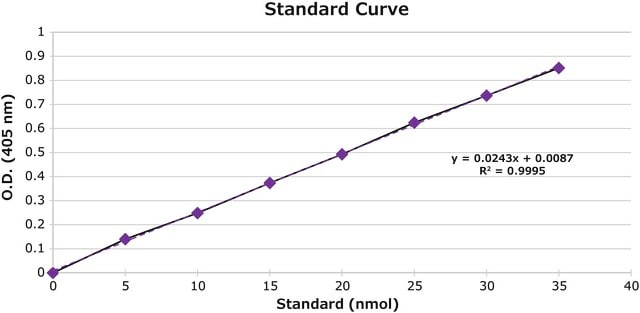
p-Nitrophenylphosphorylcholine is a chromogenic substrate that is used in this kit to measure the activity of PLC. Hydrolysis of p-nitrophenylphosphorylcholine by PLC results in the liberation of p-nitrophenol, which can be measured at 405 nm at pH 7.2-7.5. The colorimetric signal is proportional to the PLC activity.
Supportive calculator (Click here to download a calculator excel file): Will calculate the reagents needed according to your experimental needs.
PC-PLC has a wide range of biological functions and is involved in various cell signalling pathways, including apoptosis, proliferation, differentiation, motility, gene expression and metastasis. Furthermore, it has been demonstrated that PC-PLC plays a crucial role in the development of atherosclerosis, making PC-PLC an interesting target for the development of cardiovascular drugs. Therefore, it is desirable to identify novel inhibitors of PC-PLC and to analyze their influence on PC-PLC.
Phospholipase C (PLC) Activity Assay Kit provides a simple, rapid and sensitive procedure for measuring PLC activity in various sample types. The kit can detect as low as 0.03 mU/well of PLC activity. The kit can detect PC-PLC activity of purified enzymes and PC-PLC activity in cell extracts. The kit can be used in screening PC-PLC inhibitors.
p-Nitrophenylphosphorylcholine is a chromogenic substrate that is used in this kit to measure the activity of PLC. Hydrolysis of p-nitrophenylphosphorylcholine by PLC results in the liberation of p-nitrophenol, which can be measured at 405 nm at pH 7.2-7.5. The colorimetric signal is proportional to the PLC activity.
Supportive calculator (Click here to download a calculator excel file): Will calculate the reagents needed according to your experimental needs.
1 of 1
Este artículo | |||
|---|---|---|---|
| description Sufficient for 100 colorimetric tests | description sufficient for 100 colorimetric or fluorometric tests | description The PAI Activity Assay Kit provides a quick, efficient & sensitive system for evaluation of inhibition of uPA activity by PAI & for screening of uPA inhibitors. | description The uPA Activity Assay Kit provides a quick, efficient & sensitive system for evaluation of uPA activity & for screening of uPA inhibitors. |
| Quality Level 200 | Quality Level - | Quality Level 100 | Quality Level 100 |
| storage temp. −20°C | storage temp. −20°C | storage temp. - | storage temp. - |
| shipped in dry ice | shipped in - | shipped in dry ice | shipped in dry ice |
Clase de almacenamiento
10 - Combustible liquids
Elija entre una de las versiones más recientes:
¿Ya tiene este producto?
Encuentre la documentación para los productos que ha comprado recientemente en la Biblioteca de documentos.
-
Can this kit be used to detect the phospholipase activity of certain microorganisms?
1 respuesta-
¿Le ha resultado útil?
-
-
Can this kit be used to measure PLC activity in human whole blood?
1 respuesta-
This kit is tested using cell lysates. It has not been tested on whole blood, however the dark color of whole blood would very likely mask results. It may be suitable for use with serum or plasma. The minimum limit of detection is 0.03 mU. It would be up to the end user to determine suitability.
¿Le ha resultado útil?
-