
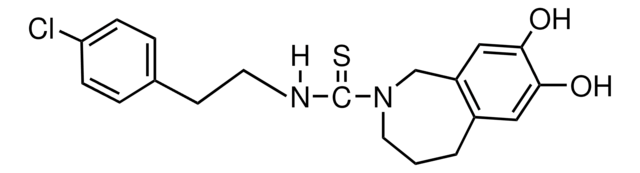
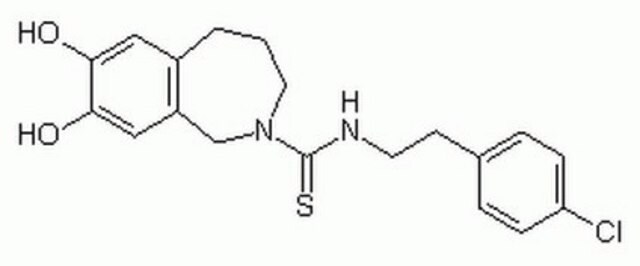

Solubility is tested up to 10mg/mL in anhydrous DMSO. Capsazepine should not be reconstituted in aqueous solutions such as water.
C191

Capsazepine
≥98% (HPLC), solid, TRPV1 antagonist
Sinónimos:
N-[2-(4-Chlorophenyl)ethyl]-1,3,4,5-tetrahydro-7,8-dihydroxy-2H-2-benzazepine-2-carbothioamide
Iniciar sesión para ver los precios por organización y contrato.
Seleccione un Tamaño
Cambiar Vistas
| Tamaño de envase | SKU | Disponibilidad | Precio |
|---|---|---|---|
| 5 mg | Póngase en contacto con nuestro Servicio de Atención al Cliente para disponibilidad | 170,00 € | |
| 25 mg | Póngase en contacto con nuestro Servicio de Atención al Cliente para disponibilidad | 575,00 € |
Acerca de este artículo
Fórmula empírica (notación de Hill):
C19H21ClN2O2S
Número CAS:
Peso molecular:
376.90
UNSPSC Code:
12352200
PubChem Substance ID:
NACRES:
NA.77
MDL number:
170,00 €
Póngase en contacto con nuestro Servicio de Atención al Cliente para disponibilidad
Servicio técnico
¿Necesita ayuda? Nuestro equipo de científicos experimentados está aquí para ayudarle.
Permítanos ayudarleNombre del producto
Capsazepine, ≥98% (HPLC), solid
Quality Level
assay
≥98% (HPLC)
form
solid
color
off-white
solubility
DMSO: >10 mg/mL, clear
storage temp.
2-8°C
SMILES string
Oc1cc2CCCN(Cc2cc1O)C(=S)NCCc3ccc(Cl)cc3
InChI
1S/C19H21ClN2O2S/c20-16-5-3-13(4-6-16)7-8-21-19(25)22-9-1-2-14-10-17(23)18(24)11-15(14)12-22/h3-6,10-11,23-24H,1-2,7-9,12H2,(H,21,25)
InChI key
DRCMAZOSEIMCHM-UHFFFAOYSA-N
Gene Information
human ... TRPV1(7442), TRPV4(59341)
rat ... Trpv1(83810)
Application
Capsazepine has been used as a transient receptor potential vanilloid-1 (TRPV1) antagonist:
- to study its effect on capsaicin induced extracellular signal-regulated kinase (ERK) phosphorylation[1]
- to study the role of TRPV1 in central terminals on nociception in rats
- for functional characterization of the TRPV1 in bull spermatozoa[2]
Biochem/physiol Actions
Capsazepine is a synthetic analog of capsaicin and a transient receptor potential vanilloid-1 (TRPV1) antagonist.[1] It exhibits anti-proliferative and anti-cancer effects in various cancer types including oral squamous cell carcinoma, non-small cell lung cancer (NSCLC), breast cancer, and prostate cancer cell lines (HSC-3, H460, MDA-231, and PC-3 respectively).[3] Capsazepine recovers impaired lung mechanics during endotoxemia and it may be a potential therapeutic target for acute lung injury (ALI).[4]
1 of 1
Este artículo | |||
|---|---|---|---|
| form solid | form solid | form powder | form solid |
| assay ≥98% (HPLC) | assay ≥97% (HPLC) | assay ≥98% (HPLC) | assay ≥98% (HPLC) |
| Quality Level 100 | Quality Level 100 | Quality Level 100 | Quality Level 100 |
| storage temp. 2-8°C | storage temp. 10-30°C | storage temp. 2-8°C | storage temp. 2-8°C |
| solubility DMSO: >10 mg/mL, clear | solubility DMSO: soluble, methanol: soluble | solubility H2O: >10 mg/mL | solubility DMSO: >10 mg/mL |
| color off-white | color off-white | color white | color off-white |
Clase de almacenamiento
11 - Combustible Solids
wgk
WGK 3
flash_point_f
Not applicable
flash_point_c
Not applicable
ppe
Eyeshields, Gloves, type N95 (US)
Elija entre una de las versiones más recientes:
¿Ya tiene este producto?
Encuentre la documentación para los productos que ha comprado recientemente en la Biblioteca de documentos.
Ablation and regeneration of peripheral and central TRPV1 expressing nerve terminals and the consequence of nociception
Yu SQ and Premkumar LS
Open Medicine : A Peer-Reviewed, Independent, Open-Access Journal, 8(1) (2015)
Jorge De La Chapa et al.
Bioorganic & medicinal chemistry, 27(1), 208-215 (2018-12-12)
We previously demonstrated that capsazepine (CPZ), a synthetic transient receptor potential Vanilloid subtype 1 (TRPV1) antagonist, has significant anti-cancer effects in vivo. The purpose of this study was to develop more potent analogs based upon CPZ pharmacophore and structure-activity relationships
S Bevan et al.
British journal of pharmacology, 107(2), 544-552 (1992-10-01)
1. Capsazepine is a synthetic analogue of the sensory neurone excitotoxin, capsaicin. The present study shows the capsazepine acts as a competitive antagonist of capsaicin. 2. Capsazepine (10 microM) reversibly reduced or abolished the current response to capsaicin (500 nM)
Número de artículo de comercio global
| SKU | GTIN |
|---|---|
| C191-25MG | 04061833468883 |
| C191-5MG | 04061835370177 |
-
With respect to product number catalog C191, concentrations below 10 mg/ml can be diluted with water?
1 respuesta-
¿Le ha resultado útil?
-