Saltar al contenido
Merck

Saltar a

A5977

Anti-VSV-G−Peroxidase antibody, Mouse monoclonal

1.0-1.5 mg/mL, clone P5D4, purified from hybridoma cell culture

Sinónimos:

Monoclonal Anti-VSV Glycoprotein

Iniciar sesión para ver los precios por organización y contrato.

Seleccione un Tamaño

Cambiar Vistas
Talla/SKUDisponibilidadPrecio
1 vial
Póngase en contacto con nuestro Servicio de Atención al Cliente para disponibilidad
610,00 €
518,50 €

Acerca de este artículo

NACRES:
NA.56
UNSPSC Code:
12352203
eCl@ss:
32160702
Conjugate:
peroxidase conjugate
Clone:
P5D4, monoclonal
Application:
WB
Citations:
-

518,50 €

Precio de catálogo610,00 €Ahorre 15 %
Descuento solo en la Web

Póngase en contacto con nuestro Servicio de Atención al Cliente para disponibilidad

​
Servicio técnico
¿Necesita ayuda? Nuestro equipo de científicos experimentados está aquí para ayudarle.
Permítanos ayudarle


biological source

mouse

Quality Segment

conjugate

peroxidase conjugate

antibody form

purified from hybridoma cell culture

antibody product type

primary antibodies

clone

P5D4, monoclonal

form

lyophilized powder

concentration

1.0-1.5 mg/mL

technique(s)

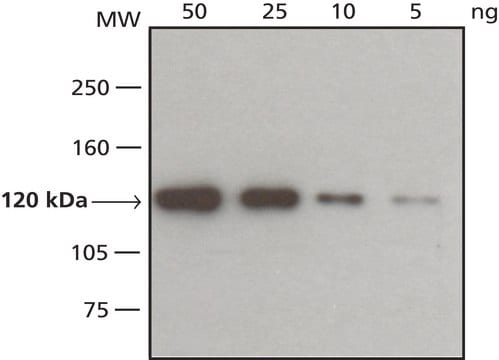
western blot: 1:1,000 using 20-50 ng of a purified VSV-G tagged fusion protein

isotype

IgG1

shipped in

wet ice

storage temp.

2-8°C

General description

Monoclonal Anti-VSV-G-Peroxidase is a lyophilized preparation of the purified immunoglobulin fraction of monoclonal Anti-VSV-G (mouse IgG1 isotype) isolated from ascites fluid of the P5D4 hybridoma, conjugated to horseradish peroxidase (HRP). The antibody is derived from the P5D4 hybridoma produced by the fusion of mouse myeloma cells and splenocytes from BALB/c mouse immunized with a synthetic peptide. Vesicular Stomatitis Virus Glycoprotein (VSV-G) exists as a trimer and comprises of four domains, among which domain III is a pleckstrin homology (PH) domain.

Immunogen

synthetic peptide containing the 15 carboxy-terminal amino acids (497-511) of Vesicular Stomatitis Virus Glycoprotein (VSV-G), conjugated to KLH.

Application

Monoclonal Anti-VSV-G−Peroxidase antibody produced in mouse may be used immunoblotting.

Biochem/physiol Actions

Vesicular Stomatitis Virus Glycoprotein (VSV-G) amino acid sequence YTDIEMNRLGK, corresponding to amino acids 501-511 has been widely used as an epitope tag in expression vectors, enabling the expression of proteins as VSV-G tagged fusion proteins. It constitutes an attractive model to study maturation and intracellular transport of membrane proteins. VSV-G mediates attachment of VSV to the cell surface and induces pH-dependent fusion between viral and target membranes. Besides, its cytoplasmic domain contains information for several intracellular sorting steps, which include efficient export from the endoplasmic reticulum, basolateral delivery and endocytosis..VSV-G is transported through stacks in the Golgi cisternae.
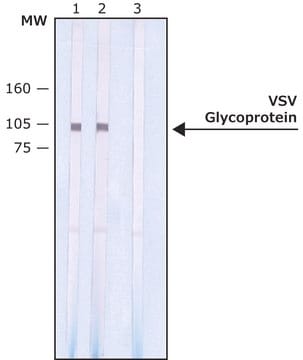
The antibody recognizes an epitope containing the five carboxy-terminal amino acids of VSV Glycoprotein. In infected cells, the antibody localizes the immature forms of VSV-G in the rough endoplasmic reticulum (RER) and in the cisternae of Golgi complex, as well as mature VSV-G at the cell surface and in the budding virus. The antibody does not stain the secreted form of VSV-G which lacks the membrane and the cytoplasmic domain. This antibody has been used for studies on the role of the cytoplasmic domain on newly-synthesized VSV-G during transfer to the plasma membrane and cell surface, using micro-injected antibody, immunoblotting, immunoprecipitation, immunocytochemistry and immunoelectron microscopy. The antibody has been used for the detection, immunoprecipitation and immunocytochemical staining of exogenously introduced constructs tagged with the carboxyl-terminus of VSV-G. This tag does not interfere with the function of the studied protein and can be specifically recognized by the P5D4 antibody without cross-reaction with any endogenous protein.
VSV-G tag sequence (YTDIEMNRLGK) on VSV-G tagged fusion proteins when expressed N- or C-terminal to the fusion protein. Recognizes native and denatured forms of VSV-G tagged proteins.

Physical form

Supplied as a lyophilized powder. After reconstitution,the solution contains 1% BSA and 0.05% MIT in 0.01 M sodium phosphate buffered saline, pH 7.4.

Preparation Note

Reconstitution with 0.5 mL water results in a solution of 0.01 M sodium phosphate buffered saline, pH 7.4, containing 1% BSA and 0.05% MIT.
Stored the lyophilized product at 2-8 °C. After reconstitution, for extended storage, freeze in working aliquots at –20 °C. For continuous use, the solution may be store at 2-8 °C for up to 1 month. Working dilutions should be discarded. Avoid repeated freeze-thaw.

Disclaimer

Unless otherwise stated in our catalog, our products are intended for research use only and are not to be used for any other purpose, which includes but is not limited to, unauthorized commercial uses, in vitro diagnostic uses, ex vivo or in vivo therapeutic uses or any type of consumption or application to humans or animals.

Comparar elementos similares

Ver comparación completa

Mostrar Diferencias

1 of 1

Este artículo
C7706V5507V4888
description

1.0-1.5 mg/mL, clone P5D4, purified from hybridoma cell culture

description

clone P5D4, purified immunoglobulin, buffered aqueous solution

description

clone P5D4, ascites fluid

description

affinity isolated antibody, buffered aqueous solution

biological source

mouse

biological source

mouse

biological source

mouse

biological source

rabbit

conjugate

peroxidase conjugate

conjugate

CY3 conjugate

conjugate

unconjugated

conjugate

unconjugated

clone

P5D4, monoclonal

clone

P5D4, monoclonal

clone

P5D4, monoclonal

clone

polyclonal

antibody form

purified from hybridoma cell culture

antibody form

purified immunoglobulin

antibody form

ascites fluid

antibody form

affinity isolated antibody

technique(s)

western blot: 1:1,000 using 20-50 ng of a purified VSV-G tagged fusion protein

technique(s)

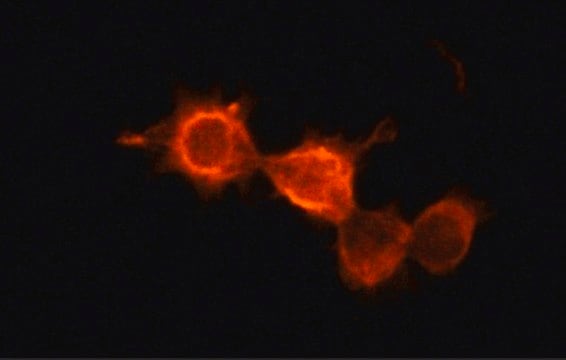
direct immunofluorescence: 1:10,000 using COS-7 cells transfected with a VSV-G tagged vinculin construct

technique(s)

immunoprecipitation (IP): suitable, immunocytochemistry: suitable, western blot: 1:100,000 using whole cell extracts expressing VSV-G tagged fusion protein

technique(s)

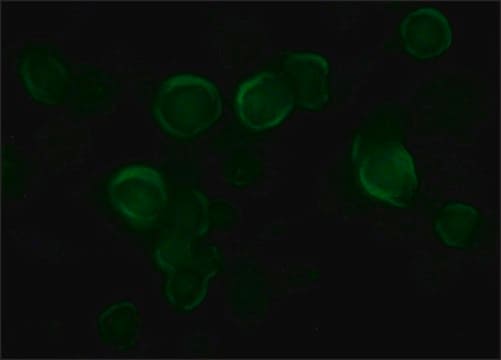
immunoprecipitation (IP): 0.5 μg using VSV-G tagged fusion proteins from transfected mammalian cell lysates (tagged fusion proteins from transfected mammalian cell lysates), western blot: 0.1-0.2 μg/mL using VSV-G tagged fusion proteins from transfected mammalian cell lysates, indirect immunofluorescence: 1.0 μg/mL using VSV-G tagged fusion proteins in methanol/acetone fixed transiently transfected cells

shipped in

wet ice

shipped in

wet ice

shipped in

-

shipped in

-


Still not finding the right product?

Pruebe nuestra Herramienta de selección de productos para limitar sus opciones


Pictogramas

Exclamation mark

Palabra de advertencia

Warning

Códigos de peligro

Hazard Classifications

Skin Sens. 1

Clase de almacenamiento

13 - Non Combustible Solids

WGK

WGK 2

Punto de inflamación (°F)

Not applicable

Punto de inflamación (°C)

Not applicable


Elija entre una de las versiones más recientes:

Certificados de análisis (COA)

Lot/Batch Number

It looks like we've run into a problem, but you can still download Certificates of Analysis from our Documentos section.

Si necesita más asistencia, póngase en contacto con Atención al cliente

¿Ya tiene este producto?

Encuentre la documentación para los productos que ha comprado recientemente en la Biblioteca de documentos.

Visite la Librería de documentos


Preguntas

Revisiones

Sin puntuación

Filtros activos