
208733

Calpain Inhibitor Set
The Calpain Inhibitor Set controls the biological activity of Calpain. This small molecule/inhibitor is primarily used for Protease Inhibitors applications.
Sinónimos:
Calplain inhibitor
Iniciar sesión para ver los precios por organización y contrato.
Seleccione un Tamaño
Cambiar Vistas
| A ustedes/SKU | Disponibilidad | Precio |
|---|---|---|
1 set | Póngase en contacto con nuestro Servicio de Atención al Cliente para disponibilidad | 582,00 € |
Acerca de este artículo
NACRES:
NA.77
UNSPSC Code:
12352200
Form:
solid
Storage condition:
OK to freeze, desiccated, protect from light
582,00 €
Póngase en contacto con nuestro Servicio de Atención al Cliente para disponibilidad
Servicio técnico
¿Necesita ayuda? Nuestro equipo de científicos experimentados está aquí para ayudarle.
Permítanos ayudarleQuality Segment
form
solid
potency
8 nM Ki
manufacturer/tradename
Calbiochem®
storage condition
OK to freeze, desiccated, protect from light
shipped in
ambient
storage temp.
−20°C
General description
Calpains are a family of calcium-dependent thiol-proteases that act on a wide variety of cytoskeletal, membrane-associated, and regulatory proteins. There are two major isoforms: calpain I (µ-form) and calpain II (m-form), which differ in their calcium requirement for activation Calpains are composed of heterodimers of 80 kDa and a 30 kDa subunits. The 80 kDa unit has the catalytic site and is unique to each isozyme, whereas the 30 kDa unit is the regulatory subunit and is common to both µ- and m-isozymes.
More recently, attention has been focused on the pathological significance of calcium accumulation in the central nervous system following cerebral ischemia and traumatic brain injury. Over-activation of NMDA, kainate, and AMPA receptors in the brain leads to sustained influx of Ca2+ through the voltage-gated calcium channels. Overexpression of calpains has been positively linked to both acute and chronic neurodegenerative processes including ischemia, trauma, and Alzheimer′s disease. In Alzheimer′s disease the ratio of active (76 kDa) to inactive (80 kDa) µ-calpain is reported to be much higher Calpain-dependent proteolysis is usually the late-stage common pathway towards cell death induced by excitotoxic compounds, hence, a selective inhibition of calpains to limit neuronal damage appears to be a viable therapeutic measure.
More recently, attention has been focused on the pathological significance of calcium accumulation in the central nervous system following cerebral ischemia and traumatic brain injury. Over-activation of NMDA, kainate, and AMPA receptors in the brain leads to sustained influx of Ca2+ through the voltage-gated calcium channels. Overexpression of calpains has been positively linked to both acute and chronic neurodegenerative processes including ischemia, trauma, and Alzheimer′s disease. In Alzheimer′s disease the ratio of active (76 kDa) to inactive (80 kDa) µ-calpain is reported to be much higher Calpain-dependent proteolysis is usually the late-stage common pathway towards cell death induced by excitotoxic compounds, hence, a selective inhibition of calpains to limit neuronal damage appears to be a viable therapeutic measure.
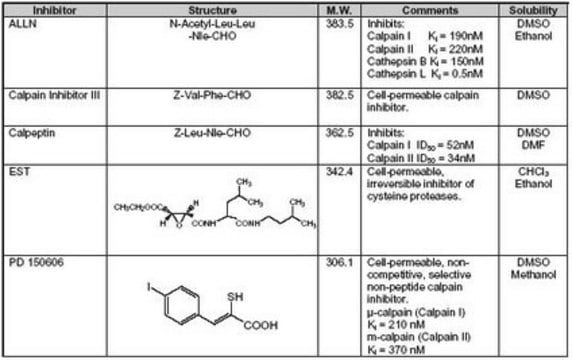
Contains 5 mg of ALLN (Cat. No. 208719), 25 mg of Calpain Inhibitor III (Cat. No. 208722), 5 mg of Calpeptin (Cat. No. 03-34-0051), 1 mg of EST (Cat. No. 330005), and 5 mg of PD 150606 (Cat. No. 513022).
Biochem/physiol Actions
Cell permeable: yes
Primary Target
calpain 1, calpain 2
calpain 1, calpain 2
Reversible: no
Packaging
Packaged under inert gas
Other Notes
Johnson, G.V.W., and Guttmann, R.P. 1997. BioEssays19, 1011.
Kampfl, A., et al. 1997. J. Neurotauma14, 121.
Sorimachi, H., et al., 1997. Biochem. J.328, 721.
Bartus, R.T., et al. 1995. Neurol. Res.17, 249.
Wang, K.K.W., and Yuen, P-W. 1994. Trends Pharmacol. Sci.15, 412.
Saito, K., et al. 1993. Proc. Natl. Acad. Sci. USA90, 2628.
Goll, D.E., et al. 1992. BioEssays14, 549.
Kampfl, A., et al. 1997. J. Neurotauma14, 121.
Sorimachi, H., et al., 1997. Biochem. J.328, 721.
Bartus, R.T., et al. 1995. Neurol. Res.17, 249.
Wang, K.K.W., and Yuen, P-W. 1994. Trends Pharmacol. Sci.15, 412.
Saito, K., et al. 1993. Proc. Natl. Acad. Sci. USA90, 2628.
Goll, D.E., et al. 1992. BioEssays14, 549.
Legal Information
CALBIOCHEM is a registered trademark of Merck KGaA, Darmstadt, Germany
Disclaimer
Toxicity: Multiple Toxicity Values, refer to MSDS (O)
1 of 1
Este artículo | |||
|---|---|---|---|
| form solid | form lyophilized solid | form solid | form solid |
| manufacturer/tradename Calbiochem® | manufacturer/tradename Calbiochem® | manufacturer/tradename Calbiochem® | manufacturer/tradename Calbiochem® |
| Quality Level 100 | Quality Level 100 | Quality Level 100 | Quality Level 100 |
| storage temp. −20°C | storage temp. 2-8°C | storage temp. 2-8°C | storage temp. −20°C |
| storage condition OK to freeze, protect from light, desiccated | storage condition OK to freeze | storage condition OK to freeze, desiccated (hygroscopic) | storage condition OK to freeze, desiccated |
| potency 8 nM Ki | potency 8 nM IC50 | potency - | potency - |


Clase de almacenamiento
11 - Combustible Solids
Certificados de análisis (COA)
Busque Certificados de análisis (COA) introduciendo el número de lote del producto. Los números de lote se encuentran en la etiqueta del producto después de las palabras «Lot» o «Batch»
¿Ya tiene este producto?
Encuentre la documentación para los productos que ha comprado recientemente en la Biblioteca de documentos.