
14-933-M

ATM, active
Sinónimos:
Ataxia telangiectasia mutated
Iniciar sesión para ver los precios por organización y contrato.
Seleccione un Tamaño
Cambiar Vistas
| A ustedes/SKU | Disponibilidad | Precio |
|---|---|---|
10 μg | Póngase en contacto con nuestro Servicio de Atención al Cliente para disponibilidad | 1110,00 € |
250 μg | Póngase en contacto con nuestro Servicio de Atención al Cliente para disponibilidad | 6780,00 € |
Acerca de este artículo
UNSPSC Code:
12352200
NACRES:
NA.32
eCl@ss:
32160405
Biological source:
human
1110,00 €
Póngase en contacto con nuestro Servicio de Atención al Cliente para disponibilidad
Servicio técnico
¿Necesita ayuda? Nuestro equipo de científicos experimentados está aquí para ayudarle.
Permítanos ayudarleGeneral description
Research area: CANCER
Product Source: Recombinant, human FLAG-tagged ATM full length, expressed in a mammalian cell line.
The Ataxia telangiectasia mutated protein (ATM) is a serine/threonine protein kinase primarily found in the nuclei of cells and plays a crucial role in cellular processes. It shows similarities with phosphatidylinositol-3′-kinases and possesses inherent protein kinase activity. Located on chromosome 11 (11q22-23), the ATM gene comprises 66 exons and codes for the ATM protein consisting of 3056 amino acids. The ATM protein is made up of various domains and belongs to the phosphatidylinositol 3-kinase-related kinase (PIKK) superfamily. ATM kinase forms inactive homodimers under normal conditions and is activated under stressful conditions like DNA structural changes, oxidative stress, nutrient deprivation, or hypoxia.
Product Source: Recombinant, human FLAG-tagged ATM full length, expressed in a mammalian cell line.
The Ataxia telangiectasia mutated protein (ATM) is a serine/threonine protein kinase primarily found in the nuclei of cells and plays a crucial role in cellular processes. It shows similarities with phosphatidylinositol-3′-kinases and possesses inherent protein kinase activity. Located on chromosome 11 (11q22-23), the ATM gene comprises 66 exons and codes for the ATM protein consisting of 3056 amino acids. The ATM protein is made up of various domains and belongs to the phosphatidylinositol 3-kinase-related kinase (PIKK) superfamily. ATM kinase forms inactive homodimers under normal conditions and is activated under stressful conditions like DNA structural changes, oxidative stress, nutrient deprivation, or hypoxia.
Application
ATM protein has been used for in vitro ATM kinase assays to check the radiosensitization induced in pancreatic cells by kinase inhibition.
Biochem/physiol Actions
The Ataxia telangiectasia mutated protein (ATM), belonging to the phosphatidylinositol 3-kinase family, is involved in multiple cellular signaling pathways. It serves as a key regulator of the DNA double-strand break (DSB) repair pathway by sensing these breaks and regulating the physiological responses through tumor protein 53 (TP53), checkpoint kinase 1 (CHK1), and checkpoint kinase 2 (CHK2) pathways. It is also involved in activating proteins like p53 and cdc25C, thus acting as a tumor suppressor. Moreover it serves an important role in mitogenic signal transduction, meiotic recombination, and cell cycle control. However, loss in ATM activity leads to development of ataxia-telangiectasia (AT), a rare autosomal recessive disorder causing neurodegeneration, hypersensitivity to radiation, immune deficiencies, and an increased susceptibility to cancer. Alterations in the ATM gene are frequently observed in various types of cancer, including breast, pancreatic, prostate, and ovarian cancer. Necessary for activation of ABL1 and SAPK. Phosphorylates DYRK2, CHEK2, p53/TP53, FANCD2, NFKBIA, BRCA1, CTIP, nibrin (NBN), TERF1, RAD9 and DCLRE1C. May play a role in vesicle and/or protein transport. May play a role in vesicle and/or protein transport. Could play a role in T-cell development, gonad and neurological function. Plays a role in replication-dependent histone mRNA degradation.
Packaging
Also available in 250μg size as catalog # 14-933M and in bulk as catalog # 14-933-K.
Physical form
Protein in frozen storage buffer
Preparation Note
6 months at -70°C
Analysis Note
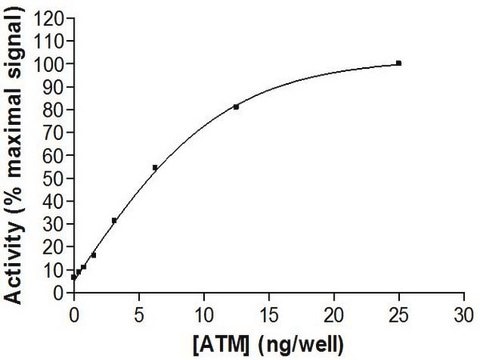
Routinely evaluated by phosphorylation of recombinant human p53, full length (c-Myc, 6His tagged) as the substrate (Millipore cat # 23-034)
Other Notes
For Specific Activity data, refer to the Certificate of Analysis for individual lots of this enzyme.
Legal Information
UPSTATE is a registered trademark of Merck KGaA, Darmstadt, Germany
Disclaimer
Unless otherwise stated in our catalog or other company documentation accompanying the product(s), our products are intended for research use only and are not to be used for any other purpose, which includes but is not limited to, unauthorized commercial uses, in vitro diagnostic uses, ex vivo or in vivo therapeutic uses or any type of consumption or application to humans or animals.
1 of 1
Este artículo | |||
|---|---|---|---|
| biological source human | biological source rabbit | biological source human | biological source human |
| technique(s) activity assay: suitable (kinase) | technique(s) immunocytochemistry: suitable, western blot: suitable | technique(s) activity assay: suitable (kinase) | technique(s) activity assay: suitable (kinase) |
| Gene Information human ... ATM(472) | Gene Information bovine ... Atm(526824) | Gene Information human ... CHEK2(11200) | Gene Information human ... MAPKAPK2(9261) |
| mol wt Mw 352 kDa | mol wt - | mol wt Mw 89.6 kDa | mol wt Mw 66 kDa |
| UniProt accession no. | UniProt accession no. | UniProt accession no. | UniProt accession no. |
| NCBI accession no. | NCBI accession no. | NCBI accession no. | NCBI accession no. |

Certificados de análisis (COA)
Busque Certificados de análisis (COA) introduciendo el número de lote del producto. Los números de lote se encuentran en la etiqueta del producto después de las palabras «Lot» o «Batch»
¿Ya tiene este producto?
Encuentre la documentación para los productos que ha comprado recientemente en la Biblioteca de documentos.