Sign In to View Organizational & Contract Pricing.
Select a Size
Change View
| Pack Size | SKU | Availability | Price |
|---|---|---|---|
| 5 mg | Please contact Customer Service for Availability | €344.00 |
About This Item
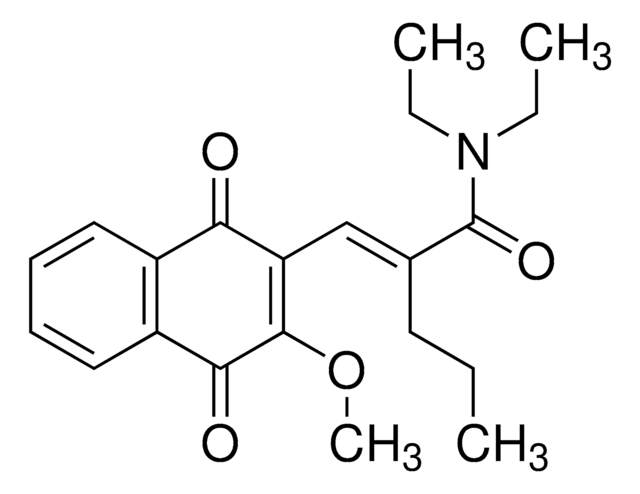
Empirical Formula (Hill Notation):
C21H30O6
CAS Number:
Molecular Weight:
378.46
NACRES:
NA.77
PubChem Substance ID:
UNSPSC Code:
12352200
MDL number:
Quality Level
assay
≥98% (HPLC)
form
powder
color
red to orange
solubility
DMSO: >20 mg/mL
storage temp.
2-8°C
SMILES string
CCCCCCCCC\C(=C/C1=C(C)C(=O)C(OC)=C(OC)C1=O)C(O)=O
InChI
1S/C21H30O6/c1-5-6-7-8-9-10-11-12-15(21(24)25)13-16-14(2)17(22)19(26-3)20(27-4)18(16)23/h13H,5-12H2,1-4H3,(H,24,25)/b15-13+
InChI key
AALSSIXXBDPENJ-FYWRMAATSA-N
Application
E3330 has been used in the inhibition of endothelial cancer cells and apurinic/apyrimidinic endodeoxyribonuclease 1 (APEX1).
Biochem/physiol Actions
E3330 is a specific inhibitor of AP endonuclease 1 redox domain. E3330 inhibits APE-1 regulation of transcription factors, but does not affect Ape1 DNA repair activity. AP endonuclease 1 (APE1; also known as REF-1) is a multifunctional protein with dual functions in DNA repair and redox regulation of transcription factors. It is involved in apurinic/apyrimidinic endonuclease DNA base excision repair activity, in proofreading exonuclease activity, and in modulating DNA binding activity of several transcription factors including NF-κB, Egr-1, p53, AP-1, CREB, HIF-α, and members of the Pax family. APE1 is overexpressed in several human cancers, and disruption of APE1 function has detrimental effects on cancer cell viability. E3330 significantly reduces the growth of human pancreatic cancer cells in vitro and inhibits pancreatic cancer cell migration.
E3330 is a specific inhibitor of AP endonuclease 1 redox domain; inhibits APE-1 regulation of transcription factors, but does not affect Ape1 DNA repair activity.
1 of 1
This Item | |||
|---|---|---|---|
| assay ≥98% (HPLC) | assay ≥98% (HPLC) | assay ≥98% (HPLC) | assay ≥98% (HPLC) |
| form powder | form powder | form powder | form powder |
| Quality Level 100 | Quality Level 100 | Quality Level - | Quality Level 100 |
| storage temp. 2-8°C | storage temp. 2-8°C | storage temp. 2-8°C | storage temp. 2-8°C |
| solubility DMSO: >20 mg/mL | solubility H2O: <2 mg/mL, DMSO: >20 mg/mL | solubility DMSO: ≥10 mg/mL | solubility DMSO: 10 mg/mL, clear |
| color red to orange | color yellow | color yellow | color white to beige |
hcodes
pcodes
Hazard Classifications
Aquatic Chronic 4
Storage Class
11 - Combustible Solids
wgk
WGK 3
flash_point_f
Not applicable
flash_point_c
Not applicable
Choose from one of the most recent versions:
Already Own This Product?
Find documentation for the products that you have recently purchased in the Document Library.
[Elucidation of pharmacological mechanism of drugs by studying the receptors].
Hiroshi Handa
The Japanese journal of antibiotics, 56 Suppl A, 39-46 (2003-12-19)
N Shimizu et al.
Nature biotechnology, 18(8), 877-881 (2000-08-10)
We have developed a method using novel latex beads for rapid identification of drug receptors using affinity purification. Composed of a glycidylmethacrylate (GMA) and styrene copolymer core with a GMA polymer surface, the beads minimize nonspecific protein binding and maximize
Andrej Jedinak et al.
Anticancer research, 31(2), 379-385 (2011-03-08)
The multi-functional apyrimidinic endonuclease 1/redox factor-1 (APE1/Ref-1) DNA repair and redox signaling protein has been shown to have a role in cancer growth and survival, however, little has been investigated concerning its role in inflammation. In this study, an APE1
Global Trade Item Number
| SKU | GTIN |
|---|---|
| E8534-5MG | 04061833608784 |
| E8534-25MG | 04061832722344 |