Skip to Content
Merck

Skip To

D4196

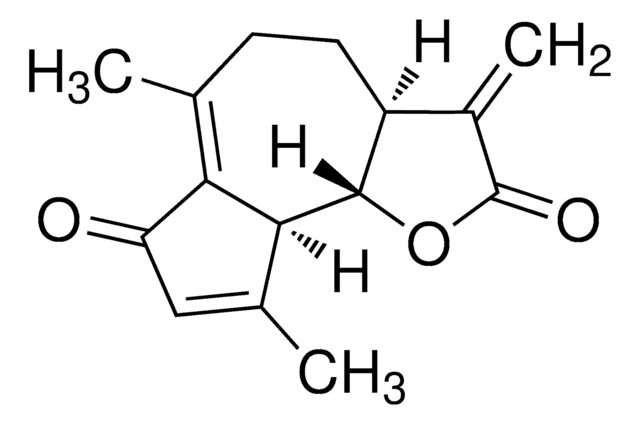
Dehydroleucodine

≥98% (HPLC)

Synonym(s):

11,13-Dehydroleucodin, Dehydroleucodin, Leucodin, Lidbeckialactone, Mesatlantin E, NSC 180034, [3aS-(3aalpha,9aalpha,9bbeta)]-3,3a,4,5,9a,9b-hexahydro-6,9-dimethyl-3-methylene-azuleno[4,5-b]furan-2,7-dione, dehydro-

Sign In to View Organizational & Contract Pricing.

Select a Size

Change View
Pack SizeSKUAvailabilityPrice
5 mg
Please contact Customer Service for Availability
€119.00
25 mg
Please contact Customer Service for Availability
€298.00

About This Item

Empirical Formula (Hill Notation):
C15H16O3
CAS Number:
Molecular Weight:
244.29
NACRES:
NA.77
PubChem Substance ID:
UNSPSC Code:
12352200
MDL number:
Assay:
≥98% (HPLC)
Form:
powder
Quality level:
Storage condition:
desiccated, protect from light

€119.00


Please contact Customer Service for Availability

Request a Bulk Order
Technical Service
Need help? Our team of experienced scientists is here for you.
Let Us Assist


Quality Level

assay

≥98% (HPLC)

form

powder

storage condition

desiccated, protect from light

color

white to off-white

solubility

DMSO: ≥30 mg/mL

storage temp.

room temp

SMILES string

CC1=C2[C@@H]([C@H]3OC(=O)C(=C)[C@@H]3CC1)C(C)=CC2=O

InChI

1S/C15H16O3/c1-7-4-5-10-9(3)15(17)18-14(10)13-8(2)6-11(16)12(7)13/h6,10,13-14H,3-5H2,1-2H3/t10-,13-,14-/m0/s1

InChI key

SKNVIAFTENCNGB-BPNCWPANSA-N

Biochem/physiol Actions

Dehydroleucodine is a sesquiterpene lactone isolated from Artemisia douglasiana Besser; mast cell stabilizers.
Dehydroleucodine is a sesquiterpene lactone isolated from Artemisia douglasiana Besser; mast cell stabilizers. An extract from the plant is widely used in Cuyo region (Argentina) as folk medicine for the treatment of gastric ailments. The compound prevents gastric and duodenal damages in response to necrosis-inducing agents. Stabilization of mast cells may be a key mechanism to protect the gastrointestinal tract from injury and ulceration. Recently, it was established that dehydroleucodine and xanthatin inhibit mast cell degranulation induced by compound 48/80.

Compare Similar Items

View Full Comparison

Show Differences

1 of 1

This Item
D1756SML0147SML1570
form

powder

form

powder

form

powder

form

powder

assay

≥98% (HPLC)

assay

≥98% (HPLC)

assay

≥98% (HPLC)

assay

≥98% (HPLC)

Quality Level

100

Quality Level

200

Quality Level

100

Quality Level

100

storage temp.

room temp

storage temp.

2-8°C

storage temp.

2-8°C

storage temp.

−20°C

solubility

DMSO: ≥30 mg/mL

solubility

methanol: 25 mg/mL

solubility

DMSO: ≥15

solubility

-

storage condition

desiccated, protect from light

storage condition

-

storage condition

desiccated

storage condition

protect from light


Storage Class

11 - Combustible Solids

wgk

WGK 3

flash_point_f

Not applicable

flash_point_c

Not applicable


Choose from one of the most recent versions:

Certificates of Analysis (COA)

Lot/Batch Number

Don't see the Right Version?

If you require a particular version, you can look up a specific certificate by the Lot or Batch number.

Already Own This Product?

Find documentation for the products that you have recently purchased in the Document Library.

Visit the Document Library


Verónica Jimenez-Ortiz et al.
The Journal of parasitology, 91(1), 170-174 (2005-04-29)
Sesquiterpene lactones constitute a large group of biologically active compounds obtained from plants. The lactones, mexicanin (MXN) and helenalin (HLN), were reported recently as active against the infective form of Trypanosoma cruzi. In this work, we studied the effects of
M G Repetto et al.
Brazilian journal of medical and biological research = Revista brasileira de pesquisas medicas e biologicas, 35(5), 523-534 (2002-05-16)
There is evidence concerning the participation of reactive oxygen species in the etiology and physiopathology of human diseases, such as neurodegenerative disorders, inflammation, viral infections, autoimmune pathologies, and digestive system disorders such as gastrointestinal inflammation and gastric ulcer. The role
T Guardia et al.
Journal of ethnopharmacology, 88(2-3), 195-198 (2003-09-10)
The effect of Dehydroleucodine (DhL) on gastric acid secretion in rats was investigated at a dose of 40 mg/kg, while its anti-inflammatory effect was investigated in two experimental models: arthritis induced by Freund's adjuvant carrageenan- and cotton pellet-induced granuloma. DhL


Global Trade Item Number

SKUGTIN
D4196-5MG04061832631943
D4196-25MG04061832631936

Questions

Reviews

No rating value

Active Filters