Skip to Content
Merck

Skip To

C8115

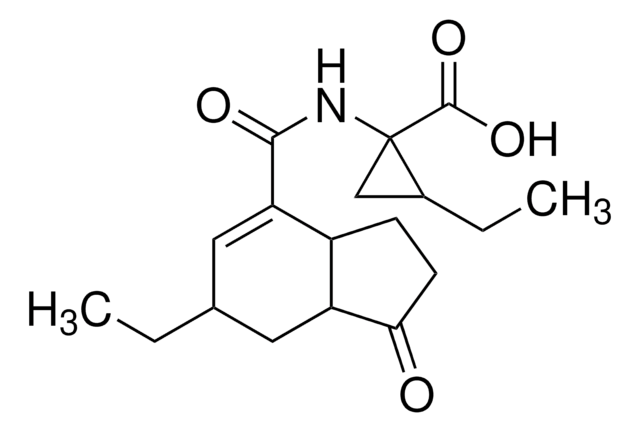
Coronatine

from Pseudomonas syringae pv Glycinea, >95% (HPLC)

Synonym(s):

COR, Cyclopropanecarboxylic acid,2-ethyl-1-[[(6-ethyl-2,3,3a,6,7a-hexahydro-1-oxo-1H-inden-4-yl)carbonyl] amino]

Sign In to View Organizational & Contract Pricing.

Select a Size

Change View
Pack SizeSKUAvailabilityPrice

About This Item

Empirical Formula (Hill Notation):
C18H25NO4
Molecular Weight:
319.40
NACRES:
NA.85
PubChem Substance ID:
UNSPSC Code:
51102829
MDL number:
Pricing and availability is not currently available.
Technical Service
Need help? Our team of experienced scientists is here for you.
Let Us Assist


biological source

Pseudomonas syringae pv Glycinea

Quality Level

assay

>95% (HPLC)

form

powder

solubility

H2O: soluble 0.2 mg/mL, DMSO: soluble 20 mg/mL, methanol: soluble 20 mg/mL

mode of action

enzyme | interferes

storage temp.

−20°C

SMILES string

CCC1CC2C(CCC2=O)C(=C1)C(=O)NC3(CC3CC)C(O)=O

InChI

1S/C18H25NO4/c1-3-10-7-13-12(5-6-15(13)20)14(8-10)16(21)19-18(17(22)23)9-11(18)4-2/h8,10-13H,3-7,9H2,1-2H3,(H,19,21)(H,22,23)

InChI key

FMGBNISRFNDECK-UHFFFAOYSA-N

Application

Coronatine is a polyketide phytotoxin produced by several members of the Pseudomonas syringae group of pathovars such as atropurpurea, glycinea, maculicola,morsprunorum and tomato. Coronatine was used to study the regulatory genes: corP, corS and corR.[1] It was used to study the stimulation of ethylene synthesis in Nicotiana tabacum leaves.[2]

Biochem/physiol Actions

Coronatine is a polyketide phytotoxin produced by several members of the Pseudomonas syringae group of pathovars. It consists of two distinct structural components that function as biosynthetic intermediates: coronafacic acid (CFA) and coronamic acid (CMA). It is known to induce hypertrophy and chlorosis, inhibit root elongation, and stimulate ethylene production.
Coronatine is a polyketide phytotoxin produced by several members of the Pseudomonas syringae group of pathovars. It is known to induce hypertrophy and chlorosis, inhibit root elongation, and stimulate ethylene production.

Other Notes

Keep container tightly closed in a dry and well-ventilated place.

Compare Similar Items

View Full Comparison

Show Differences

1 of 1

This Item
SML2080SML1680SML2692
mode of action

enzyme | interferes

mode of action

-

mode of action

-

mode of action

-

Quality Level

200

Quality Level

-

Quality Level

100

Quality Level

-

assay

>95% (HPLC)

assay

≥98% (HPLC)

assay

≥98% (HPLC)

assay

≥98% (HPLC)

form

powder

form

powder

form

powder

form

powder

biological source

Pseudomonas syringae pv Glycinea

biological source

-

biological source

-

biological source

-

storage temp.

−20°C

storage temp.

−20°C

storage temp.

2-8°C

storage temp.

−20°C


Storage Class

11 - Combustible Solids

wgk

WGK 3

flash_point_f

Not applicable

flash_point_c

Not applicable

ppe

Eyeshields, Gloves, type N95 (US)


Choose from one of the most recent versions:

Certificates of Analysis (COA)

Lot/Batch Number

Don't see the Right Version?

If you require a particular version, you can look up a specific certificate by the Lot or Batch number.

Already Own This Product?

Find documentation for the products that you have recently purchased in the Document Library.

Visit the Document Library


Related Content

Product Information Sheet


Minoru Ueda et al.
ACS central science, 3(5), 462-472 (2017-06-03)
Coronatine (
J S Kenyon et al.
Plant physiology, 100(1), 219-224 (1992-09-01)
Coronatine is a chlorosis-inducing toxin produced by the plant pathogen Pseudomonas syringae pv atropurpurea. This bacterium is the causal agent of chocolate spot disease, in which brown lesions with chlorotic margins develop on the leaves of Lolium multiflorum Lam. Among
C Dutheil et al.
Scientific reports, 10(1), 4838-4838 (2020-03-18)
Climate model projections generally indicate fewer but more intense tropical cyclones (TCs) in response to increasing anthropogenic emissions. However these simulations suffer from long-standing biases in their Sea Surface Temperature (SST). While most studies investigating future changes in TC activity


Global Trade Item Number

SKUGTIN
C8115-1MG04061833521779

Questions

Reviews

No rating value

Active Filters