Skip to Content
Merck

Skip To

A4979

Anti-Water Channel Aquaporin 5 antibody produced in rabbit

affinity isolated antibody, lyophilized powder

Synonym(s):

Anti-AQP-5, Anti-PPKB

Sign In to View Organizational & Contract Pricing.

Select a Size

Change View
Pack SizeSKUAvailabilityPrice
50 μL
Please contact Customer Service for Availability
€432.00
200 μL
Please contact Customer Service for Availability
€871.00

About This Item

UNSPSC Code:
12352203
NACRES:
NA.41
MDL number:
Conjugate:
unconjugated
Clone:
polyclonal
Application:
WB
Citations:
7

€432.00


Please contact Customer Service for Availability

Technical Service
Need help? Our team of experienced scientists is here for you.
Let Us Assist


biological source

rabbit

Quality Level

conjugate

unconjugated

antibody form

affinity isolated antibody

antibody product type

primary antibodies

clone

polyclonal

form

lyophilized powder

species reactivity

mouse, rat

technique(s)

western blot: 1:200-1:500 using mouse salivary gland and rat lung

UniProt accession no.

shipped in

dry ice

storage temp.

−20°C

target post-translational modification

unmodified

Gene Information

mouse ... Aqp5(11830)
rat ... Aqp5(25241)

General description

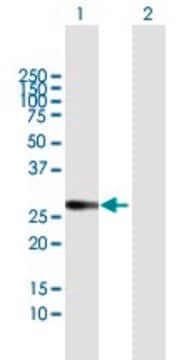
Anti-Water Channel Aquaporin 5 binds to aquaporin 5 from mouse salivary gland and rat lung membranes.
Aquaporin-5 is part of a family of aquaporins that function to transport water across cell membranes. AQP5 is involved in tear, saliva, and sweat production.
Aquaporins are a family of small integral membrane proteins related to the major intrinsic protein (MIP or AQP0).

Immunogen

peptide corresponding to residues 251-265 of rat AQP5. The sequence is identical in mouse and 10/16 residues identical in human.

Application

Rabbit Anti-Water Channel Aquaporin 5 antibody can be used for western blot at a dilution of 1:200-1:500 using mouse salivary gland and rat lung tissue extracts.

Physical form

Lyophilized from phosphate buffered saline, pH 7.4, 1% BSA, ≤0.1% sodium azide.

Disclaimer

Unless otherwise stated in our catalog or other company documentation accompanying the product(s), our products are intended for research use only and are not to be used for any other purpose, which includes but is not limited to, unauthorized commercial uses, in vitro diagnostic uses, ex vivo or in vivo therapeutic uses or any type of consumption or application to humans or animals.

Compare Similar Items

View Full Comparison

Show Differences

1 of 1

This Item
A5971SAB1409248WH0000343M1
antibody form

affinity isolated antibody

antibody form

affinity isolated antibody

antibody form

purified immunoglobulin

antibody form

purified immunoglobulin

Quality Level

200

Quality Level

200

Quality Level

100

Quality Level

100

biological source

rabbit

biological source

rabbit

biological source

mouse

biological source

mouse

conjugate

unconjugated

conjugate

unconjugated

conjugate

unconjugated

conjugate

unconjugated

form

lyophilized powder

form

lyophilized powder

form

buffered aqueous solution

form

buffered aqueous solution

species reactivity

mouse, rat

species reactivity

human, mouse, rat

species reactivity

human

species reactivity

human, mouse, rat


Still not finding the right product?

Try our Product Selector Tool to narrow your options


Storage Class

10 - Combustible liquids

wgk

WGK 2

flash_point_f

Not applicable

flash_point_c

Not applicable


Choose from one of the most recent versions:

Certificates of Analysis (COA)

Lot/Batch Number

Don't see the Right Version?

If you require a particular version, you can look up a specific certificate by the Lot or Batch number.

Already Own This Product?

Find documentation for the products that you have recently purchased in the Document Library.

Visit the Document Library


Related Content

Instructions


J W Snuggs et al.
Scientific reports, 11(1), 3164-3164 (2021-02-06)
The central region of the intervertebral disc (IVD) is rich in proteoglycans, leading to a hyperosmotic environment, which fluctuates with daily loading. The cells of the nucleus pulposus (NP cells) have adapted to this environment via the function of tonicity
Michael G Haase et al.
The journal of histochemistry and cytochemistry : official journal of the Histochemistry Society, 62(5), 355-368 (2014-03-29)
Ionizing radiation (IR) leads to fibrosing alveolitis (FA) after a lag period of several weeks to months. In a rat model, FA starts at 8 weeks after IR. Before that, at 5.5 weeks after IR, the transcription factors Sp1 (stimulating
Mulugu V Brahmajothi et al.
Antioxidants & redox signaling, 21(13), 1823-1836 (2014-08-05)
The aims of this study were to determine hyperoxia effects on S-nitrosothiol (SNO) accumulation and L-type amino acid transporter 1 (LAT1) expression/function in alveolar epithelium and to determine whether hyperoxia impairs exogenous nitric oxide (NO) treatment effects in alveolar epithelium


Global Trade Item Number

SKUGTIN
A4979-200UL04061838102270
A4979-50UL04061838160768

Questions

Reviews

No rating value

Active Filters