




The specific concentration of glycerol is considered proprietary, but will range from 50 - 70%.
U1875

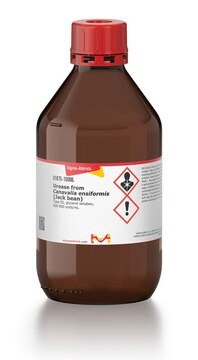
Urease from Canavalia ensiformis (Jack bean)
Type III, glycerol solution, 500-800 units/mL
Synonym(s):
Jack bean urease, Urea amidohydrolase
Sign In to View Organizational & Contract Pricing.
Select a Size
Change View
| Size/SKU | Availability | Price |
|---|---|---|
25 mL | Please contact Customer Service for Availability | CZK 3,600.00 |
100 mL | Please contact Customer Service for Availability | CZK 11,300.00 |
About This Item
CAS Number:
UNSPSC Code:
12352204
eCl@ss:
32160410
NACRES:
NA.54
MDL number:
Biological source:
Canavalia ensiformis
Concentration:
500-800 units/mL
biological source
Canavalia ensiformis
Quality Segment
type
Type III
form
glycerol solution
mol wt
~544620
concentration
500-800 units/mL
storage temp.
2-8°C
General description
Subunit molecular weight: ~90,770
Composed of six subunits with total molecular weight: ~544,620
Composed of six subunits with total molecular weight: ~544,620
Urease of jack bean (Canavalia ensiformis), a hexamer of a single chain of 840 amino acid residues, is found in plants, bacteria, fungi, algae, and soil. It is considered the first nickel-containing enzyme and the first enzyme to be crystallized. Ureases exist in several isoforms, some are jack bean urease (JBURE-I), canatoxin (CNTX), and JBURE-IIB. JBURE-I is more abundant than the other two isoforms. Ureases are found in mature seeds.
Application
Urease from Canavalia ensiformis (Jack bean) has been used:
- to assay creatine and creatine phosphate using the sample extracted from the left ventricle (LV) and septal tissue
- to determine the concentration of urea in a stabilized urine sample
- as one of the standards to measure the urease activity of plant extracts
Biochem/physiol Actions
In plants, ureases are essential for the bioavailability/metabolism of nitrogen in nature and defense mechanisms. Ureases are metalloenzymes that catalyze the hydrolysis of urea to release ammonia a nitrogen source for growth and carbon dioxide. They exhibit internal peptides-mediated insecticidal action and fungicidal activity.
Urease activity has been shown to be inhibited by benzpyrene following exposure to light. This inhibition was due to the effect of benzpyrene on urease′s sulfhydryl groups. [1]
Other Notes
One micromolar unit will liberate 1.0 μmole of NH3 from urea per min at pH 7.0 at 25 °C. It is equivalent to 1.0 I.U. or 0.054 Sumner unit (1.0 mg ammonia nitrogen in 5 minutes at pH 7.0 at 20 °C)
1 of 1
This Item | |||
|---|---|---|---|
| biological source Canavalia ensiformis | biological source Canavalia ensiformis | biological source Canavalia ensiformis | biological source Canavalia ensiformis |
| concentration 500-800 units/mL | concentration - | concentration - | concentration - |
| form glycerol solution | form powder | form powder | form powder |
| storage temp. 2-8°C | storage temp. 2-8°C | storage temp. −20°C | storage temp. −20°C |
| mol wt ~544620 | mol wt ~544620 Da | mol wt ~544620 Da | mol wt Mr ~480000 |
| Quality Level 200 | Quality Level 300 | Quality Level 200 | Quality Level 100 |
Still not finding the right product?
Explore all of our products under Urease from Canavalia ensiformis (Jack bean)
signalword
Danger
hcodes
Hazard Classifications
Eye Irrit. 2 - Resp. Sens. 1 - Skin Irrit. 2 - STOT SE 3
target_organs
Respiratory system
Storage Class
10 - Combustible liquids
wgk
WGK 1
flash_point_f
Not applicable
flash_point_c
Not applicable
Choose from one of the most recent versions:
Already Own This Product?
Find documentation for the products that you have recently purchased in the Document Library.
-
How much glycerol is in Urease product no. U1875?
1 answer-
Helpful?
-