
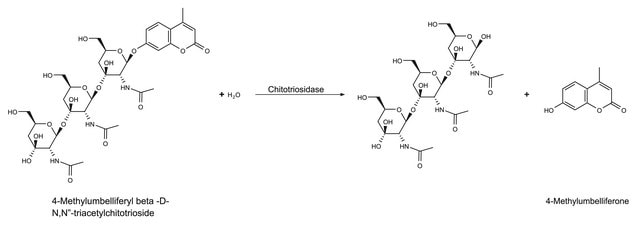

The buffers used in the experiment were 0.1M citrate/0.2M phosphate with a pH of 5.6 and 0.3 M Glycine with a pH of 10.6. The stop solution was used with a standard curve ranging from 1-1000 nM.
SAE0052

Chitotriosidase human
recombinant, expressed in HEK 293 cells
Synonym(s):
Chitinase-1, Chitotriosidase-1
Sign In to View Organizational & Contract Pricing.
Select a Size
Change View
| Size/SKU | Availability | Price |
|---|---|---|
10 μg | Please contact Customer Service for Availability | CZK 7,400.00 |
recombinant
expressed in HEK 293 cells
Quality Segment
assay
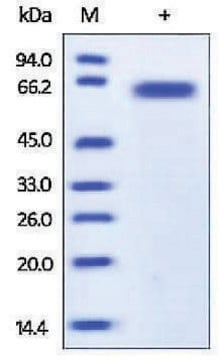
98% (SDS-PAGE)
form
lyophilized powder
specific activity
≥15,000 units/μg protein
mol wt
50 kDa
shipped in
ambient
storage temp.
−20°C
General description
Chitotriosidase (CT) is a human chitinase with catalytic activity upon the substrate chitin, a polymer of ?-1,4-N-acetylglucosamine. The mature CT consists of 445 amino acids, and contains a potential N-glycosylation site as well as three intrachain disulfide bonds.
Application
The enzymatic activity of recombinant human CT is measured by its ability to hydrolyze the substrate 4-Methylumbelliferyl beta -D-N,N′,N”-triacetylchitotriose (Cat. # M5639). This enzymatic hydrolysis releases 4-methylumbelliferone (4MU), which upon ionization in basic pH, can be measured fluorimetrically at an excitation wavelength of 340 nm and an emission wavelength of 465 nm. The use of fluorimetric substrates provides a very sensitive detection system.
Biochem/physiol Actions
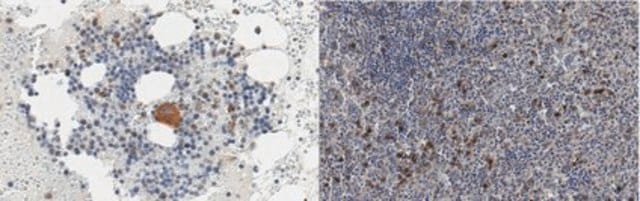
CT is currently the most reliable biomarker in Gaucher disease - serum and plasma CT activity is usually measured as the first step in diagnosis of Gaucher disease. Monitoring chitotriosidase activity is widely used during treatment of this pathology by enzyme replacement therapy. Its elevated plasma level reflects gradual intralysosomal accumulation in Gaucher cells (lipid-loaded macrophages). Macrophages overloaded by the enzyme accumulated in lysosomal material (lipids) were shown to secrete chitotriosidase; its increased expression was noted in several lysosomal storage diseases and atherosclerosis.
Physical form
Supplied as a lyophilized powder containing phosphate buffered saline
Other Notes
AKLVCYFTNWAQYRQGEARFLPKDLDPSLCTHLIYAFAGMTNHQLSTTEWNDETLYQEFNGLKKMNPKLKTLLAIGGWNFGTQKFTDMVATANNRQTFVNSAIRFLRKYSFDGLDLDWEYPGSQGSPAVDKERFTTLVQDLANAFQQEAQTSGKERLLLSAAVPAGQTYVDAGYEVDKIAQNLDFVNLMAYDFHGSWEKVTGHNSPLYKRQEESGAAASLNVDAAVQQWLQKGTPASKLILGMPTYGRSFTLASSSDTRVGAPATGSGTPGPFTKEGGMLAYYEVCSWKGATKQRIQDQKVPYIFRDNQWVGFDDVESFKTKVSYLKQKGLGGAMVWALDLDDFAGFSCNQGRYPLIQTLRQELSLPYLPSGTPELEVPKPGQPSEPEHGPSPGQDTFCQGKADGLYPNPRERSSFYSCAAGRLFQQSCPTGLVFSNSCKCCTWNGHHHHHHHHGQ
One unit is defined as the amount of CT required to produce 1 pmol of 4-Methylumbelliferone from 4-Methylumbelliferyl beta -D-
N′,N”-triacetylchitotrioside per minute at 25 °C, pH 5.6.
N′,N”-triacetylchitotrioside per minute at 25 °C, pH 5.6.
1 of 1
This Item | |||
|---|---|---|---|
| assay 98% (SDS-PAGE) | assay ≥95% (SDS-PAGE) | assay ≥95% (SDS-PAGE) | assay - |
| specific activity ≥15,000 units/μg protein | specific activity - | specific activity - | specific activity - |
| recombinant expressed in HEK 293 cells | recombinant expressed in HEK 293 cells | recombinant expressed in HEK 293 cells | recombinant - |
| form lyophilized powder | form lyophilized powder | form lyophilized powder | form - |
| mol wt 50 kDa | mol wt calculated mol wt 66.5 kDa, observed mol wt 55-66 kDa (DTT-reduced. Asp 108 is the predicted N-terminus .) | mol wt 127.5 kDa (The protein migrates as a 140 kDa band on SDS-PAGE due to glycosylation.) | mol wt - |
| shipped in ambient | shipped in wet ice | shipped in dry ice | shipped in - |
Storage Class
10 - Combustible liquids
wgk
WGK 1
flash_point_f
Not applicable
flash_point_c
Not applicable
Choose from one of the most recent versions:
Already Own This Product?
Find documentation for the products that you have recently purchased in the Document Library.
-
What are the reaction conditions for the experiment?
1 answer-
Helpful?
-