
P3075

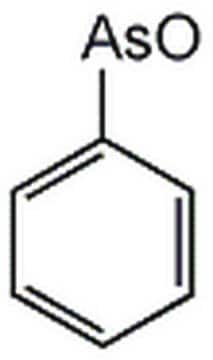
Phenylarsine oxide
synthetic (organic), ≥97%, tyrosine phosphatase inhibitor, powder
Synonym(s):
Arzene, Oxophenylarsine, PAO
Select a Size
| Size/SKU | Availability | Price |
|---|---|---|
1 g | Please contact Customer Service for Availability | CZK 2,430.00 |
5 g | Please contact Customer Service for Availability | CZK 5,570.00 |
About This Item
Product Name
Phenylarsine oxide, ≥97%, powder
biological source
synthetic (organic)
Quality Segment
assay
≥97%
form
powder
color
white to off-white
mp
145-148 °C
solubility
DMSO: 50 mg/mL
SMILES string
O=[As]c1ccccc1
InChI
1S/C6H5AsO/c8-7-6-4-2-1-3-5-6/h1-5H
InChI key
BQVCCPGCDUSGOE-UHFFFAOYSA-N
General description
Application
Biochem/physiol Actions
Features and Benefits
1 of 1
This Item | |||
|---|---|---|---|
| form powder | form solid | form powder | form liquid |
| assay ≥97% | assay ≥96% (titration) | assay - | assay ≥99.5% (GC) |
| Quality Level 100 | Quality Level 100 | Quality Level 100 | Quality Level 200 |
| solubility DMSO: 50 mg/mL | solubility chloroform: 100 mg/mL, DMSO: 50 mg/mL | solubility - | solubility - |
| color white to off-white | color white | color - | color - |
| biological source synthetic (organic) | biological source - | biological source - | biological source - |



Still not finding the right product?
Explore all of our products under Phenylarsine oxide


signalword
Danger
hcodes
Hazard Classifications
Acute Tox. 3 Inhalation - Acute Tox. 3 Oral - Aquatic Acute 1 - Aquatic Chronic 1
Storage Class
6.1C - Combustible acute toxic Cat.3 / toxic compounds or compounds which causing chronic effects
wgk
WGK 3
flash_point_f
Not applicable
flash_point_c
Not applicable
Regulatory Listings
Regulatory Listings are mainly provided for chemical products. Only limited information can be provided here for non-chemical products. No entry means none of the components are listed. It is the user’s obligation to ensure the safe and legal use of the product.
637-03-6
Choose from one of the most recent versions:
Already Own This Product?
Find documentation for the products that you have recently purchased in the Document Library.