Skip to Content
Merck

Skip To

F9554

Anti-Fatty Acid Synthase antibody produced in rabbit

1 mg/mL, affinity isolated antibody, buffered aqueous solution

Synonym(s):

Anti-FAS, Anti-FASN

Sign In to View Organizational & Contract Pricing.

About This Item

UNSPSC Code:
12352203
NACRES:
NA.41
MDL number:
Conjugate:
unconjugated
Clone:
polyclonal
Application:
WB
Citations:
14


biological source

rabbit

conjugate

unconjugated

antibody form

affinity isolated antibody

antibody product type

primary antibodies

clone

polyclonal

form

buffered aqueous solution

mol wt

antigen 270 kDa

species reactivity

mouse, rat, human (predicted)

concentration

1 mg/mL

technique(s)

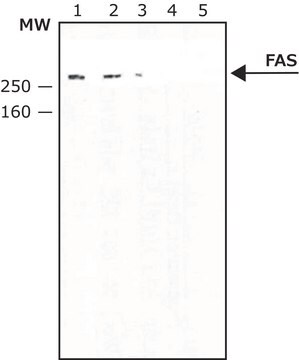
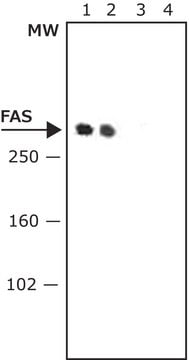
western blot: 0.5-1 μg/mL using lysates of mouse myoblast C2 cells, western blot: 0.5-1 μg/mL using lysates of rat hepatocytoma FAO cells

UniProt accession no.

shipped in

dry ice

storage temp.

−20°C

target post-translational modification

unmodified

Gene Information

human ... FASN(2194)
mouse ... Fasn(14104)
rat ... Fasn(50671)

General description

Fatty Acid Synthase encodes an enzyme that is a multifunctional protein. Its main function is to catalyze the synthesis of palmitate from acetyl-CoA and malonyl-CoA, in the presence of NADPH, into long-chain saturated fatty acids.
Fatty acid synthase (FAS, FASN) is encoded by the gene mapped to human chromosome 17q25.3.[1] In mammals, it is composed of two identical multifunctional polypeptides, in which three catalytic domains in the N-terminal section (β-ketoacyl synthase, malonyl/acetyl tansferase, and dehydrase) are separated by a core region of about 600 residues from four C-terminal domains (enoyl reductase, β-ketoacyl reductase, acyl carrier protein, and thioesterase).

Immunogen

synthetic peptide corresponding to amino acids 1982-1999 of mouse fatty acid synthase, conjugated to KLH via an N-terminal added cysteine residue. The immunizing peptide is conserved in rat and differs from the human sequence by three amino acids.

Application

Anti-Fatty Acid Synthase antibody is suitable for western blot analysis at a concentration of 0.5-1μg/mL using lysates of mouse myoblast C2 cells and rat hepatocytoma FAO cells.
Fatty acid synthase antibody produced in rabbit has been used in immunohistochemistry and western blot analysis.

Biochem/physiol Actions

FAS plays an essential role during embryogenesis and energy homeostasis in adult animals. It also acts as the carbon source for fatty acid synthesis. It has been shown to be overexpressed in various types of human cancer, including prostate, breast, ovary and others. FASN is a multifunctional protein, mainly involved in catalyzing the synthesis of palmitate from acetyl-CoA and malonyl CoA, in the presence of NADPH.

Physical form

Solution in 0.01 M phosphate buffered saline, pH 7.4, containing 15 mM sodium azide.

Disclaimer

Unless otherwise stated in our catalog or other company documentation accompanying the product(s), our products are intended for research use only and are not to be used for any other purpose, which includes but is not limited to, unauthorized commercial uses, in vitro diagnostic uses, ex vivo or in vivo therapeutic uses or any type of consumption or application to humans or animals.

Compare Similar Items

View Full Comparison

Show Differences

1 of 1

This Item
F9679SAB5700006WH0002194M1
conjugate

unconjugated

conjugate

unconjugated

conjugate

unconjugated

conjugate

unconjugated

biological source

rabbit

biological source

rabbit

biological source

rabbit

biological source

mouse

antibody form

affinity isolated antibody

antibody form

affinity isolated antibody

antibody form

affinity isolated antibody

antibody form

purified immunoglobulin

mol wt

antigen 270 kDa

mol wt

antigen 270 kDa

mol wt

273

mol wt

-

form

buffered aqueous solution

form

buffered aqueous solution

form

buffered aqueous solution

form

buffered aqueous solution

technique(s)

western blot: 0.5-1 μg/mL using lysates of mouse myoblast C2 cells, western blot: 0.5-1 μg/mL using lysates of rat hepatocytoma FAO cells

technique(s)

western blot: 0.5-1 μg/mL using lysates of Rat1 cells, western blot: 1-2 μg/mL using lysates of human HEK 293-T cells

technique(s)

immunofluorescence: 1:50-1:200, immunohistochemistry: 1:50-1:100, immunoprecipitation (IP): 1:50-1:100, western blot: 1:500-1:2000

technique(s)

immunohistochemistry (formalin-fixed, paraffin-embedded sections): suitable, immunoprecipitation (IP): suitable, indirect ELISA: suitable, indirect immunofluorescence: suitable, western blot: 1-5 μg/mL


Still not finding the right product?

or

Try our Product Selector Tool to narrow your options


Storage Class

10 - Combustible liquids

wgk

WGK 3

flash_point_f

Not applicable

flash_point_c

Not applicable

ppe

Eyeshields, Gloves, multi-purpose combination respirator cartridge (US)


Choose from one of the most recent versions:

Certificates of Analysis (COA)

Lot/Batch Number

Don't see the Right Version?

If you require a particular version, you can look up a specific certificate by the Lot or Batch number.

Already Own This Product?

Find documentation for the products that you have recently purchased in the Document Library.

Visit the Document Library


Related Content


Bobby Guillory et al.
Aging cell, 17(1) (2017-10-13)
Nonalcoholic fatty liver disease (NAFLD) is the most common liver disease worldwide. NAFLD usually begins as low-grade hepatic steatosis which further progresses in an age-dependent manner to nonalcoholic steatohepatitis (NASH), fibrosis, cirrhosis, and hepatocellular carcinoma in some patients. Ghrelin is
Henriette Kirchner et al.
Molecular metabolism, 5(3), 171-183 (2016-03-16)
Epigenetic modifications contribute to the etiology of type 2 diabetes. We performed genome-wide methylome and transcriptome analysis in liver from severely obese men with or without type 2 diabetes and non-obese men to discover aberrant pathways underlying the development of
C Rufo et al.
The Journal of biological chemistry, 276(24), 21969-21975 (2001-03-30)
Refeeding carbohydrate to fasted rats induces the transcription of genes encoding enzymes of fatty acid biosynthesis, e.g. fatty-acid synthase (FAS). Part of this transcriptional induction is mediated by insulin. An insulin response element has been described for the fatty-acid synthase


Global Trade Item Number

SKUGTIN
F9554-200UL04061838105394

Questions

Reviews

No rating value

Active Filters