Skip to Content
Merck

Skip To

E0157

Anti-eIF2α antibody produced in rabbit

IgG fraction of antiserum, buffered aqueous solution

Synonym(s):

Anti-EIF2, Anti-EIF2S1, Anti-Eukaryotic translation initiation factor 2, subunit 1, Anti-eIF-2A

Sign In to View Organizational & Contract Pricing.

Select a Size

Change View
Pack SizeSKUAvailabilityPrice

About This Item

NACRES:
NA.41
UNSPSC Code:
12352203
Conjugate:
unconjugated
Clone:
polyclonal
Application:
IHC, WB
Citations:
9
To inquire about this product E0157, please contact your local Merck office or dealer. Contact Technical Service
Technical Service
Need help? Our team of experienced scientists is here for you.
Let Us Assist


biological source

rabbit

Quality Level

conjugate

unconjugated

antibody form

IgG fraction of antiserum

antibody product type

primary antibodies

clone

polyclonal

form

buffered aqueous solution

mol wt

antigen ~35 kDa

species reactivity

human

technique(s)

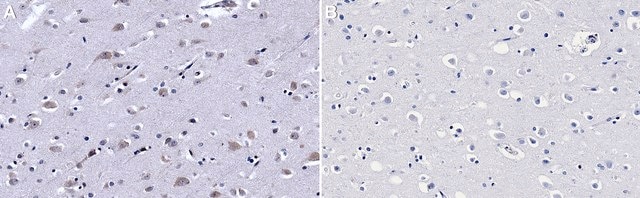
immunohistochemistry: 1:250 using human cerebral cortex sections , western blot: 1:250-1:500 using PC-12 cell lysate

UniProt accession no.

shipped in

dry ice

storage temp.

−20°C

target post-translational modification

unmodified

Gene Information

human ... EIF2S1(1965)

General description

The eukaryotic translation initiation factor 2 subunit α (EIF2A) gene is mapped to human chromosome 14q23.3. The eukaryotic translation initiation factor 2 (eIF2), a multimeric protein is composed of three subunits termed α, β, and γ.

Application

Anti-eIF2α antibody produced in rabbit has been used in western blotting.
Anti-elF2α antibody is also suitable for immunohistochemistry at a working dilution of 1:250 using human cerebral cortex sections.
Anti-eIF2α antibody produced in rabbit is suitable for immunoblotting at a working dilution of 1:250-1:500 using PC-12 cell lysate. It was used as a primary antibody to detect eIF2α in a study.

Biochem/physiol Actions

Anti-eIF2α (also known as eIF-2A) recognizes human eIF2α.
Increased eIF2α phosphorylation has been observed in Alzheimer′s disease. Viral infections are also known to induce eIF2α phosphorylation.
The main role of eIF2 complex is to transfer Met-tRNAi in the presence of GTP to the 40S ribosomal subunit during the initiation of translation. Regulation of the initiation of translation at the level of eIF2 involves the phosphorylation of eIF2α at a conserved Ser51 residue. This leads to inhibition of eIF2β activity, thus reducing guanine nucleotide exchange and consequently, the translation rate. Protein synthesis inhibition at the level of eIF2α phosphorylation is linked to a variety of cell stress signaling pathways via specific kinases. Phosphorylation of eIF2α reduces the rate of translation and gives the cell time to correct the stress damage, and selectively enhance the translation of genes important for stress remedy.

Physical form

Solution in 0.01 M phosphate buffered saline, pH 7.4, containing 15 mM sodium azide.

Preparation Note

For continuous use, store at 2–8 °C for up to one month. For extended storage, freeze in working aliquots. Repeated freezing and thawing, or storage in “frost-free” freezers, is not recommended. If slight turbidity occurs upon prolonged storage, clarify the solution by centrifugation before use. Working dilutions should be discarded if not used within 12 hours.

Disclaimer

Unless otherwise stated in our catalog or other company documentation accompanying the product(s), our products are intended for research use only and are not to be used for any other purpose, which includes but is not limited to, unauthorized commercial uses, in vitro diagnostic uses, ex vivo or in vivo therapeutic uses or any type of consumption or application to humans or animals.

Compare Similar Items

View Full Comparison

Show Differences

1 of 1

This Item
E6407WH0001965M1AV40508
Quality Level

200

Quality Level

200

Quality Level

100

Quality Level

-

biological source

rabbit

biological source

rabbit

biological source

mouse

biological source

rabbit

conjugate

unconjugated

conjugate

unconjugated

conjugate

unconjugated

conjugate

unconjugated

antibody form

IgG fraction of antiserum

antibody form

IgG fraction of antiserum

antibody form

purified immunoglobulin

antibody form

IgG fraction of antiserum

shipped in

dry ice

shipped in

dry ice

shipped in

dry ice

shipped in

wet ice

form

buffered aqueous solution

form

buffered aqueous solution

form

buffered aqueous solution

form

buffered aqueous solution


Still not finding the right product?

or

Try our Product Selector Tool to narrow your options


Storage Class

12 - Non Combustible Liquids

flash_point_f

Not applicable

flash_point_c

Not applicable

ppe

Eyeshields, Gloves, multi-purpose combination respirator cartridge (US)

wgk

nwg


Choose from one of the most recent versions:

Certificates of Analysis (COA)

Lot/Batch Number

Don't see the Right Version?

If you require a particular version, you can look up a specific certificate by the Lot or Batch number.

Already Own This Product?

Find documentation for the products that you have recently purchased in the Document Library.

Visit the Document Library


Related Content

Instructions


R C Wek et al.
Biochemical Society transactions, 34(Pt 1), 7-11 (2005-10-26)
In response to environmental stresses, a family of protein kinases phosphorylate eIF2 (eukaryotic initiation factor 2) to alleviate cellular injury or alternatively induce apoptosis. Phosphorylation of eIF2 reduces global translation, allowing cells to conserve resources and to initiate a reconfiguration
R C Wek
Trends in biochemical sciences, 19(11), 491-496 (1994-11-01)
Phosphorylation of eukaryotic initiation factor-2 (eIF-2) is an important mechanism regulating general translation initiation. Two mammalian eIF-2 kinases, the double-stranded-RNA-dependent kinase (PKR) and heme-regulated inhibitor kinase (HRI), have been characterized by sequencing, revealing shared sequence and structural features distinct from
Anton A Komar et al.
International journal of molecular sciences, 21(6) (2020-03-21)
Initiation of protein synthesis in eukaryotes is a complex process requiring more than 12 different initiation factors, comprising over 30 polypeptide chains. The functions of many of these factors have been established in great detail; however, the precise role of


Global Trade Item Number

SKUGTIN
E0157-200UL04061838030825

Questions

Reviews

No rating value

Active Filters