Skip to Content
Merck

Skip To

AB9014

Anti-Chx10 Antibody, CT

Chemicon®, from sheep

Synonym(s):

Hox-10, Ocular Retardation, C. Elegans ceh-10 Homeo Domain Containing Homolog

Sign In to View Organizational & Contract Pricing.

About This Item

UNSPSC Code:
12352203
NACRES:
NA.41
eCl@ss:
32160702
Conjugate:
unconjugated
Clone:
polyclonal
Application:
WB
Citations:
7


biological source

sheep

Quality Level

conjugate

unconjugated

antibody form

purified immunoglobulin

antibody product type

primary antibodies

clone

polyclonal

species reactivity

mouse, rat, bovine, human

manufacturer/tradename

Chemicon®

technique(s)

western blot: suitable

NCBI accession no.

UniProt accession no.

shipped in

dry ice

target post-translational modification

unmodified

Gene Information

human ... VSX2(338917)

Immunogen

Epitope: C-terminus
Recombinant human Chx10 protein, C-terminal.

Application

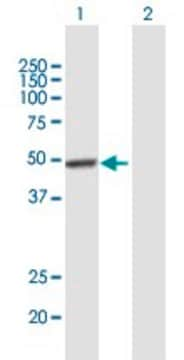
Immunoblotting: 0.5-1.0 μg/mL. Reacts with the 46 kD protein in rat and mouse retinal tissue lysate.

Optimal working dilutions must be determined by the end user.
Research Category
Neuroscience
Research Sub Category
Developmental Neuroscience

Neuronal & Glial Markers
This Anti-Chx10 Antibody, C-terminus is validated for use in WB for the detection of Chx10.

Biochem/physiol Actions

Chx10

Physical form

Format: Purified
Purified immunoglobulin. Liquid in PBS containing 0.08% sodium azide.

Preparation Note

Maintain at -20°C in undiluted aliquots for up to 6 months after date of receipt. Avoid repeated freeze/thaw cycles.

Other Notes

Concentration: Please refer to the Certificate of Analysis for the lot-specific concentration.

Legal Information

CHEMICON is a registered trademark of Merck KGaA, Darmstadt, Germany

Disclaimer

Unless otherwise stated in our catalog or other company documentation accompanying the product(s), our products are intended for research use only and are not to be used for any other purpose, which includes but is not limited to, unauthorized commercial uses, in vitro diagnostic uses, ex vivo or in vivo therapeutic uses or any type of consumption or application to humans or animals.

Compare Similar Items

View Full Comparison

Show Differences

1 of 1

This Item
AB9016SAB1409219SAB4501465
Quality Level

100

Quality Level

100

Quality Level

-

Quality Level

100

antibody form

purified immunoglobulin

antibody form

purified immunoglobulin

antibody form

purified immunoglobulin

antibody form

affinity isolated antibody

biological source

sheep

biological source

sheep

biological source

mouse

biological source

rabbit

conjugate

unconjugated

conjugate

unconjugated

conjugate

unconjugated

conjugate

unconjugated

Gene Information

human ... VSX2(338917)

Gene Information

human ... VSX2(338917)

Gene Information

human ... VSX2(338917)

Gene Information

human ... HSPE1(3336)

shipped in

dry ice

shipped in

dry ice

shipped in

dry ice

shipped in

wet ice


Still not finding the right product?

Try our Product Selector Tool to narrow your options


Storage Class

12 - Non Combustible Liquids

wgk

WGK 2

flash_point_f

Not applicable

flash_point_c

Not applicable


Certificates of Analysis (COA)

Search for Certificates of Analysis (COA) by entering the products Lot/Batch Number. Lot and Batch Numbers can be found on a product’s label following the words ‘Lot’ or ‘Batch’.

Already Own This Product?

Find documentation for the products that you have recently purchased in the Document Library.

Visit the Document Library


Related Content

SHEEP ANTI- Chx10 C-TERMINAL


Rowena Smith et al.
The Journal of neuroscience : the official journal of the Society for Neuroscience, 37(33), 7975-7993 (2017-07-22)
During vertebrate eye morphogenesis, a transient fissure forms at its inferior part, known as the optic fissure. This will gradually close, giving rise to a healthy, spherical optic cup. Failure of the optic fissure to close gives rise to an
Proliferation and expression of progenitor and mature retinal phenotypes in the adult mammalian ciliary body after retinal ganglion cell injury.
Nickerson, PE; Emsley, JG; Myers, T; Clarke, DB
Investigative Ophthalmology & Visual Science null
Yanling Xin et al.
eLife, 11 (2022-12-03)
N 6-methyladenosine (m6A) is the most prevalent mRNA internal modification and has been shown to regulate the development, physiology, and pathology of various tissues. However, the functions of the m6A epitranscriptome in the visual system remain unclear. In this study


Global Trade Item Number

SKUGTIN
AB901404053252673610

Questions

Reviews

No rating value

Active Filters