Skip to Content
Merck

Skip To

07-095

Anti-PP2A-methylesterase/PME-1 Antibody

Upstate®, from rabbit

Sign In to View Organizational & Contract Pricing.

About This Item

UNSPSC Code:
12352203
NACRES:
NA.41
eCl@ss:
32160702
Conjugate:
unconjugated
Clone:
polyclonal
Application:
WB
Citations:
10


biological source

rabbit

Quality Level

conjugate

unconjugated

antibody form

purified immunoglobulin

antibody product type

primary antibodies

clone

polyclonal

species reactivity

human, rat, mouse

manufacturer/tradename

Upstate®

technique(s)

western blot: suitable

isotype

IgG

NCBI accession no.

UniProt accession no.

shipped in

dry ice

target post-translational modification

unmodified

Gene Information

human ... PPME1(51400)

General description

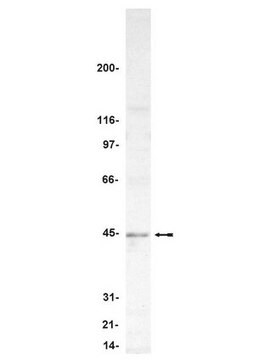
44kDa

Immunogen

A mixture of two nickel agarose-purified, His6-tagged, bacterial expressed human Protein Phosphatase Methylesterase-1 (PME-1) fragments (residues 225-302 and 277-387). These two fragments represent the carboxyl-terminal portion of the protein.

Application

Research Category
Signaling

Neuroscience
Research Sub Category
Neurotransmitters & Receptors

Neurodegenerative Diseases
This Anti-PP2A-methylesterase/PME-1 Antibody is validated for use in IP, WB for the detection of PP2A-methylesterase/PME-1.

Biochem/physiol Actions

Protein Phosphatase Methylesterase-1

Physical form

0.1M Tris-glycine, pH 7.4, 0.15M NaCl, 0.05% sodium azide before the addition of glycerol to 30%
Format: Purified
Protein A chromatography

Preparation Note

2 years at -20°C

Analysis Note

Control
Positive Antigen Control: Catalog #12-305, 3T3/A31 lysate. Add 2.5 μL of 2-mercapto-ethanol/100 μL of lysate and boil for 5 minutes to reduce the preparation. Load 20 μg of reduced lysate per lane for minigels.
routinely evaluated by immunoblot on RIPA lysates from mouse 3T3 fibroblasts

Legal Information

UPSTATE is a registered trademark of Merck KGaA, Darmstadt, Germany

Disclaimer

Unless otherwise stated in our catalog or other company documentation accompanying the product(s), our products are intended for research use only and are not to be used for any other purpose, which includes but is not limited to, unauthorized commercial uses, in vitro diagnostic uses, ex vivo or in vivo therapeutic uses or any type of consumption or application to humans or animals.

Compare Similar Items

View Full Comparison

Show Differences

1 of 1

This Item
06-22205-59207-250
biological source

rabbit

biological source

rabbit

biological source

mouse

biological source

rabbit

antibody form

purified immunoglobulin

antibody form

serum

antibody form

ascites fluid

antibody form

affinity isolated antibody

species reactivity

human, rat, mouse

species reactivity

mouse, human, rabbit, rat

species reactivity

rat, bovine, mouse, Xenopus, rabbit, pig, human

species reactivity

human, mouse, Xenopus, pig, rat

conjugate

unconjugated

conjugate

unconjugated

conjugate

unconjugated

conjugate

unconjugated

clone

polyclonal

clone

polyclonal

clone

2G9, monoclonal

clone

polyclonal

Gene Information

human ... PPME1(51400)

Gene Information

human ... PPP2CA(5515)

Gene Information

human ... PPP2CA(5515)

Gene Information

human ... PPP2R1A(5518)


Still not finding the right product?

Try our Product Selector Tool to narrow your options


Storage Class

10 - Combustible liquids

wgk

WGK 1


Certificates of Analysis (COA)

Search for Certificates of Analysis (COA) by entering the products Lot/Batch Number. Lot and Batch Numbers can be found on a product’s label following the words ‘Lot’ or ‘Batch’.

Already Own This Product?

Find documentation for the products that you have recently purchased in the Document Library.

Visit the Document Library


Single-pot enzymatic synthesis of Dicer-substrate siRNAs.
Guiley, KZ; Pratt, AJ; MacRae, IJ
Nucleic Acids Research null
Madhumathi Gnanaprakash et al.
Journal of Alzheimer's disease : JAD, 79(4), 1813-1829 (2021-01-19)
The serine/threonine protein phosphatase, PP2A, is thought to play a central role in the molecular pathogenesis of Alzheimer's disease (AD), and the activity and substrate specificity of PP2A is regulated, in part, through methylation and demethylation of its catalytic subunit.
Christina Ising et al.
Nature, 575(7784), 669-673 (2019-11-22)
Alzheimer's disease is characterized by the accumulation of amyloid-beta in plaques, aggregation of hyperphosphorylated tau in neurofibrillary tangles and neuroinflammation, together resulting in neurodegeneration and cognitive decline1. The NLRP3 inflammasome assembles inside of microglia on activation, leading to increased cleavage


Questions

Reviews

No rating value

Active Filters