


Information regarding buffer preparation can be found in the product information sheet (PIS).
MBD0032

Eubacteria FISH probe - ATTO488
Probe for fluorescence in situ hybridization (FISH), 20 µM in water
Sinónimos:
Fluorescent Probe
Iniciar sesión para ver los precios por organización y contrato.
Seleccione un Tamaño
Cambiar Vistas
| Talla/SKU | Disponibilidad | Precio |
|---|
Acerca de este artículo
NACRES:
NA.55
UNSPSC Code:
12352200
En este momento no podemos mostrarle ni los precios ni la disponibilidad
Servicio técnico
¿Necesita ayuda? Nuestro equipo de científicos experimentados está aquí para ayudarle.
Permítanos ayudarleQuality Segment
technique(s)
FISH: suitable
fluorescence
λex 504 nm; λem 521 nm (ATTO488)
shipped in
dry ice
storage temp.
−20°C
General description
Fluorescent In Situ Hybridization technique (FISH) is based on the hybridization of fluorescent labeled oligonucleotide probe to a specific complementary DNA or RNA sequence in whole and intact cells. Microbial FISH allows the visualization, identification and isolation of bacteria due to recognition of ribosomal RNA also in unculturable samples.
FISH technique can serve as a powerful tool in the microbiome research field by allowing the observation of native microbial populations in diverse microbiome environments, such as samples from human origin (blood and tissue), microbial ecology (solid biofilms and aquatic systems) and plants.
Prokaryotic single cell life forms are divided into two domains, called Bacteria and Archaea, originally categorized as Eubacteria and Archaebacteria. However both terms, Eubacteria and Bacteria are still being used in microbiology. Eubacteria probe recognizes most bacteria as it is complementary to a portion of 16S rRNA found in almost all bacteria.,
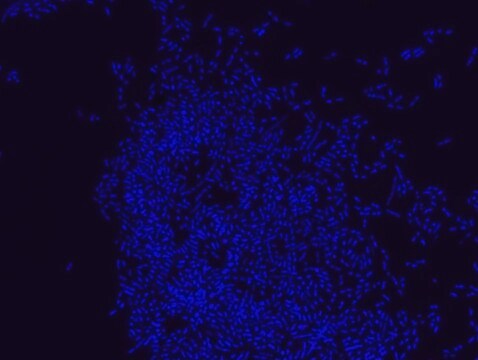
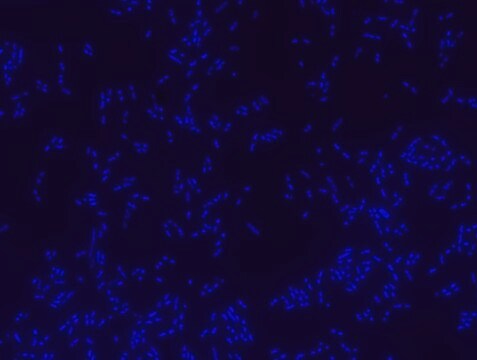
FISH technique was successfully used to identify different bacteria with the universal bacterial probe in various samples such as, pure culture (as described in the figure legends), blood cultures,, periapical tooth lesions12, saliva13, biofilms from voice prostheses14, subgingival biofilm15, aortic wall tissue16, buccal epithelial cells, pure culture and cell culture17, intestine tissue embedded in paraffin18, necrotizing fasciitis and pure culture19, colon sections embedded in paraffin20,21, cancer tissues22,23, environmental samples24 and gut of the medicinal leech25. The probe can also be used for combined technique of FISH and Flow cytometric analysis. 9,26,27
It is strongly recommended to include positive and negative controls in FISH assays to ensure specific binding of the probe of interest and appropriate protocol conditions. We offer positive (MBD0032/33) and negative (MBD0034/35) control probes, that accompany the specific probe of interest.
FISH technique can serve as a powerful tool in the microbiome research field by allowing the observation of native microbial populations in diverse microbiome environments, such as samples from human origin (blood and tissue), microbial ecology (solid biofilms and aquatic systems) and plants.
Prokaryotic single cell life forms are divided into two domains, called Bacteria and Archaea, originally categorized as Eubacteria and Archaebacteria. However both terms, Eubacteria and Bacteria are still being used in microbiology. Eubacteria probe recognizes most bacteria as it is complementary to a portion of 16S rRNA found in almost all bacteria.,
FISH technique was successfully used to identify different bacteria with the universal bacterial probe in various samples such as, pure culture (as described in the figure legends), blood cultures,, periapical tooth lesions12, saliva13, biofilms from voice prostheses14, subgingival biofilm15, aortic wall tissue16, buccal epithelial cells, pure culture and cell culture17, intestine tissue embedded in paraffin18, necrotizing fasciitis and pure culture19, colon sections embedded in paraffin20,21, cancer tissues22,23, environmental samples24 and gut of the medicinal leech25. The probe can also be used for combined technique of FISH and Flow cytometric analysis. 9,26,27
It is strongly recommended to include positive and negative controls in FISH assays to ensure specific binding of the probe of interest and appropriate protocol conditions. We offer positive (MBD0032/33) and negative (MBD0034/35) control probes, that accompany the specific probe of interest.
Application
Eubacteria FISH probe - ATTO488 is suitable to use as a probe for fluorescence in situ hybridization (FISH) to recognize Eubacteria cells .
Features and Benefits
- Visualize, identify and isolate bacteria cells.
- Observe native bacteria cell populations in diverse microbiome environments.
- Specific, sensitive and robust identification of bacteria cells in mixed microorganism population.
- Specific, sensitive and robust identification even when bacteria are in low abundance in the sample.
- FISH can complete PCR based detection methods by avoiding contaminant bacteria detection.
- Provides information on bacteria morphology and allows to study biofilm architecture.
- Identify various bacteria in environmental and clinical samples such as, formalin-fixed paraffin-embedded (FFPE) samples, blood cultures, saliva and more.
- The ability to detect bacteria in its natural habitat is an essential tool for studying host-microbiome interaction.
1 of 1
Este artículo | |||
|---|---|---|---|
| description Probe for fluorescence in situ hybridization (FISH), 20 µM in water | description Probe for fluorescence in situ hybridization (FISH),20 μM in water | description Probe for fluorescence in situ hybridization (FISH),20 μM in water | description Probe for fluorescence in situ hybridization (FISH),20 μM in water |
| shipped in dry ice | shipped in dry ice | shipped in dry ice | shipped in dry ice |
| storage temp. −20°C | storage temp. −20°C | storage temp. −20°C | storage temp. −20°C |
| technique(s) FISH: suitable | technique(s) FISH: suitable | technique(s) FISH: suitable | technique(s) FISH: suitable |
| Quality Level 200 | Quality Level 200 | Quality Level 200 | Quality Level 200 |
| fluorescence λex 504 nm; λem 521 nm (ATTO488) | fluorescence λex 504 nm; λem 521 nm (ATTO488) | fluorescence λex 504 nm; λem 521 nm (ATTO488) | fluorescence λex 550 nm; λem 570 nm (Cy3) |
Clase de almacenamiento
12 - Non Combustible Liquids
¿Qué está pasando?
nwg
Elija entre una de las versiones más recientes:
¿Ya tiene este producto?
Encuentre la documentación para los productos que ha comprado recientemente en la Biblioteca de documentos.
-
PlEASE LET ME KNOW ABOUT HYBRIDIZATION BUFFER TO BE USED FOR THE Eubacteria FISH probe - ATTO488
1 answer-
Helpful?
-