Passa al contenuto
Merck

Vai a

07-1817

Anti-phospho-SRPK2 (Ser494) Antibody

from rabbit, purified by affinity chromatography

Sinonimo/i:

Serine/threonine-protein kinase SRPK2, SFRS protein kinase 2, Serine/arginine-rich protein-specific kinase 2, SR-protein-specific kinase 2

Autenticati per visualizzare i prezzi organizzativi e contrattuali.

Informazioni su questo articolo

UNSPSC Code:
12352203
NACRES:
NA.41
eCl@ss:
32160702
Clone:
polyclonal
Species reactivity:
human, mouse
Application:
WB, inhibition assay
Citations:
2


biological source

rabbit

Quality Level

antibody form

affinity isolated antibody

antibody product type

primary antibodies

clone

polyclonal

purified by

affinity chromatography

species reactivity

human, mouse

species reactivity (predicted by homology)

Xenopus (based on 100% sequence homology), rat (based on 100% sequence homology)

technique(s)

inhibition assay: suitable (peptide), western blot: suitable

NCBI accession no.

UniProt accession no.

shipped in

wet ice

target post-translational modification

phosphorylation (pSer494)

Gene Information

human ... SRPK2(6733)

General description

Along with Serine/threonine protein kinase 2 (SRPK2), SRPK1 phosphorylates serine residues found in RS-domain-containing proteins, such as SFRS1 and SFRS2. These kinases also phosphorylate the same serine residues on the HBV core protein both in vitro and in vivo. The cytoplasmic proteins are critical for nuclear import of SR proteins in a phosphorylation-dependent manner. Additionally, they mediate the trafficking of splicing factors and play a role in spliceosome assembly and mitogenesis.
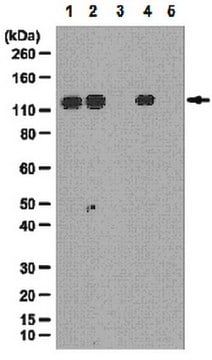
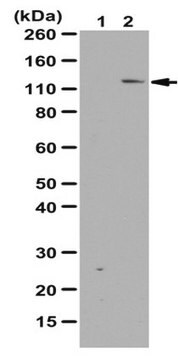
~120 kDa observed. Two isoforms at ~77 kDa and ~79 kDa may be observed in some cell lysates.

Immunogen

Epitope: Protein kinase domain
KLH-conjugated linear peptide corresponding to the protein kinase domain of SRPK2 phosphorylated at Ser494.

Application

Anti-phospho-SRPK2 (Ser494) Antibody is an antibody against phospho-SRPK2 (Ser494) for use in WB, PIA.
Peptide Inhibition Analysis: 1 µg/mL from a representative lot detected SRPK2 in 10 µg of insulin treated HepG2 cell lysate.
Research Category
Signaling
Research Sub Category
Cell Cycle, DNA Replication & Repair

Biochem/physiol Actions

This antibody is specific for the protein kinase domain of SRPK2 phosphorylated at Ser494, independent of observed phosphorylation at Ser497.

Physical form

Affinity purified
Purified rabbit polyclonal in buffer containing 0.1 M Tris-Glycine (pH 7.4), 150 mM NaCl with 0.05% sodium azide.

Preparation Note

Stable for 1 year at 2-8°C from date of receipt.

Analysis Note

Control
Untreated and insulin treated HepG2 cell lysate
Evaluated by Western Blot in untreated and insulin treated HepG2 cell lysate.

Western Blot Analysis: 1 µg/mL of this antibody detected SRPK2 in 10 µg HepG2 cell lysate.

Other Notes

Concentration: Please refer to the Certificate of Analysis for the lot-specific concentration.

Disclaimer

Unless otherwise stated in our catalog or other company documentation accompanying the product(s), our products are intended for research use only and are not to be used for any other purpose, which includes but is not limited to, unauthorized commercial uses, in vitro diagnostic uses, ex vivo or in vivo therapeutic uses or any type of consumption or application to humans or animals.

Confronta articoli simili

Visualizza il confronto per intero

Mostra le differenze

1 of 1

Questo articolo
ABS19204-73605-669
antibody form

affinity isolated antibody

antibody form

affinity isolated antibody

antibody form

culture supernatant

antibody form

purified antibody

species reactivity

human, mouse

species reactivity

hamster, mouse, human

species reactivity

mouse, human

species reactivity

rat, canine, mouse, human

biological source

rabbit

biological source

rabbit

biological source

rabbit

biological source

mouse

clone

polyclonal

clone

polyclonal

clone

SK703, monoclonal

clone

11E6, monoclonal

Gene Information

human ... SRPK2(6733)

Gene Information

human ... SRPK2(6733)

Gene Information

human ... AKT1(207)

Gene Information

dog ... Akt1(490878)
human ... AKT1(207)

shipped in

wet ice

shipped in

wet ice

shipped in

dry ice

shipped in

dry ice


Still not finding the right product?

Provate il nostro Motore di ricerca dei prodotti per restringere le opzioni.


Classe di stoccaggio

12 - Non Combustible Liquids

wgk

WGK 1

flash_point_f

Not applicable

flash_point_c

Not applicable


Certificati d'analisi (COA)

Cerca il Certificati d'analisi (COA) digitando il numero di lotto/batch corrispondente. I numeri di lotto o di batch sono stampati sull'etichetta dei prodotti dopo la parola ‘Lotto’ o ‘Batch’.

Possiedi già questo prodotto?

I documenti relativi ai prodotti acquistati recentemente sono disponibili nell’Archivio dei documenti.

Visita l’Archivio dei documenti


Mousumi Khatun et al.
Hepatology (Baltimore, Md.), 74(1), 41-54 (2020-11-26)
HCV often causes chronic infection in liver, cirrhosis, and, in some instances, HCC. HCV encodes several factors' those impair host genes for establishment of chronic infection. The long noncoding RNAs (lncRNAs) display diverse effects on biological regulations. However, their role
Aneesha Radhakrishnan et al.
Cancer biology & therapy, 17(2), 219-229 (2016-02-09)
Signaling plays an important role in regulating all cellular pathways. Altered signaling is one of the hallmarks of cancers. Phosphoproteomics enables interrogation of kinase mediated signaling pathways in biological systems. In cancers, this approach can be utilized to identify aberrantly


Questions

Reviews

No rating value

Active Filters