Direkt zum Inhalt
Merck

C3545

Monoclonal Anti-Calmodulin antibody produced in mouse

clone 6D4, ascites fluid

Synonym(e):

Anti-CALM3, Anti-calmodulin

Anmelden zur Ansicht der Organisations- und Vertragspreise.

Größe auswählen

0.2 ML

CHF 343.40

CHF 343.40

ListenpreisCHF 404.00Sparen Sie 15%
Aktion nur im Web

Warenkorb auf Verfügbarkeit prüfen
Für Ihr Target ist ein rekombinanter, konservierungsmittelfreier Antikörper verfügbar. Probieren Sie ZRB1586

Großbestellung anfragen

Über diesen Artikel

UNSPSC Code:
12352203
NACRES:
NA.44
MDL number:
Conjugate:
unconjugated
Clone:
6D4, monoclonal
Application:
WB
Citations:
13

Fortfahren mit

Technischer Dienst
Benötigen Sie Hilfe? Unser Team von erfahrenen Wissenschaftlern ist für Sie da.
Unterstützung erhalten

biological source

mouse

Quality Level

conjugate

unconjugated

antibody form

ascites fluid

antibody product type

primary antibodies

clone

6D4, monoclonal

contains

15 mM sodium azide as preservative

species reactivity

chicken, Dictyostelium discoideum, bovine, rat

technique(s)

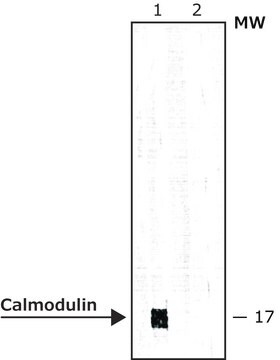
western blot: 1:2,000 using a bovine brain calmodulin preparation

isotype

IgG1

UniProt accession no.

shipped in

dry ice

storage temp.

−20°C

target post-translational modification

unmodified

Gene Information

rat ... Calm1(24242)

Suchen Sie nach ähnlichen Produkten? Aufrufen Leitfaden zum Produktvergleich

Ähnliche Artikel vergleichen

Vollständigen Vergleich anzeigen

Unterschiede anzeigen

1 of 4

Dieser Artikel
T6557C7464M4278
Gene Information

rat ... Calm1(24242)

Gene Information

human ... TUBG1(7283)
mouse ... Tubg1(103733)
rat ... Tubg1(252921)

Gene Information

human ... CCND1(595)
mouse ... Ccnd1(12443)
rat ... Ccnd1(58919)

Gene Information

mouse ... Mtap1a(17754)
rat ... Map1a(25152)

clone

6D4, monoclonal

clone

GTU-88, monoclonal

clone

DCS-6, monoclonal

clone

HM-1, monoclonal

species reactivity

chicken, Dictyostelium discoideum, bovine, rat

species reactivity

rat, hamster, chicken, human, bovine, canine, Xenopus, mouse

species reactivity

rat, mouse, human, monkey

species reactivity

mouse, rat

conjugate

unconjugated

conjugate

unconjugated

conjugate

unconjugated

conjugate

unconjugated

biological source

mouse

biological source

mouse

biological source

mouse

biological source

mouse

antibody form

ascites fluid

antibody form

ascites fluid

antibody form

ascites fluid

antibody form

ascites fluid

General description

Calmodulin belongs to a family of structurally homologous Ca2+-binding proteins. CALM1 gene is located on human chromosome 14q32.11.
Calmodulin is a highly conserved 17kDa calcium binding protein found in all eukaryotic cells. It is a multifunctional molecule. Monoclonal anti-Calmodulin (mouse IgG1 isotype) is derived from the 6D4 hybridoma produced by the fusion of mouse myeloma cells and splenocytes from BALB/c mice immunized with calmodulin, purified from Dictyostelium discoideum and conjugated to KLH.

Immunogen

preparation of purified calmodulin from Dictyostelium discoideum conjugated to KLH.

Application

Monoclonal Anti-Calmodulin antibody produced in mouse has been used in:
  • enzyme-linked immunosorbent assay (ELISA)
  • immunoblot
  • dot blot
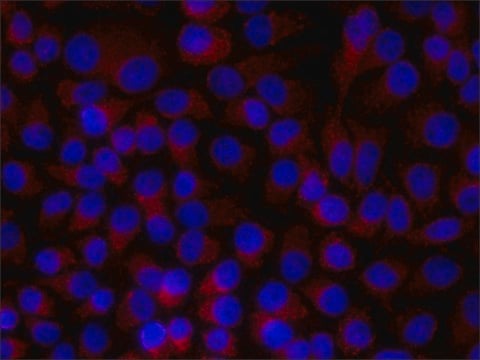
  • immunocytochemistry
  • immunoprecipitation
  • immunofluorescence[1]

Biochem/physiol Actions

Calmodulin is a ubiquitous molecule which can bind up to 4 calcium ions, regulating and mediating a wide variety of biochemical processes.
The antibody recognizes native and SDS-denatured calmodulin.
These antibodies are directed against different epitopes within the calmodulin molecule.

Disclaimer

Unless otherwise stated in our catalog or other company documentation accompanying the product(s), our products are intended for research use only and are not to be used for any other purpose, which includes but is not limited to, unauthorized commercial uses, in vitro diagnostic uses, ex vivo or in vivo therapeutic uses or any type of consumption or application to humans or animals.

Sie haben nicht das passende Produkt gefunden?  

Probieren Sie unser Produkt-Auswahlhilfe. aus.

related product

Lagerklasse

12 - Non Combustible Liquids

wgk

nwg

flash_point_f

Not applicable

flash_point_c

Not applicable


Hier finden Sie alle aktuellen Versionen:

Analysenzertifikate (COA)

Lot/Batch Number

Die passende Version wird nicht angezeigt?

Wenn Sie eine bestimmte Version benötigen, können Sie anhand der Lot- oder Chargennummer nach einem spezifischen Zertifikat suchen.

Besitzen Sie dieses Produkt bereits?

In der Dokumentenbibliothek finden Sie die Dokumentation zu den Produkten, die Sie kürzlich erworben haben.

Die Dokumentenbibliothek aufrufen

Maximal stimulation-induced in situ myosin light chain kinase activity is upregulated in fetal compared with adult ovine carotid arteries
Injeti ER, et al.
American Journal of Physiology. Heart and Circulatory Physiology, 295(6), H2289-H2298 (2008)
The role of calmodulin and related proteins in plant cell function: an ever-thickening plot
Bergey DR, et al.
Springer Science Reviews, 2(1-2), 145-159 (2014)
The role of calmodulin and related proteins in plant cell function: an ever-thickening plot
Bergey DR, et al.
Springer Science Reviews, 2(1-2), 145-159 (2014)
William D Kim et al.
International journal of molecular sciences, 22(4) (2021-02-13)
Calmodulin (CaM) is an essential calcium-binding protein within eukaryotes. CaM binds to calmodulin-binding proteins (CaMBPs) and influences a variety of cellular and developmental processes. In this study, we used immunoprecipitation coupled with mass spectrometry (LC-MS/MS) to reveal over 500 putative
C J Pallen et al.
The Journal of biological chemistry, 259(10), 6134-6141 (1984-05-25)
Calcineurin possesses phosphatase activity towards both protein (Stewart, A.A., Ingebritsen , T.S., Manalan , A., Klee , C.B., and Cohen, P. (1982) FEBS Lett. 137, 80-84) and nonprotein substrates ( Pallen , C.J., and Wang, J.H. (1983) J. Biol. Chem.

Global Trade Item Number

SKUGTIN
C3545-.2ML04061838104281

Questions

Reviews

No rating value

Active Filters

Unser Team von Wissenschaftlern verfügt über Erfahrung in allen Forschungsbereichen einschließlich Life Science, Materialwissenschaften, chemischer Synthese, Chromatographie, Analytik und vielen mehr..

Setzen Sie sich mit dem technischen Dienst in Verbindung