

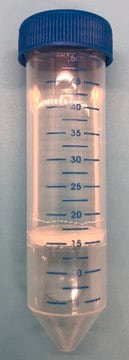


Accuspin tubes are obtained from an outside supplier. Their exact dimensions are not available but should approximate the dimensions of a standard 50 ml centrifuge tube. Standard dimensions are generally 29.1 mm in diameter X 114.4 mm long.
Fortfahren mit
A2055

ACCUSPIN™ Röhrchen, steril, 50 ml Fassungsvolumen
radiation sterilized tube fitted with a high density polyethylene barrier
Anmelden zur Ansicht der Organisations- und Vertragspreise.
Größe auswählen
Ansicht ändern
| Ihnen/SKU | Verfügbarkeit | Preis |
|---|---|---|
10 ea | Warenkorb auf Verfügbarkeit prüfen | CHF 166.00 |
Über diesen Artikel
NACRES:
NA.75
UNSPSC Code:
12352207
Technischer Dienst
Benötigen Sie Hilfe? Unser Team von erfahrenen Wissenschaftlern ist für Sie da.
Unterstützung erhaltenQuality Segment
sterility
sterile; irradiated
form
tubes
application(s)
hematology
histology
storage temp.
15-25°C
General description
ACCUSPIN™-Röhrchen sind durch Bestrahlung sterilisierte Polypropylenröhrchen mit einer Barriere aus Polyethylen hoher Dichte. Jedes Röhrchen kann 15 ml Dichtegradient aufnehmen.
Application
ACCUSPIN™-Röhrchen, steril, 50 ml Kapazität, sind bestimmt für die Verwendung mit dem Dichtegradienten-Trennmedium Histopaque™-1077:
- Zur Isolierung von Lymphozyten und anderen mononukleären Zellen.
- Zur Isolierung von Endothel–Vorläuferzellen aus Nabelschnurblut.[1]
- Zur Isolierung der mononukleären Zellschicht aus Knochenmarkproben.
- Geeignet für die Aufreinigung von humanem Knochenmarkaspirat zur Untersuchung des therapeutischen Nutzens von BET-Inhibitoren bei akuter myeloischer Leukämie.
Biochem/physiol Actions
Nach Zugabe von Histopaque-1077 in dasACCUSPIN-Röhrchen wird das Histopaque-1077 durch kurzeZentrifugation unter die Fritte gebracht. Die Blutprobe kannin die obere Kammer des Röhrchens zugegeben werden, ohne dass die Gefahr einerVermischung mit dem Histopaque-1077 in der unteren Kammerunter der Fritte besteht. Beim anschließenden Zentrifugieren sinkt das Vollblutdurch die Fritte und kommt mit demHistopaque-1077 in Kontakt. Die Elemente mit höherer Dichteverdrängen ein Volumen von Histopaque-1077 oberhalb der Fritte,wodurch eine klare Trennung der Blutbestandteile erreicht wird. DieErythrozyten aggregieren und Granulozyten werdenleicht hypertonisch, wodurch sich ihre Sedimentationsrate erhöht,was zu einer Pelletierung am Boden des ACCUSPIN-Röhrchens führt. Lymphozyten und andere mononukleäre Zellen, z. B.Monozyten, verbleiben an der Plasma/Histopaque-1077-Grenzfläche. Dieses dichte Band aus mononukleären Zellen kanndurch Abgießen des Inhalts der oberen Kammeroder mithilfe einer Pipette gesammelt werden. Eine Kontamination mit Erythrozytenwird durch die Barriere zwischen denKammern vermieden.
Preparation Note
10 Röhrchen pro Packung
Legal Information
Accuspin is a trademark of Sigma-Aldrich Co. LLC
1 of 1
Dieser Artikel | |||
|---|---|---|---|
| sterility sterile; irradiated | sterility sterile; irradiated | sterility aseptically filled | sterility aseptically filled |
| form tubes | form tubes | form solution | form solution |
| Quality Level 200 | Quality Level 200 | Quality Level 400 | Quality Level 400 |
| storage temp. 15-25°C | storage temp. 15-25°C | storage temp. 2-8°C | storage temp. 2-8°C |
| application(s) hematology | application(s) hematology | application(s) hematology | application(s) hematology |
signalword
Danger
hcodes
Hazard Classifications
Resp. Sens. 1 - Skin Sens. 1
flash_point_f
Not applicable
flash_point_c
Not applicable
Lagerklasse
10 - Combustible liquids
Hier finden Sie alle aktuellen Versionen:
Besitzen Sie dieses Produkt bereits?
In der Dokumentenbibliothek finden Sie die Dokumentation zu den Produkten, die Sie kürzlich erworben haben.
-
Liebes Team, sind die Abmessungen (AußendurchmesserxHöhe) der Röhrchen bekannt? Liebe Grüße!
1 answer-
Helpful?
-
-
How should a 4-20% sucrose gradient be used to reduce platelet contamination, as recommended in the user manual?
1 answer-
Sucrose exerts an osmotic pressure of 300 mOsm at a concentration of about 0.25M, which is iso-osmotic with the contents of most mammalian cells. This concentration is approximately 81.25 grams/L or 8.125%, as per protocols used to remove platelets. Recommended procedures for removing platelets:
Perform Procedure 1077 or 1077/1119.
Collect the cell band and layer it over a second gradient.
A. Bottom layer = 1077-1
B. Top layer = 8.125% sucrose solution (prepared in deionized water).
C. Layer the cell suspension on top of the gradient formed in steps 1-2.
D. Use a 300 g spin for 10-15 minutes.
E. Depending upon the original volume of the cell suspension, times and speed may have to be adjusted to maximize cell recovery.
F. Use separate tubes for mononuclear and polymorphonuclear cells.Helpful?
-
-
Is Accuspin (A2055) suitable for use with canine blood?
1 answer-
The suggestion is to make a decision based on individual circumstances.If currently using a plain centrifuge tube for collecting PBMCs from canine blood using a single density gradient, the Accuspin Tubes can be used for the same collection, provided that the G force does not exceed 1000G and a single density gradient is used.
Helpful?
-
-
Does the Accuspin Tubes Product #A2055, which are prefilled with a frit, also contain EDTA or another anticoagulant?
1 answer-
None of the Accuspin spin tubes (filled or unfilled) contain any anticoagulant. It is expected that when blood is drawn, it is typically drawn into a vacuum tube that already contains an anticoagulant or it is necessary to add anticoagulant immediately after the blood draw is completed. The most common anticoagulants used are EDTA and Heparin.
Helpful?
-
-
Are Accuspin tubes compatible with blood that has been anticoagulated with ACD-A?
1 answer-
Certainly, Accuspin tubes are suitable for use with any blood containing an anticoagulant, with fresher blood being preferable. Regardless of the anticoagulant used, the anticoagulant is essentially washed away during the steps to remove the density gradient from the collected white blood cells. With ACD-A, the cell band is wider at the interface and the cells are more dispersed over a larger area, possibly due to the dextrose/glucose in the formulation. When using ACD-A, a somewhat unusual cell band is produced after the tubes are removed from the centrifuge. In comparison, cell bands with heparin, EDTA, sodium citrate, and other typical anticoagulants typically provide a rather narrow cell band when viewed from the side of the Accuspin tube.
Helpful?
-
-
Can I remove the Frit after collecting the mononuclear cells to recover the granulocytes?
1 answer-
When using the Accuspin System to collect Peripheral Blood Mononuclear Cells (PBMCs), there is no expectation that the neutrophils can be recovered. Although it is possible to dislodge the frit, some granulocytes will be suspended in the lower layers of the density gradient. The remaining granulocytes will appear as a gray layer on top of the packed red blood cells.
In theory, the end-user may be able to collect this buffy coat that sits atop the packed red blood cell layer. It is recommended to either perform a lysis step to lyse the red blood cells, or run the cells back over another density gradient - such as Histopaque 11191 that has a density of 1.119 g/ml.
Instead of performing this 2-step procedure that has not been validated, the more logical option would be to simply run the whole peripheral blood over a 2-step discontinuous gradient. Currently, Histopaque 10771 and Histopaque 11191, are offered. The Histopaque 11191 instructions for use are available in the DOCUMENTATION section in the 'More Documents' tab of the product detail page:
https://www.sigmaaldrich.com/product/sigma/a2055#product-documentation
https://www.sigmaaldrich.com/deepweb/assets/sigmaaldrich/product/documents/193/872/a2055pis.pdfHelpful?
-