Direkt zum Inhalt
Merck

Fortfahren mit

P8825

Monoklonales Anti-PCNA (Proliferating Cell Nuclear Antigen) in Maus hergestellte Antikörper

clone PC 10, ascites fluid

Synonym(e):

Monoclonal Anti-Proliferating Cell Nuclear Antigen

Anmelden zur Ansicht der Organisations- und Vertragspreise.

Größe auswählen

Ansicht ändern
Größe/SKUVerfügbarkeitPreis
25 μL
Warenkorb auf Verfügbarkeit prüfen
€ 157,00
100 μL
Warenkorb auf Verfügbarkeit prüfen
€ 413,00
0.2 mL
Warenkorb auf Verfügbarkeit prüfen
€ 541,00

Über diesen Artikel

NACRES:
NA.41
UNSPSC Code:
12352203
Conjugate:
unconjugated
Clone:
PC 10, monoclonal
Application:
ARR, ELISA (i), FACS, ICC, IHC (f), IHC (p), IP, WB
Citations:
193

€ 157,00


Warenkorb auf Verfügbarkeit prüfen

​
Sonderanfertigung anfragen
Technischer Dienst
Benötigen Sie Hilfe? Unser Team von erfahrenen Wissenschaftlern ist für Sie da.
Unterstützung erhalten


biological source

mouse

Quality Segment

conjugate

unconjugated

antibody form

ascites fluid

antibody product type

primary antibodies

clone

PC 10, monoclonal

contains

15 mM sodium azide

species reactivity

human, monkey, insect, yeast, rat, mouse

packaging

antibody small pack of 25 μL

technique(s)

flow cytometry: suitable, immunocytochemistry: suitable, immunohistochemistry (formalin-fixed, paraffin-embedded sections): 1:3,000 using human tonsil sections, immunohistochemistry (frozen sections): suitable, immunoprecipitation (IP): suitable, indirect ELISA: suitable, microarray: suitable, western blot: 1:3,000 using HS-68 human foreskin- cell extract

isotype

IgG2a

UniProt accession no.

shipped in

dry ice

storage temp.

−20°C

target post-translational modification

unmodified

Gene Information

human ... PCNA(5111)

General description

Monoclonal Anti-Proliferating Cell Nuclear Antigen (mouse IgG2a isotype) is derived from the PC 10 hybridoma produced by the fusion of mouse myeloma cells and splenocytes from a BALB/c mouse immunized with PCNA-Protein A fusion protein. Proliferating cell nuclear antigen (PCNA, 36 kDa), also known as cyclin, is an auxiliary protein of DNA polymerase. The protein is present in the nucleoplasm of continually cycling cells throughout the cell cycle.
PCNA (proliferating cell nuclear antigen) is a member of the structurally and functionally conserved family of DNA sliding clamps (β clamps). They exist as ring-shaped complexes- homotrimers in eukaryotes, having pseudohexameric symmetry. A monomer of PCNA is composed of two similar globular domains, connected by an interdomain connecting loop, which is a long, and probably a flexible loop. These monomers organize themselves in a head-to-tail manner to form a ring, which has an inner positively charged surface composed of α helices and an outer surface of β sheets.

Immunogen

PCNA-Protein A fusion protein

Application

Monoclonal Anti-Proliferating Cell Nuclear Antigen antibody produced in mouse has been used for immunohistochemistry (IHC) Western blotting (WB).
Monoclonal Anti-Proliferating Cell Nuclear Antigen antibody produced in mouse has been used in:
  • enzyme linked immuno sorbent assay (ELISA)
  • immunoblotting
  • immunohistology
  • immunoprecipitation
  • flow cytometry

Biochem/physiol Actions

PCNA (proliferating cell nuclear antigen) is loaded around the template-primer 3′ ends, which is recognized by the conserved chaperone-like complex RFC (replication factor C), and this mechanism is ATP-dependent. Encircling of the DNA by the PCNA ring ensures firm anchoring of the polymerases to the DNA, and hence, functions as a co-factor for DNA polymerases. Post-translation modifications of this protein at the K164 residue is required for the regulation of DNA damage tolerance (DDT) pathways, pathways that ensure recovery from replication arrest at DNA lesions.
Proliferating cell nuclear antigen (PCNA) is essential for DNA replication during S-phase. It is essential for cellular DNA synthesis. PCNA is required for leading strand synthesis in the SV40 system where it acts as an auxiliary protein for polymerase.
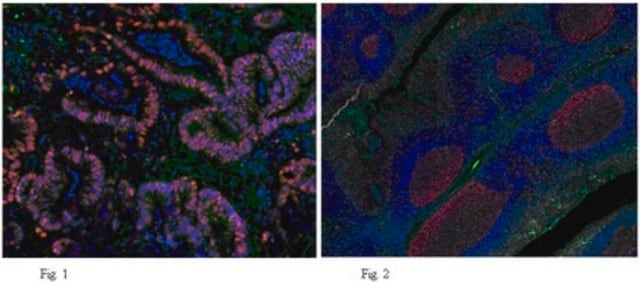
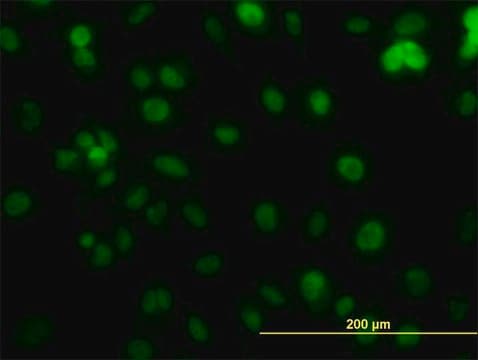
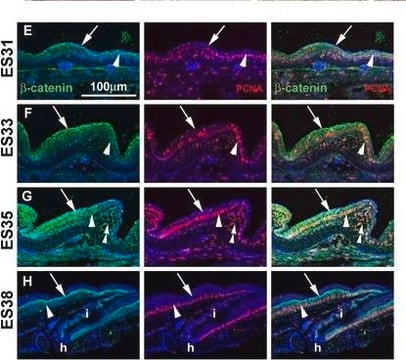
Recognizes the acidic, non-histone, auxiliary protein of DNA polymerase, PCNA, also known as polymerase delta accessory protein. Fixation duration can markedly affect the intensity of PCNA immunoreactivity. However, delay in fixation does not affect the immunoreactivity. Enzymatic treatment destroys staining. In immunocytochemical labeling of acetone-methanol, or methanol-fixed cells, the antibody shows granular staining throughout the nucleus (nucleolus and nucleoplasm). Specific staining is observed in proliferating cell nuclei, particularly in germinal centers, of a wide range of normal and malignant tissues.

Disclaimer

Unless otherwise stated in our catalog or other company documentation accompanying the product(s), our products are intended for research use only and are not to be used for any other purpose, which includes but is not limited to, unauthorized commercial uses, in vitro diagnostic uses, ex vivo or in vivo therapeutic uses or any type of consumption or application to humans or animals.

Ähnliche Artikel vergleichen

Vollständigen Vergleich anzeigen

Unterschiede anzeigen

1 of 1

Dieser Artikel
MABE288WH0005111M2CBL407
description

clone PC 10, ascites fluid

description

clone PC10, from mouse

description

clone 1G7, purified immunoglobulin, buffered aqueous solution

description

clone PC10, Chemicon®, from mouse

antibody form

ascites fluid

antibody form

purified immunoglobulin

antibody form

purified immunoglobulin

antibody form

purified antibody

clone

PC 10, monoclonal

clone

PC10, monoclonal

clone

1G7, monoclonal

clone

PC10, monoclonal

conjugate

unconjugated

conjugate

unconjugated

conjugate

unconjugated

conjugate

unconjugated

species reactivity

rat, mouse, human, monkey, insect, yeast

species reactivity

human

species reactivity

human

species reactivity

vertebrates, invertebrates

Gene Information

human ... PCNA(5111)

Gene Information

human ... PCNA(5111)

Gene Information

human ... PCNA(5111)

Gene Information

human ... PCNA(5111)

biological source

mouse

biological source

mouse

biological source

mouse

biological source

mouse


Still not finding the right product?

Probieren Sie unser Produkt-Auswahlhilfe, um Ihre Auswahl einzugrenzen


Lagerklasse

12 - Non Combustible Liquids

Was ist los?

nwg

Flammpunkt (°F)

Not applicable

Flammpunkt (°C)

Not applicable


Hier finden Sie alle aktuellen Versionen:

Analysenzertifikate (COA)

Lot/Batch Number

It looks like we've run into a problem, but you can still download Certificates of Analysis from our Dokumente section.

Wenn Sie Hilfe benötigen, wenden Sie sich bitte an Kundensupport

Besitzen Sie dieses Produkt bereits?

In der Dokumentenbibliothek finden Sie die Dokumentation zu den Produkten, die Sie kürzlich erworben haben.

Die Dokumentenbibliothek aufrufen


Questions

Reviews

No rating value

Active Filters