Direkt zum Inhalt
Merck

Fortfahren mit

G2404

Anti-Golgi FTCD antibody, clone 58k-9, Mouse monoclonal

ascites fluid

Synonym(e):

Anti-LCHC1

Anmelden zur Ansicht der Organisations- und Vertragspreise.

Größe auswählen

Ansicht ändern
Ihnen/SKUVerfügbarkeitPreis
100 μL
Warenkorb auf Verfügbarkeit prüfen
€ 453,00
0.2 mL
Warenkorb auf Verfügbarkeit prüfen
€ 648,00

Über diesen Artikel

UNSPSC Code:
12352203
NACRES:
NA.41
MDL number:
Conjugate:
unconjugated
Clone:
monoclonal
Application:
EM, IF, WB
Citations:
60

€ 453,00


Warenkorb auf Verfügbarkeit prüfen

Großbestellung anfragen
Technischer Dienst
Benötigen Sie Hilfe? Unser Team von erfahrenen Wissenschaftlern ist für Sie da.
Unterstützung erhalten


biological source

mouse

Quality Segment

conjugate

unconjugated

antibody form

ascites fluid

antibody product type

primary antibodies

clone

monoclonal

mol wt

antigen 58 kDa

contains

15 mM sodium azide

species reactivity

human, bovine, mouse, pig, canine, kangaroo rat, hamster, monkey, rat

technique(s)

electron microscopy: suitable, indirect immunofluorescence: 1:50 using cultured CHO cells, western blot: 1:5,000 using whole rat liver extract

isotype

IgG1

UniProt accession no.

shipped in

dry ice

storage temp.

−20°C

target post-translational modification

unmodified

Gene Information

human ... FTCD(10841)
mouse ... Ftcd(14317)
rat ... Ftcd(89833)

General description

FTCD is a homooctamer with its subunits arranged in a planar ring. It is predominantly expressed in the liver. Apart from being associated with the Golgi apparatus, it is detectable in the supernatant cytosolic fraction, and may also be localized to cytoplasmic vesicles.
Monoclonal Anti-Golgi 58K Protein/formiminotransferase cyclodeaminase (FTCD) (mouse IgG1 isotype) is derived from the 58K-9 hybridoma produced by the fusion of mouse myeloma cells and splenocytes from a mouse immunized with FTCD/Golgi 58K protein purified from rat liver.

Immunogen

Golgi 58K protein from rat liver.

Application

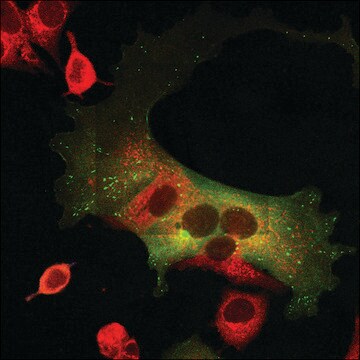
Anti-Golgi FTCD antibody, clone 58k-9, Mouse monoclonal has been used in western blot analysis and dual immunofluorescence staining.
Anti-Golgi FTCD antibody, clone 58k-9, Mouse monoclonal is suitable for electron microscopy, indirect immunofluorescence at a working dilution of 1:50 using cultured CHO cells and indirect immunoblotting at 1:5000 working dilution using whole rat liver extract. It is also useful for the localization of Golgi 58K protein using immunoblotting, dot blot, electron microscopy, and immunocytochemistry.
The antibody was used:


  • for the analysis of distribution of the 58K9 protein exclusively localized in the Golgi
  • as a primary antibody in the immunofluorescence analysis in studies related to functioning of nuclear envelope protein TMEM209 in lung carcinoma cells, tracking TG2 (Transglutaminase Type 2) transport in renal tubular epithelial cells, binding of TRADD (TNFR-associated death domain protein) to TNF-R1 at the plasma membrane and localization of Wilson disease protein in the Golgi apparatus
  • in immunoprecipitation studies
Applications in which this antibody has been used successfully, and the associated peer-reviewed papers, are given below.
Immunofluorescence (1 paper)
Western Blotting (1 paper)

Biochem/physiol Actions

FTCD/58K protein of the Golgi apparatus used in conjunction with other antibodies to Golgi proteins (e.g., the Golgi β-COP protein) may be used for studies on the role and relationships of this protein in the cell. It is also useful for localization studies following subcellular fractionation procedures.
Golgi 58K protein is associated with the Golgi apparatus peripherally and has been identified as a version of FTCD (Formiminotransferase Cyclodeaminase). It is a bifunctional metabolic enzyme involved in conversion of histidine to glutamic acid. It acts as a channel for the transport of one-carbon units from formiminoglutamate to the folate pool. It also interacts with vimentin subunits and with polymerized vimentin filaments. Autosomal recessive disorder glutamate formiminotransferase deficiency is caused by defects in FTCD.
The antibody recognizes an epitope located on the microtubule-binding peripheral Golgi membrane 58 kDa protein. It is also useful for studies on the effect of microtubule-perturbing agents on the Golgi apparatus.

Disclaimer

Unless otherwise stated in our catalog or other company documentation accompanying the product(s), our products are intended for research use only and are not to be used for any other purpose, which includes but is not limited to, unauthorized commercial uses, in vitro diagnostic uses, ex vivo or in vivo therapeutic uses or any type of consumption or application to humans or animals.

Ähnliche Artikel vergleichen

Vollständigen Vergleich anzeigen

Unterschiede anzeigen

1 of 1

Dieser Artikel
G3893C7082T2780
antibody form

ascites fluid

antibody form

ascites fluid

antibody form

ascites fluid

antibody form

ascites fluid

conjugate

unconjugated

conjugate

unconjugated

conjugate

unconjugated

conjugate

unconjugated

species reactivity

human, bovine, mouse, pig, canine, kangaroo rat, hamster, monkey, rat

species reactivity

rat, human, pig

species reactivity

human, chicken, canine, bovine

species reactivity

pig, chicken, bovine, rabbit, mouse, hamster, rat, human

Gene Information

human ... FTCD(10841)
mouse ... Ftcd(14317)
rat ... Ftcd(89833)

Gene Information

human ... GFAP(2670)
rat ... Gfap(24387)

Gene Information

human ... CTNNB1(1499)

Gene Information

bovine ... TPM1(281544)
chicken ... TPM1(396366)
human ... TPM1(7168)
mouse ... Tpm1(22003)
rat ... Tpm1(24851)

biological source

mouse

biological source

mouse

biological source

mouse

biological source

mouse

clone

monoclonal

clone

G-A-5, monoclonal

clone

6F9, monoclonal

clone

TM311, monoclonal


Still not finding the right product?

Probieren Sie unser Produkt-Auswahlhilfe, um Ihre Auswahl einzugrenzen


Lagerklasse

12 - Non Combustible Liquids

wgk

nwg

flash_point_f

Not applicable

flash_point_c

Not applicable


Hier finden Sie alle aktuellen Versionen:

Analysenzertifikate (COA)

Lot/Batch Number

It looks like we've run into a problem, but you can still download Certificates of Analysis from our Dokumente section.

Wenn Sie Hilfe benötigen, wenden Sie sich bitte an Kundensupport

Besitzen Sie dieses Produkt bereits?

In der Dokumentenbibliothek finden Sie die Dokumentation zu den Produkten, die Sie kürzlich erworben haben.

Die Dokumentenbibliothek aufrufen


Questions

Reviews

No rating value

Active Filters