Direkt zum Inhalt
Merck

Fortfahren mit

MABS1704

Anti-Potassium Channel Kir6.2 Antibody, clone 10C1.1

clone 10C1.1, from mouse

Synonym(e):

ATP-sensitive inward rectifier potassium channel 11, IKATP, Inward rectifier K(+) channel Kir6.2, Potassium channel, inwardly rectifying subfamily J member 11

Anmelden zur Ansicht der Organisations- und Vertragspreise.

Größe auswählen

Ansicht ändern
Ihnen/SKUVerfügbarkeitPreis

Über diesen Artikel

UNSPSC Code:
12352203
NACRES:
NA.41
eCl@ss:
32160702
Conjugate:
unconjugated
Clone:
10C1.1, monoclonal
Application:
WB
Citations:
-
Preise und Verfügbarkeit sind derzeit nicht verfügbar.
Technischer Dienst
Benötigen Sie Hilfe? Unser Team von erfahrenen Wissenschaftlern ist für Sie da.
Unterstützung erhalten


biological source

mouse

Quality Segment

conjugate

unconjugated

antibody form

purified immunoglobulin

antibody product type

primary antibodies

clone

10C1.1, monoclonal

species reactivity

human, rat

technique(s)

western blot: suitable

isotype

IgG1κ

NCBI accession no.

UniProt accession no.

target post-translational modification

unmodified

Gene Information

human ... KCNJ11(3767)

General description

ATP-sensitive inward rectifier potassium channel 11 (UniProt Q14654; also known as IKATP, Inward rectifier K(+) channel Kir6.2, Potassium channel, inwardly rectifying subfamily J member 11) is encoded by the KCNJ11 (also known as BIR, HHF2, MODY13, PNDM, TNDM3) gene (Gene ID 3767) in human. Inward rectifier K+ channels (Kirs) modulate cell membrane potential and are classified as K+ transport channels (Kir1.x, Kir4.x, Kir5.x, Kir7.x), classic Kir (Kir2.x), G-protein-gated Kirs (Kir2.x and Kir3.x), and ATP-sensitive Kirs (Kir6.x). Kirs mediate diverse physiological functions of both excitable and nonexcitable epithelial cells, such as cell adhesion-migration, volume regulation, apoptosis, and proliferation. ATP-sensitive potassium (K-ATP) channels are hetero-octamers composed of pore-forming Kir6.x (6.1 or 6.2) subunits and sulfonylurea receptor (SUR1 or SUR2) regulatory subunits. K-ATP channels are regulated by intracellular ATP and ADP concentrations and are highly expressed in cardiomyocytes, where they play crucial roles in ischemic preconditioning (IPC). Potassium channel openers mimic the cardioprotection, while K-ATP channel blocker or Kir6.2-knockout is shown to abolish the effect of IPC in mice. Human Kir6.2 is a 390-amino acid multi-pass membrane (a.a. 69-93, 117-128, 145-166) protein that contains two small extraceullar regions (a.a. 94-116 and 136-144) and a pore-forming domain (a.a. 117-128), having both its N- and C-terminal exposed intracellularly (a.a. 1-68 and a.a. 167-390).
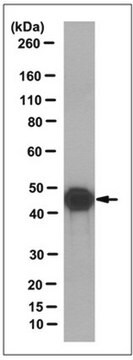
~45 kDa observed. 43.54 kDa (human) and 43.61 kDa (rat) calculated.

Immunogen

Epitope: N-terminal cytoplasmic domain.
KLH-conjugated linear peptide corresponding an N-terminal cytoplasmic domain sequence of human potassium channel Kir6.2.

Application

Research Category
Signaling
Research Sub Category
Ion Channels & Transporters
This Anti-Potassium Channel Kir6.2 Antibody, clone 10C1.1 is validated for use in Western Blotting for the detection of Potassium Channel Kir6.2.
Western Blotting Analysis: A 1:1000 dilution from a representative lot detected potassium channel Kir6.2 in 10 µg of rat pancreas tissue lysate.

Biochem/physiol Actions

Clone 10C1.1 targets human Kir6.2 N-terminal cytoplasmic region not present in the alternatively spliced isoform 2.

Physical form

Format: Purified
Protein G purified.
Purified mouse monoclonal IgG1κ antibody in buffer containing 0.1 M Tris-Glycine (pH 7.4), 150 mM NaCl with 0.05% sodium azide.

Preparation Note

Stable for 1 year at 2-8°C from date of receipt.

Analysis Note

Evaluated by Western Blotting in human pancreas tissue lysate.

Western Blotting Analysis: A 1:1000 dilution of this antibody detected potassium channel Kir6.2 in 10 µg of human pancreas tissue lysate.

Other Notes

Concentration: Please refer to lot specific datasheet.

Disclaimer

Unless otherwise stated in our catalog or other company documentation accompanying the product(s), our products are intended for research use only and are not to be used for any other purpose, which includes but is not limited to, unauthorized commercial uses, in vitro diagnostic uses, ex vivo or in vivo therapeutic uses or any type of consumption or application to humans or animals.

Ähnliche Artikel vergleichen

Vollständigen Vergleich anzeigen

Unterschiede anzeigen

1 of 1

Dieser Artikel
SAB4501635SAB4301579P0874
species reactivity

human, rat

species reactivity

mouse, human

species reactivity

human, mouse

species reactivity

rat

Gene Information

human ... KCNJ11(3767)

Gene Information

human ... KCNJ11(3767)

Gene Information

human ... KCNJ11(3767)

Gene Information

human ... KCNJ8(3764)
mouse ... Kcnj8(16523)
rat ... Kcnj8(25472)

conjugate

unconjugated

conjugate

unconjugated

conjugate

-

conjugate

unconjugated

biological source

mouse

biological source

rabbit

biological source

rabbit

biological source

rabbit

antibody form

purified immunoglobulin

antibody form

affinity isolated antibody

antibody form

affinity isolated antibody

antibody form

affinity isolated antibody

clone

10C1.1, monoclonal

clone

polyclonal

clone

polyclonal

clone

polyclonal


Still not finding the right product?

Probieren Sie unser Produkt-Auswahlhilfe, um Ihre Auswahl einzugrenzen


Lagerklasse

12 - Non Combustible Liquids

wgk

WGK 1

flash_point_f

Not applicable

flash_point_c

Not applicable


Analysenzertifikate (COA)

Suchen Sie nach Analysenzertifikate (COA), indem Sie die Lot-/Chargennummer des Produkts eingeben. Lot- und Chargennummern sind auf dem Produktetikett hinter den Wörtern ‘Lot’ oder ‘Batch’ (Lot oder Charge) zu finden.

Besitzen Sie dieses Produkt bereits?

In der Dokumentenbibliothek finden Sie die Dokumentation zu den Produkten, die Sie kürzlich erworben haben.

Die Dokumentenbibliothek aufrufen


Questions

Reviews

No rating value

Active Filters