Skip to Content
MilliporeSigma

Skip To

L8754

Lectin from Phaseolus vulgaris (red kidney bean)

Phytohemagglutinin PHA-P, lyophilized powder

Synonym(s):

Phaseolus vulgaris agglutinin, PHA

Sign In to View Organizational & Contract Pricing.

Select a Size

Change View
Size/SKUAvailabilityPrice

About This Item

UNSPSC Code:
12352202
EC Number:
232-718-7
NACRES:
NA.32
Form:
lyophilized powder
Biological source:
Phaseolus vulgaris
Pricing and availability is not currently available.
Technical Service
Need help? Our team of experienced scientists is here for you.
Let Us Assist


biological source

Phaseolus vulgaris

Quality Segment

form

lyophilized powder

potency

≤62.5 μg per mL agglutination activity, ≤10 μg/mL mitogenic activity

impurities

salt, free

storage temp.

2-8°C

General description

PHAs are carbohydrate-binding proteins. There are several types of PHAs identified, predominantly in leguminous plants.
Phytohaemagglutinin (PHA, or phytohemagglutinin) is a lectin found in plants (esp. in legumes). It is obtained from Phaseolus vulgaris (red kidney beans) and acts as a mitogen in human leucocyte culture.[1]

Application

It has also been used as an antigen to measure in vivo T-cell-mediated immune responsiveness.
Lectin from Phaseolus vulgaris (red kidney bean) has been used in phytohemagglutinin (PHA) assay[2] and during assessment of cellular and humoral immunity.[3]

Biochem/physiol Actions

PHA consists of two molecular species, an erythroagglutinin (PHA-E) which has low mitogenic activity and high erythroagglutinin activity, and leucoagglutinin (PHA-L) which has high mitogenic and leucoagglutinating activity, but very low erythroagglutinating activity.
PHA-E is not blood group specific, but agglutination can be inhibited by certain oligosaccharides. PHA-P is the protein form of PHA prior to separation and purification of erythroagglutinin and leucoagglutinin. PHA-M is the mucoprotein form. Conjugates are prepared from the corresponding purified lectins.

Analysis Note

Agglutination activity is expressed in mg/ml and is determined from serial dilutions of a 1 mg/ml solution. This activity is the lowest concentration to agglutinate a suspension of 2% human erythrocytes in phosphate buffered saline, pH 6.8, after 1 hr incubation at 25 °C. Mitogenic activity is determined by BrdU incorporation in HeLa cell cultures.

Compare Similar Items

View Full Comparison

Show Differences

1 of 1

This Item
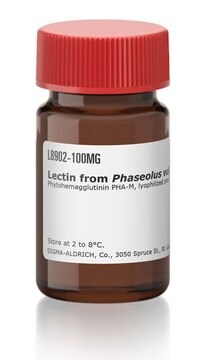
L2769L8902L4144
biological source

Phaseolus vulgaris

biological source

Phaseolus vulgaris

biological source

-

biological source

-

form

lyophilized powder

form

lyophilized powder

form

lyophilized powder

form

lyophilized powder

storage temp.

2-8°C

storage temp.

2-8°C

storage temp.

2-8°C

storage temp.

2-8°C

impurities

salt, free

impurities

salt, free

impurities

salt, free

impurities

salt, free

Quality Level

300

Quality Level

200

Quality Level

200

Quality Level

200

potency

≤62.5 μg per mL agglutination activity, ≤10 μg/mL mitogenic activity

potency

erythroagglutination activity (Does not agglutinate a 2% suspension of human erythrocytes at <62.5 μg lectin/ml.), ≤1.0 μg/mL leucoagglutination activity, ≤5 μg/mL mitogenic activity

potency

<40 μg per mL agglutination activity

potency

erythroagglutination activity (Does not agglutinate a 2% suspension of human erythrocytes at 250 μg lectin/ml.), ≤1.0 μg per mL leucoagglutination activity, ≤5 μg per mL mitogenic activity (Bromdeoxyuridine incorporation in human peripheral blood mononuclear cells)


Still not finding the right product?


Storage Class

11 - Combustible Solids

wgk

WGK 3

flash_point_f

Not applicable

flash_point_c

Not applicable


Choose from one of the most recent versions:

Certificates of Analysis (COA)

Lot/Batch Number

It looks like we've run into a problem, but you can still download Certificates of Analysis from our Documents section.

If you need assistance, please contact Customer Support

Already Own This Product?

Find documentation for the products that you have recently purchased in the Document Library.

Visit the Document Library


Questions

  1. What do the designations -P, -L, -M, and -E represent in the names of PHA products?

    1 answer
    1. Generally, PHA-P or PHA-L is utilized to stimulate lymphocytes, although PHA-M will also work, but not to the same degree. The most active form is PHA-L (the mitogenic concentration is < 5μg/ml). PHA, or Phytohemagglutinin, comprises two molecular species:

      1. Erythroagglutinin (PHA-E), which demonstrates low mitogenic activity and high erythroagglutinating activity.

      2. Leucoagglutinin (PHA-L), which possesses high mitogenic and leucoagglutinating activity, accompanied by very low erythroagglutinating activity.

      PHA-P represents the protein form of PHA before the erythroagglutinin and leucoagglutinin components are separated and purified. PHA-M refers to the mucoprotein form of Phytohemagglutinin.

      Helpful?

Reviews

No rating value

Active Filters