Skip to Content
MilliporeSigma

SAE0193

Exosome standards, fluorescent

recombinant, expressed in human cells

Synonym(s):

Extracellular vesicles (EVs), Intraluminal vesicles (ILVs), Microvesicles, exosome-like vesicles

Sign In to View Organizational & Contract Pricing.

Select a Size

1 VIAL

$277.00

$277.00


Please contact Customer Service for Availability


About This Item

NACRES:
NA.24
UNSPSC Code:
41116100

Skip To

Technical Service
Need help? Our team of experienced scientists is here for you.
Let Us Assist

Product Name

Exosome standards, fluorescent, recombinant, expressed in human cells

recombinant

expressed in human cells

assay

≥70% (fluorimetric)

form

solid

shipped in

dry ice

storage temp.

−70°C

Quality Level

Compare Similar Items

View Full Comparison

Show Differences

1 of 4

This Item
SBVT27SBVT12CEP-500
form

solid

form

liquid

form

liquid

form

-

recombinant

expressed in human cells

recombinant

expressed in HEK 293 cells

recombinant

expressed in baculovirus infected Sf9 cells

recombinant

-

assay

≥70% (fluorimetric)

assay

-

assay

-

assay

-

shipped in

dry ice

shipped in

dry ice

shipped in

dry ice

shipped in

-

storage temp.

−70°C

storage temp.

−70°C

storage temp.

−70°C

storage temp.

-

Quality Level

200

Quality Level

-

Quality Level

-

Quality Level

100

Biochem/physiol Actions

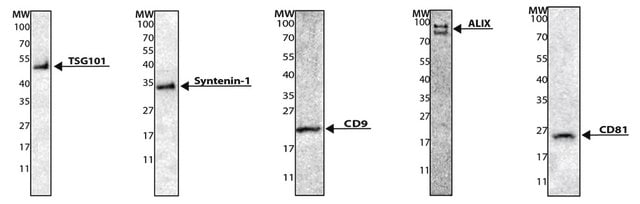
Extracellular vesicles (Evs) are populations of cell-secreted membranous structures typically 30–150 nm in diameter.
In multicellular organisms, Evs are found in biological fluids and body tissues and involved in different physiological processes. They are also released to growth medium by cultured cells.

Evs carry markers of their cells of origin. Therefore there is a growing interest in clinical applications of EVs as biomarkers and therapies alike.

General description

These recombinant EV express green fluorescent protein (GFP) on their membrane surface, making them fluorescent. Their fluorescence enables sensitive and differential trackability and thus allowing them to be used as a biological reference material, to be implemented in EV separation methods and measurement instruments. These recombinant EV share equivalent physicochemical and biochemical properties to sample EV. They may be used for quality control, data normalization, method development and accurate calibration of optical and nonoptical EV measurement.

Other Notes

Vial content: >= 1 x 10e9 particles

Storage Class

11 - Combustible Solids

wgk

WGK 1


Choose from one of the most recent versions:

Certificates of Analysis (COA)

Lot/Batch Number

Don't see the Right Version?

If you require a particular version, you can look up a specific certificate by the Lot or Batch number.

Already Own This Product?

Find documentation for the products that you have recently purchased in the Document Library.

Visit the Document Library

Questions

1–4 of 4 Questions  
  1. What is the purity of the samples? Are there any lipid particle contaminants? (any particles with phosphatidylserine besides the EV's themselves) - was FBS used in the medium culture of the cell line?

    1 answer
    1. For Product No. SAE0193, Exosome Standards, the purity can be found on the Certificate of Analysis as % Fluorescence. Unfortunately, this product is not tested for impurities. The initial growth medium of HEK293T cells contains FBS, but in the next stages, it changes to a medium without FBS.

      Please navigate to the DOCUMENTATION section of the Product Detail Page to access a Certificate under ‘Certificate of Analysis’:https://www.sigmaaldrich.com/product/sigma/sae0193#product-documentation

      Helpful?

  2. How is the GFP expressed at the exosomes' surface?

    1 answer
    1. The mechanism of expression of GFP at the exosome surface is currently not available. The public data sheet describes that the exosomes express the fluorescent protein GFP on the surface of their membrane, to allow their detection by instruments equipped with green fluorescence detectors, e.g. 488 nm laser. Please see the link below to review the product datasheet:

      https://www.sigmaaldrich.com/deepweb/assets/sigmaaldrich/product/documents/351/804/sae0193pis-ms.pdf

      In addition, the following references may also be of interest:

      Extracellular vesicles: exosomes, microparticles, their parts, and their targets to enable their biomanufacturing and clinical applications
      https://www.sciencedirect.com/science/article/pii/S095816691830140X?via%3Dihub

      Shedding light on the cell biology of extracellular vesicles
      https://pubmed.ncbi.nlm.nih.gov/29339798/

      The biology and function of exosomes in cancer
      https://www.ncbi.nlm.nih.gov/pmc/articles/PMC4811149/

      EV-TRACK: transparent reporting and centralizing knowledge in extracellular vesicle research
      https://www.nature.com/articles/nmeth.4185

      The generation and use of recombinant extracellular vesicles as biological reference material
      https://www.nature.com/articles/s41467-019-11182-0

      Helpful?

  3. How is the particle number measured and is there any reference we can look into?

    1 answer
    1. The size distribution of recombinant exosomes are measured by nanoparticle tracking analysis. Please see the product data sheet: https://www.sigmaaldrich.com/deepweb/assets/sigmaaldrich/product/documents/351/804/sae0193pis-ms.pdf

      Helpful?

  4. Hello ! How long do you think this product (powder) can hold at -20°C ? Will it last for a month or a week ? Thanks !

    1 answer
    1. We have no information regarding stability at -20deg C. We know that working solutions can be stored at 2-4 deg C for one day.

      Helpful?

Reviews

No rating value

Active Filters

Our team of scientists has experience in all areas of research including Life Science, Material Science, Chemical Synthesis, Chromatography, Analytical and many others.

Contact Technical Service