
911798

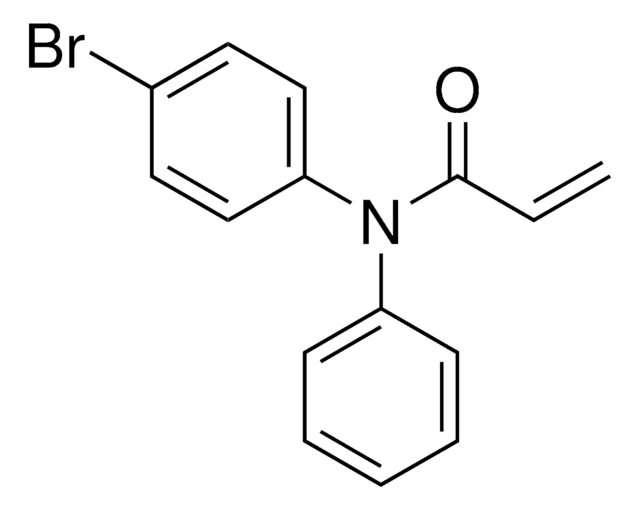
N-(4-Bromophenyl)-N-phenylacrylamide
≥95%
Synonym(s):
Electrophilic scout fragment, KB05, Scout fragment for targetable cysteine
Sign In to View Organizational & Contract Pricing.
Select a Size
Change View
| Pack Size | SKU | Availability | Price |
|---|---|---|---|
| 100 mg | Check Cart for Availability | $352.00 |
About This Item
Empirical Formula (Hill Notation):
C15H12BrNO
CAS Number:
Molecular Weight:
302.17
MDL number:
UNSPSC Code:
12352200
NACRES:
NA.22
Assay:
≥95%
Form:
(Powder or crystals or solid or chunks)
Quality Level
assay
≥95%
form
(Powder or crystals or solid or chunks)
storage temp.
2-8°C
SMILES string
Brc1ccc(cc1)N(c2ccccc2)C(=O)C=C
InChI
1S/C15H12BrNO/c1-2-15(18)17(13-6-4-3-5-7-13)14-10-8-12(16)9-11-14/h2-11H,1H2
InChI key
WFQQVUPOAKOTGT-UHFFFAOYSA-N
Related Categories
1 of 1
This Item | |||
|---|---|---|---|
| assay ≥95% | assay - | assay ≥97% (HPLC) | assay - |
| Quality Level 100 | Quality Level 100 | Quality Level 200 | Quality Level 200 |
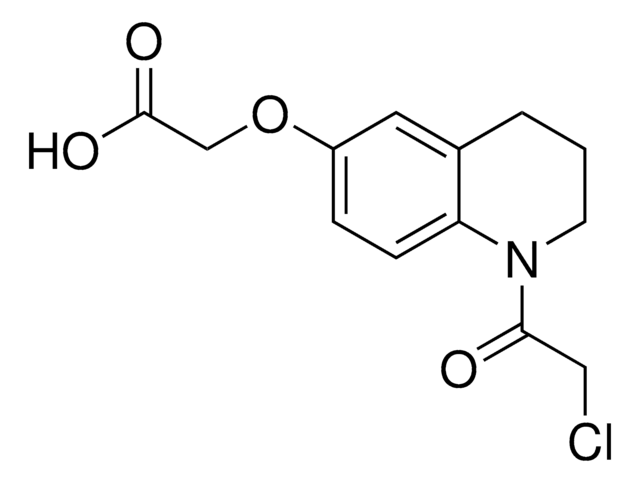
| storage temp. 2-8°C | storage temp. 2-8°C | storage temp. −20°C | storage temp. −20°C |
| form (Powder or crystals or solid or chunks) | form - | form powder | form buffered aqueous solution |

Application
N-(4-Bromophenyl)-N-phenylacrylamide is a cysteine-reactive small-molecule fragment for chemoproteomic and ligandability studies for both traditionally druggable proteins as well as ″undruggable,″ or difficult-to-target, proteins. This fragment electrophile, or ″scout″ fragment, can be used alone in fragment-based covalent ligand discovery or incorporated into bifunctional tools such as electrophilic PROTAC® molecules for targeted protein degradation as demonstrated by the Cravatt Lab for E3 ligase discovery.
Other Notes
Legal Information
PROTAC is a registered trademark of Arvinas Operations, Inc., and is used under license
related product
Product No.
Description
Pricing
Storage Class
11 - Combustible Solids
wgk
WGK 3
Choose from one of the most recent versions:
Already Own This Product?
Find documentation for the products that you have recently purchased in the Document Library.
Xiaoyu Zhang et al.
Nature chemical biology, 15(7), 737-746 (2019-06-19)
Ligand-dependent protein degradation has emerged as a compelling strategy to pharmacologically control the protein content of cells. So far, however, only a limited number of E3 ligases have been found to support this process. Here, we use a chemical proteomic
Keriann M Backus et al.
Nature, 534(7608), 570-574 (2016-06-17)
Small molecules are powerful tools for investigating protein function and can serve as leads for new therapeutics. Most human proteins, however, lack small-molecule ligands, and entire protein classes are considered 'undruggable'. Fragment-based ligand discovery can identify small-molecule probes for proteins
Global Trade Item Number
| SKU | GTIN |
|---|---|
| 911798-100MG | 04061841712022 |
Active Filters
Our team of scientists has experience in all areas of research including Life Science, Material Science, Chemical Synthesis, Chromatography, Analytical and many others.
Contact Technical Service