
8.09692

o-Cresol
for synthesis
Synonym(s):
o-Cresol, 2-Hydroxytoluene, 2-Methylphenol
Select a Size
About This Item
Skip To
Product Name
o-Cresol, for synthesis
SMILES string
Oc1c(cccc1)C
InChI
1S/C7H8O/c1-6-4-2-3-5-7(6)8/h2-5,8H,1H3
InChI key
QWVGKYWNOKOFNN-UHFFFAOYSA-N
grade
synthesis grade
vapor pressure
0.24 hPa ( 20 °C)
assay
≥99% (GC)
form
solid
autoignition temp.
555 °C
potency
121 mg/kg LD50, oral (Rat)
890 mg/kg LD50, skin (Rabbit)
expl. lim.
1.3 % (v/v)
dilution
(for synthesis)
pH
4.8 (20 °C, 20 g/L in H2O)
bp
191-192 °C/1013 hPa
mp
31 °C
transition temp
flash point 81 °C
solubility
20 g/L
density
1.046 g/cm3 at 20 °C
storage temp.
no temp limit
Quality Level
1 of 4
This Item | 8.05223 | 8.02295 | C85700 |
|---|---|---|---|
| assay ≥99% (GC) | assay ≥98.0% (GC) | assay ≥99.0% (GC) | assay ≥99% |
| Quality Level 200 | Quality Level 200 | Quality Level 200 | Quality Level 100 |
| solubility 20 g/L | solubility - | solubility 3.9 g/L | solubility - |
| form solid | form solid | form powder | form solid or liquid |
| expl. lim. 1.3 % (v/v) | expl. lim. 1 % (v/v) | expl. lim. - | expl. lim. 1.47 %, 148 °F |
| pH 4.8 (20 °C, 20 g/L in H2O) | pH - | pH 6.5 (20 °C, 1 g/L in H2O) | pH 4.5 (25 g/L) |

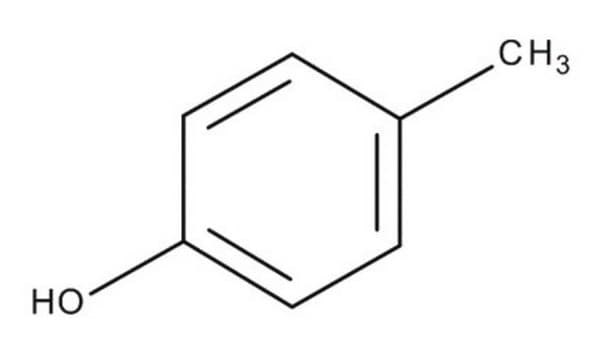


Analysis Note
Melting range (lower value): ≥ 29 °C
Melting range (upper value): ≤ 33 °C
Water (K. F.): ≤ 0.10 %
Identity (IR): passes test
Due to its specific melting range the product may be solid, liquid, a solidified melt or a supercooled melt.
Application
- Carvacrol by alkylation reaction with propylene or isopropyl alcohol in the presence of Zr/mesoporous silica as a catalyst.[1]
- Polyisobutylenes by selective cationic polymerization of isobutylene using AlCl3 as a catalyst.[2]
- Poly(o-cresol) via oxidative coupling polymerization reaction in the presence of substituted pyridine/CuCl catalysts.[3]


signalword
Danger
hcodes
Hazard Classifications
Acute Tox. 3 Dermal - Acute Tox. 3 Oral - Aquatic Chronic 3 - Eye Dam. 1 - Skin Corr. 1B
Storage Class
6.1A - Combustible acute toxic Cat. 1 and 2 / very toxic hazardous materials
wgk
WGK 2
flash_point_f
177.8 °F - closed cup
flash_point_c
81.0 °C - closed cup
Certificates of Analysis (COA)
Search for Certificates of Analysis (COA) by entering the products Lot/Batch Number. Lot and Batch Numbers can be found on a product’s label following the words ‘Lot’ or ‘Batch’.
Already Own This Product?
Find documentation for the products that you have recently purchased in the Document Library.
Active Filters
Our team of scientists has experience in all areas of research including Life Science, Material Science, Chemical Synthesis, Chromatography, Analytical and many others.
Contact Technical Service