Accéder au contenu
Merck

C6624

Carbonic Anhydrase II human

recombinant, expressed in E. coli, buffered aqueous solution

Synonyme(s) :

CA-II, CA2, Carbonic Anhydrase 2

Se connecter pour consulter les tarifs organisationnels et contractuels.

Sélectionner une taille de conditionnement

Changer de vue

A propos de cet article

UNSPSC Code:
12352204
NACRES:
NA.54
Numéro CE :
MDL number:
Specific activity:
≥5,000 units/mg protein
Recombinant:
expressed in E. coli
Concentration:
800-1000 μg/mL
Service technique
Besoin d'aide ? Notre équipe de scientifiques expérimentés est là pour vous.
Laissez-nous vous aider


recombinant

expressed in E. coli

Quality Segment

form

buffered aqueous solution

specific activity

≥5,000 units/mg protein

mol wt

large subunit 17-22 kDa, small subunit 10-12 kDa

concentration

800-1000 μg/mL

NCBI accession no.

shipped in

wet ice

storage temp.

−20°C

Gene Information

human ... CA2(760)

Application

Human carbonic anhydrase II has been used in a study to assess quantitative imaging of mitochondrial and cytosolic free zinc levels in an in vitro model of ischemia/reperfusion. Human carbonic anhydrase II has also been used in a study to investigate a new scrubber concept for catalytic CO2 hydration.

Biochem/physiol Actions

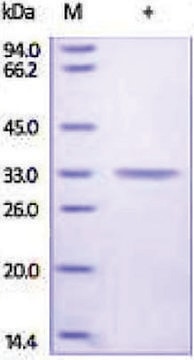
Carbonic anhydrase is a zinc metalloenzyme that catalyzes the hydration of carbon dioxide to carbonic acid. It is involved in vital physiological and pathological processes such as pH and CO2 homeostasis, transport of bicarbonate and CO2, biosynthetic reactions, bone resorption, calcification, and tumorigenicity. It is required for renal acidification. Its absence can lead to osteoporosis, renal tubular acidosis, and cerebral calcification. Therefore, this enzyme is an important target for inhibitors with clinical applications in glaucoma, epilepsy and Parkinson′s disease. In addition, it is being explored as a potential target for obesity and cancer. CAII has a molecular mass of approximately 30 kDa and is primarily present in type II pneumocytes. Due to this unique location it has been speculated that CAII is involved in pulmonary functions such as regulation of fluid secretion and facilitation of CO2 elimation. Sulfonamides, sulfamates and sulfamides are potent inhibitors of CA.

Physical form

Supplied as a solution in 20 mM Tris, pH 7.5, with 150 mM NaCl.

Other Notes

One Wilbur-Anderson (W-A) unit will cause the pH of a 0.02 M Trizma buffer to drop from 8.3 to 6.3 per min at 0 °C. (One W-A unit is essentially equivalent to one Roughton-Booth unit.)


Classe de stockage

10 - Combustible liquids


Faites votre choix parmi les versions les plus récentes :

Certificats d'analyse (COA)

Lot/Batch Number

It looks like we've run into a problem, but you can still download Certificates of Analysis from our Documents section.

Si vous avez besoin d'assistance, veuillez contacter Service Clients

Déjà en possession de ce produit ?

Retrouvez la documentation relative aux produits que vous avez récemment achetés dans la Bibliothèque de documents.

Consulter la Bibliothèque de documents