
F1308

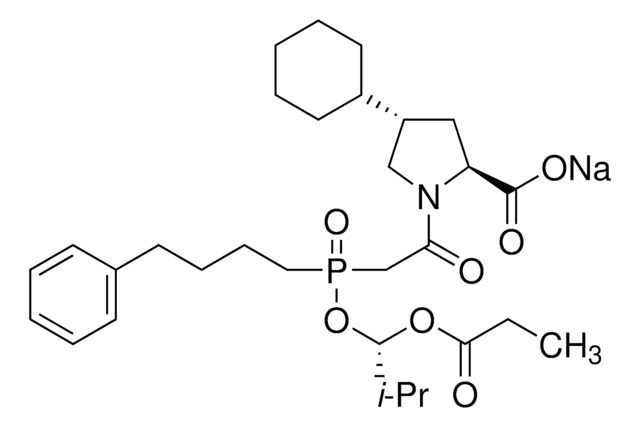
Fosinopril sodium
≥98% (HPLC), powder
Synonym(s):
(2S,4S)-4-Cyclohexyl-1-(2-{[2-methyl-1-(propanoyloxy)propoxy](4-phenylbutyl)phosphoryl}acetyl)pyrrolidine-2-carboxylic acid, Acecor, Eosinopril, Fosinopril, Monopril, SQ 28555, Secorvas, Staril
Select a Size
| Size/SKU | Availability | Price |
|---|
About This Item
Quality Segment
assay
≥98% (HPLC)
form
powder
storage condition
desiccated
color
white to off-white
solubility
H2O: >20 mg/mL
originator
Bristol-Myers Squibb
storage temp.
−20°C
SMILES string
O=C([O-])[C@H]1N(C(CP(CCCCC2=CC=CC=C2)(O[C@@H](C(C)C)OC(CC)=O)=O)=O)C[C@H](C3CCCCC3)C1.[Na+]
InChI
1S/C30H46NO7P.Na/c1-4-28(33)37-30(22(2)3)38-39(36,18-12-11-15-23-13-7-5-8-14-23)21-27(32)31-20-25(19-26(31)29(34)35)24-16-9-6-10-17-24;/h5,7-8,13-14,22,24-26,30H,4,6,9-12,15-21H2,1-3H3,(H,34,35);/q;+1/p-1/t25-,26+,30+,39?;/m1./s1
InChI key
TVTJZMHAIQQZTL-TXDYNIFHSA-M
General description
Biochem/physiol Actions
Features and Benefits
1 of 1
This Item | |||
|---|---|---|---|
| description ≥98% (HPLC), powder | description United States Pharmacopeia (USP) Reference Standard | description European Pharmacopoeia (EP) Reference Standard | description British Pharmacopoeia (BP) Reference Standard |
| form powder | form - | form - | form solid |
| assay ≥98% (HPLC) | assay - | assay - | assay - |
| Quality Level 100 | Quality Level - | Quality Level - | Quality Level - |
| storage temp. −20°C | storage temp. 2-8°C | storage temp. 2-8°C | storage temp. 2-8°C |
| solubility H2O: >20 mg/mL | solubility - | solubility - | solubility - |
| storage condition desiccated | storage condition - | storage condition - | storage condition - |
Still not finding the right product?
Explore all of our products under Fosinopril sodium


signalword
Warning
hcodes
Hazard Classifications
Eye Irrit. 2 - Repr. 2
Storage Class
11 - Combustible Solids
wgk
WGK 3
flash_point_f
Not applicable
flash_point_c
Not applicable
Choose from one of the most recent versions:
Already Own This Product?
Find documentation for the products that you have recently purchased in the Document Library.