


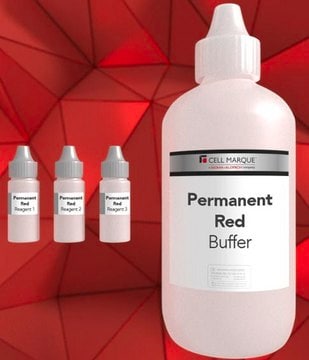


This product has not been tested specifically for use in staining elastin. However, Congo Red has historically been cited in the literature as being a suitable stain. Please see the following links to review publications that may be of interest:
https://pubmed.ncbi.nlm.nih.gov/2471435/
https://pmc.ncbi.nlm.nih.gov/articles/PMC6331669/
1.01641

Congo Red staining kit
suitable for detection, according to Highman
Sign In to View Organizational & Contract Pricing.
Select a Size
Change View
| Size/SKU | Availability | Price |
|---|
About This Item
NACRES:
NA.41
UNSPSC Code:
41116124
Pricing and availability is not currently available.
feature
according to Highman
Quality Segment
IVD
for in vitro diagnostic use
dilution
(for human-medical cell diagnosis)
application(s)
clinical testing
diagnostic assay manufacturing
hematology
histology, detection
storage temp.
15-25°C
General description
The Congo Red staining kit - Kit for the detection of amyloid acc. to Highman, is used for human-medical cell diagnosis and serves the purpose of the histological investigation of sample material of human origin for example histological sections of e. g. the kidney, the intestine, or the liver.
This Congo red staining kit contains all the reagents necessary for staining amyloid in histological tissues. Amyloid is a homogenous structure made up of protein fibrils (each between 8 and 15 nm in diameter) that can be stained eosinophilically, which e. g. in the case of amyloidosis forms deposits in the intercellular space. All deposits of amyloid contain similar protein fibrils that are resistant to the body′s natural defence mechanisms and that once they have formed cannot be eliminated.The Congo red staining principle is based on the formation of hydrogen bridge bonds with the carbohydrate component of the substrate. Congo red is an anionic dye and is capable of depositing itself in amyloid fibrils, which then exhibit a conspicuous dichroism under polarized light. The tissue stained with Congo red appears orange-red under the transmitted-light microscope; under polarized light, however, the amyloid deposits show up as brilliant green double-refraction images against a dark background. Other structures also stained by Congo red, e. g. collagen, however are not visualized under polarized light. Staining may be technically difficult when the paraffin sections used are too thin (<5 μm) or when the tissue is too strongly over-stained.
The kit is sufficient for up to 50 applications. This product is registered as IVD and CE marked. For more details, please see instructions for use (IFU). The IFU can be downloaded from this webpage.
This Congo red staining kit contains all the reagents necessary for staining amyloid in histological tissues. Amyloid is a homogenous structure made up of protein fibrils (each between 8 and 15 nm in diameter) that can be stained eosinophilically, which e. g. in the case of amyloidosis forms deposits in the intercellular space. All deposits of amyloid contain similar protein fibrils that are resistant to the body′s natural defence mechanisms and that once they have formed cannot be eliminated.The Congo red staining principle is based on the formation of hydrogen bridge bonds with the carbohydrate component of the substrate. Congo red is an anionic dye and is capable of depositing itself in amyloid fibrils, which then exhibit a conspicuous dichroism under polarized light. The tissue stained with Congo red appears orange-red under the transmitted-light microscope; under polarized light, however, the amyloid deposits show up as brilliant green double-refraction images against a dark background. Other structures also stained by Congo red, e. g. collagen, however are not visualized under polarized light. Staining may be technically difficult when the paraffin sections used are too thin (<5 μm) or when the tissue is too strongly over-stained.
The kit is sufficient for up to 50 applications. This product is registered as IVD and CE marked. For more details, please see instructions for use (IFU). The IFU can be downloaded from this webpage.
Application
Kit for the detection of amyloid acc. to Highman
Analysis Note
Suitability for microscopypasses testAmyloidpink to red; in polarized ligt green metachromasisNucleidark blueConnective tissuelight red
1 of 1
This Item | |||
|---|---|---|---|
| description suitable for detection, according to Highman | description for the microscopic investigation of acid-fast bacteria (cold staining) | description Reagents & materials supplied in the Blood Vessel Staining Kit are sufficient for staining 100 tissue sections & when stored at 2-8ºC is stable up to the expiration date. | description - |
| application(s) clinical testing | application(s) clinical testing | application(s) - | application(s) - |
| Quality Level 400 | Quality Level 400 | Quality Level 100 | Quality Level 500 |
| feature according to Highman | feature - | feature - | feature - |
| IVD for in vitro diagnostic use | IVD for in vitro diagnostic use | IVD - | IVD - |
| dilution (for human-medical cell diagnosis) | dilution - | dilution - | dilution - |
| storage temp. 15-25°C | storage temp. 15-25°C | storage temp. - | storage temp. 2-8°C |
signalword
Danger
hcodes
Hazard Classifications
Carc. 1B - Eye Irrit. 2 - Flam. Liq. 2 - Met. Corr. 1 - Skin Irrit. 2
Storage Class
3 - Flammable liquids
Choose from one of the most recent versions:
Already Own This Product?
Find documentation for the products that you have recently purchased in the Document Library.
-
Hello, can we use this product to detect the presence of elastine in a skin ? Such as a colored indicator no for pH value, but for the presence of elastine into the skin. Thank you
1 answer-
Helpful?
-