
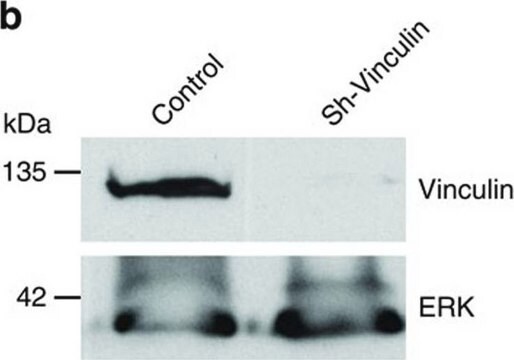


There are no available papers that cite using clone VIN-11-5 with Drosophila vinculin. The specific epitope for this antibody has not been mapped. However, there is a paper that maps the epitope binding area of this antibody clone - JBC 266, 8734-8740. 1991, Fusun Kilic, et al. --> "Hence the epitope lies between cysteines 545 and 737." Please see the link below to review this publication:
https://www.sciencedirect.com/science/article/pii/S0021925818315072?via%3Dihub
V4505

Anti-Vinculin Antibody
mouse monoclonal, VIN-11-5
Sinónimos:
Vinculin Antibody Sigma, Anti-VCL
Iniciar sesión para ver los precios por organización y contrato.
Seleccione un Tamaño
Cambiar Vistas
| A ustedes/SKU | Disponibilidad | Precio |
|---|---|---|
100 μL | Comprobar disponibilidad del carrito | $437.00 |
0.2 mL | Disponible para enviar HOYdesdeMILWAUKEE | $650.00 |
Acerca de este artículo
Conjugate:
unconjugated
Clone:
VIN-11-5, monoclonal
Application:
ARR, IF, WB
Citations:
318
$437.00
Comprobar disponibilidad del carrito
Está disponible un anticuerpo recombinante y sin conservantes para su diana. Pruebe ZMS1086
Servicio técnico
¿Necesita ayuda? Nuestro equipo de científicos experimentados está aquí para ayudarle.
Permítanos ayudarleNombre del producto
Monoclonal Anti-Vinculin antibody produced in mouse, clone VIN-11-5, ascites fluid
biological source
mouse
Quality Segment
conjugate
unconjugated
antibody form
ascites fluid
antibody product type
primary antibodies
clone
VIN-11-5, monoclonal
mol wt
antigen 116 kDa
species reactivity
bovine, human, chicken, mouse
technique(s)
indirect immunofluorescence: 1:50 using cultured chicken fibroblasts, microarray: suitable, western blot: suitable
isotype
IgG1
UniProt accession no.
application(s)
research pathology
shipped in
dry ice
storage temp.
−20°C
target post-translational modification
unmodified
Gene Information
human ... VCL(7414)
mouse ... Vcl(22330)
General description
Monoclonal Anti-Vinculin (mouse IgG1 isotype) is derived from the hybridoma produced by the fusion of mouse myeloma cells and splenocytes from an immunized mouse.
The vinculin (VCL) gene containing 22 exons is mapped to human chromosome 10q22.1-q23. The gene codes for a 117kDa cytoskeletal protein present in adherens type cell junctions. VCL is a ubiquitously expressed cell-adhesion protein. The protein is characterized with a globular head and a tail domain, which are interconnected by a short proline-rich sequence, an intramolecular interaction between the head and tail conceal many ligand-binding sites in the protein.
Immunogen
smooth muscle vinculin from chicken gizzard.
Application
Monoclonal Anti-Vinculin antibody produced in mouse has been used in:
- western blotting.
- immunofluorescence.[1]
- immunocytochemistry.
Biochem/physiol Actions
The antibody reacts best with cultured chicken fibroblasts. Labeling also may be obtained with bovine, human, or mouse cells.
Vinculin (VCL) is a cytoskeletal protein, which plays a vital role in regulation of cell-to-cell and cell to matrix junctions. VCL facilitates normal embryonic development and cardiac function. Aberration or mutation of the gene leads to cardiomyopathy. VCL also plays a crucial role in cell migration and morphogenesis. VCL might facilitate the binding of integrins and cadherins to the actin cytoskeleton. Vinculin plays an important role in integrin αIIbβ3 signaling and function, which is required for platelet aggregation.
Vinculin is suggested to be a possible link between ends of the bundles of actin filaments and the plasma membrane. It has also been proposed that vinculin may be involved in the transmembrane induction of actin bundle formation.
Other Notes
This product can be found as purified product that was produced using cell culture hybridoma product.
SAB4200729 Anti-Vinculin antibody, Mouse monoclonal
clone VIN-11-5, purified from hybridoma cell culture
SAB4200729 Anti-Vinculin antibody, Mouse monoclonal
clone VIN-11-5, purified from hybridoma cell culture
Disclaimer
Unless otherwise stated in our catalog or other company documentation accompanying the product(s), our products are intended for research use only and are not to be used for any other purpose, which includes but is not limited to, unauthorized commercial uses, in vitro diagnostic uses, ex vivo or in vivo therapeutic uses or any type of consumption or application to humans or animals.
1 of 1
Este artículo | |||
|---|---|---|---|
| conjugate unconjugated | conjugate unconjugated | conjugate unconjugated | conjugate - |
| species reactivity bovine, human, chicken, mouse | species reactivity frog, chicken, mouse, canine, human, bovine, rat, turkey | species reactivity frog, chicken, mouse, canine, human, bovine, rat, turkey | species reactivity human, monkey, rat, mouse, guinea pig, bovine, hamster, chicken, dog |
| clone VIN-11-5, monoclonal | clone hVIN-1, monoclonal | clone hVIN-1, monoclonal | clone VIN-11-5, monoclonal |
| Gene Information human ... VCL(7414) | Gene Information human ... VCL(7414) | Gene Information human ... VCL(7414) | Gene Information mouse ... Vcl(22330) |
| biological source mouse | biological source mouse | biological source mouse | biological source mouse |
| antibody form ascites fluid | antibody form ascites fluid | antibody form purified immunoglobulin | antibody form purified from hybridoma cell culture |
Still not finding the right product?
Explore all of our products under Monoclonal Anti-Vinculin antibody produced in mouse
— o —
Pruebe nuestra Herramienta de selección de productos para limitar sus opciones
Clase de almacenamiento
13 - Non Combustible Solids
wgk
WGK 1
flash_point_f
Not applicable
flash_point_c
Not applicable
Elija entre una de las versiones más recientes:
¿Ya tiene este producto?
Encuentre la documentación para los productos que ha comprado recientemente en la Biblioteca de documentos.
-
Hello! Has it been published or predicted if this antibody will react with Drosophila vinculin? Or, could you provide where in the human vinculin this antibody interacts?
1 answer-
Helpful?
-