
MBD0047

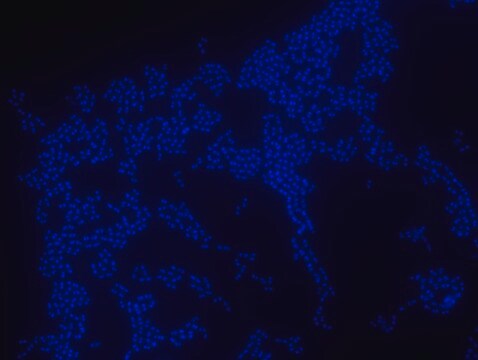
Enterococcus faecium FISH probe – ATTO 488
Probe for fluorescence in situ hybridization (FISH), 20µM in water
Iniciar sesión para ver los precios por organización y contrato.
Seleccione un Tamaño
Cambiar Vistas
| Talla/SKU | Disponibilidad | Precio |
|---|
Acerca de este artículo
NACRES:
NA.54
UNSPSC Code:
41105500
En este momento no podemos mostrarle ni los precios ni la disponibilidad
Servicio técnico
¿Necesita ayuda? Nuestro equipo de científicos experimentados está aquí para ayudarle.
Permítanos ayudarleQuality Segment
technique(s)
FISH: suitable
fluorescence
λex 504 nm; λem 521 nm
shipped in
dry ice
storage temp.
−20°C
General description
Fluorescent In Situ Hybridization technique (FISH) is based on the hybridization of fluorescent labeled oligonucleotide probe to a specific complementary DNA or RNA sequence in whole and intact cells. Microbial FISH allows the visualization, identification and isolation of bacteria due to recognition of ribosomal RNA also in unculturable samples. FISH technique can serve as a powerful tool in the microbiome research field by allowing the observation of native microbial populations in diverse microbiome environments, such as samples from human origin (blood and tissue), microbial ecology (solid biofilms, aquatic systems) and plants. It is strongly recommended to include positive and negative controls in FISH assays to ensure specific binding of the probe of interest and appropriate protocol conditions. We offer positive (MBD0032/33) and negative control (MBD0034/35) probes, that accompany the specific probe of interest. Enterococcus faecium probe specifically recognizes E. faecium cells,. E. faecium a gram-positive bacterium and is a cause of a variety of infections, including endocarditis, urinary tract infections, prostatitis, intra-abdominal infection, cellulitis, and wound infection as well as concurrent bacteremia. Studies have shown that E. faecium is highly resistant to multiple antibiotics and that vancomycin-resistant Enterococcus faecium (VRE) can be asymptomatically carried by healthy people, which can hamper hospitals’ attempts to control the spread of the bacteria. Over the past two decades, Enterococcus faecium has emerged as a leading cause of multidrug-resistant enterococcal infection in the United States. E. faecium has a high antibiotic-resistance with more than half of its pathogenic isolates expressing resistance to vancomycin, ampicillin, and high-levels of aminoglycosides.
Application
Probe for fluorescence in situ hybridization (FISH), recognizes Enterococcus faecium cells
Features and Benefits
- Visualize, identify, and isolate E. faecium cells.
- Observe native E. faecium cell populations in diverse microbiome environments.
- Specific, sensitive, and robust identification of E. faecium in bacterial mixed population.
- Specific, sensitive, and robust identification even when E. faecium is in low abundance in the sample.
- FISH can complete PCR based detection methods by avoiding contaminant bacteria detection.
- Provides information on E. faecium morphology and allows to study biofilm architecture.
- Identify E. faecium in clinical samples such as tumor and brain tissues (for example in formalin-fixed paraffin-embedded (FFPE) samples), saliva and oral cavity and medical equipment such as dental implants and voice prostheses.
- The ability to detect E. faecium in its natural habitat is an essential tool for studying host-microbiome interaction.
1 of 1
Este artículo | |||
|---|---|---|---|
| description Probe for fluorescence in situ hybridization (FISH), 20µM in water | description Probe for fluorescence in situ hybridization (FISH), 20µM in water | description NutriSelect® Plus, powder, selective and differential for Enterococcus faecium, pack of 500 g, suitable for microbiology | description 80-130 CFU mean value range, certified reference material, suitable for microbiology, Manufactured by: Sigma-Aldrich Production GmbH, Switzerland |
| fluorescence λex 504 nm; λem 521 nm | fluorescence - | fluorescence - | fluorescence - |
| shipped in dry ice | shipped in dry ice | shipped in - | shipped in - |
| Quality Level 200 | Quality Level 200 | Quality Level 200 | Quality Level 300 |
| technique(s) FISH: suitable | technique(s) FISH: suitable | technique(s) - | technique(s) - |
| storage temp. −20°C | storage temp. −20°C | storage temp. 2-8°C | storage temp. −20°C |



Clase de almacenamiento
12 - Non Combustible Liquids
¿Qué está pasando?
WGK 1
Elija entre una de las versiones más recientes:
¿Ya tiene este producto?
Encuentre la documentación para los productos que ha comprado recientemente en la Biblioteca de documentos.