
M3129

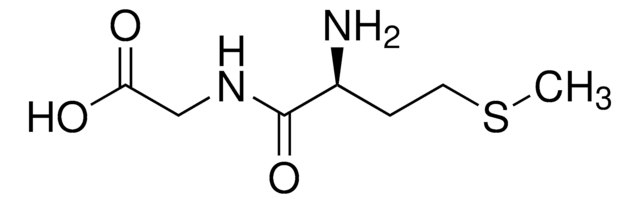
Met-Gly
≥98% (TLC)
Iniciar sesión para ver los precios por organización y contrato.
Seleccione un Tamaño
Cambiar Vistas
| Tamaño de envase | SKU | Disponibilidad | Precio |
|---|---|---|---|
| 500 mg | Fecha estimada de envío11 de mayo de 2026desdeMILWAUKEE | $225.00 |
Acerca de este artículo
Fórmula empírica (notación de Hill):
C7H14N2O3S
Número CAS:
Peso molecular:
206.26
NACRES:
NA.26
PubChem Substance ID:
UNSPSC Code:
12352202
EC Number:
238-487-9
MDL number:
Servicio técnico
¿Necesita ayuda? Nuestro equipo de científicos experimentados está aquí para ayudarle.
Permítanos ayudarleNombre del producto
Met-Gly,
assay
≥98% (TLC)
Quality Level
form
powder
color
white
storage temp.
−20°C
SMILES string
OC(CNC([C@@H](N)CCSC)=O)=O
InChI
1S/C7H14N2O3S/c1-13-3-2-5(8)7(12)9-4-6(10)11/h5H,2-4,8H2,1H3,(H,9,12)(H,10,11)/t5-/m0/s1
InChI key
QXOHLNCNYLGICT-YFKPBYRVSA-N
Biochem/physiol Actions
Met-Gly is a dipeptide.
1 of 1
Este artículo | |||
|---|---|---|---|
| form powder | form powder | form powder | form powder |
| assay ≥98% (TLC) | assay ≥98% (TLC) | assay ≥98% (TLC) | assay ≥98% (TLC) |
| storage temp. −20°C | storage temp. −20°C | storage temp. −20°C | storage temp. −20°C |
| color white | color white | color white | color white |
| Quality Level 200 | Quality Level 100 | Quality Level 200 | Quality Level 200 |


Clase de almacenamiento
11 - Combustible Solids
wgk
WGK 3
flash_point_f
Not applicable
flash_point_c
Not applicable
Elija entre una de las versiones más recientes:
¿Ya tiene este producto?
Encuentre la documentación para los productos que ha comprado recientemente en la Biblioteca de documentos.
Justin Kai-Chi Lau et al.
Journal of the American Society for Mass Spectrometry, 24(4), 543-553 (2013-02-27)
Radical cations [Met-Gly](•+), [Gly-Met](•+), and [Met-Met](•+) have been generated through collision-induced dissociation (CID) of [Cu(II)(CH3CN)2(peptide)](•2+) complexes. Their fragmentation patterns and dissociation mechanisms have been studied both experimentally and theoretically using density functional theory at the UB3LYP/6-311++G(d,p) level. The captodative structure
Urszula Rychlewska et al.
Acta crystallographica. Section C, Crystal structure communications, 66(Pt 2), m51-m54 (2010-02-04)
Crystallographic analysis of a solid solution of two diastereoisomers, i.e. ({(1S,R)-1-carboxy-3-[(R,S)-methylsulfinyl]propyl}aminocarbonyl)methanaminium tetrachloridoaurate(III) and ({(1S,R)-1-carboxy-3-[(S,R)-methylsulfinyl]propyl}aminocarbonyl)methanaminium tetrachloridoaurate(III), (C(7)H(15)N(2)O(4)S)[AuCl(4)], has shown that in the presence of gold(III), the methionine part of the Gly-D,L-Met dipeptide is oxidized to sulfoxide, and no coordination to the
J C Matthews et al.
Journal of animal science, 73(11), 3464-3475 (1995-11-01)
The absorption of carnosine, methionine, and methionylglycine (using 35S-methionine and 35S-methionylglycine as representative markers) across ruminal and omasal epithelia collected from four (carnosine) and seven sheep (methionine and methionylglycine) were studied using parabiotic chambers that were repeatedly sampled over a
Número de artículo de comercio global
| SKU | GTIN |
|---|---|
| M3129-500MG | 04061832885988 |