Saltar al contenido
MilliporeSigma

Saltar a

MABC199

Anti-BRCA1 Antibody, clone MS110

clone MS110, from mouse

Sinónimos:

Breast cancer type 1 susceptibility protein, RING finger protein 53

Iniciar sesión para ver los precios por organización y contrato.

Seleccione un Tamaño

Cambiar Vistas
Tamaño de envaseSKUDisponibilidadPrecio
100 μg
Comprobar disponibilidad del carrito
$550.00

Acerca de este artículo

UNSPSC Code:
12352203
NACRES:
NA.41
eCl@ss:
32160702
Conjugate:
unconjugated
Clone:
MS110, monoclonal
Application:
ICC, WB
Citations:
23

$550.00


Comprobar disponibilidad del carrito
Está disponible un anticuerpo recombinante y sin conservantes para su diana. Pruebe ZRB1675

Solicite una orden a granel
Servicio técnico
¿Necesita ayuda? Nuestro equipo de científicos experimentados está aquí para ayudarle.
Permítanos ayudarle


biological source

mouse

Quality Level

conjugate

unconjugated

antibody form

purified immunoglobulin

antibody product type

primary antibodies

clone

MS110, monoclonal

species reactivity

human

technique(s)

immunocytochemistry: suitable, western blot: suitable

isotype

IgG1κ

NCBI accession no.

UniProt accession no.

shipped in

wet ice

target post-translational modification

unmodified

Gene Information

human ... BRCA1(672)

General description

Breast cancer type 1 susceptibility protein (BCRA1; RING finger protein 53) functions as a tumor suppressor. BRCA1 is an important member of the DNA repair pathway. After DNA damage, BRCA1 is phosphorylated on multiple serine residues by the ATR kinase or Chk2, and is localized to lesion sites with PCNA. BRCA1 interacts with a wide range of proteins including Rad50, NBS1, and Mre11, c-Abl tyrosine kinase, and γH2A.X, involved in the detection of damaged DNA and activation of appropriate repair pathways. BRCA1 may also respond to DNA damage by promoting gene expression through association with transcriptional proteins and RNA polymerase II, and may regulate the p53 pathway by this mechanism. Previous studies have indicated that mutations in the BRCA1 gene may contribute to the development of breast and ovarian cancer.
~220 kDa and ~85 kDa observed. Multiple isoforms exist at various molecular weights and may be subject to post-translational modification.

Immunogen

Epitope: N-terminus
Recombinant protein corresponding to the N-terminus of human BRCA1.

Application

Anti-BRCA1 Antibody, clone MS110 is an antibody against BRCA1 for use in Western Blotting, ICC.
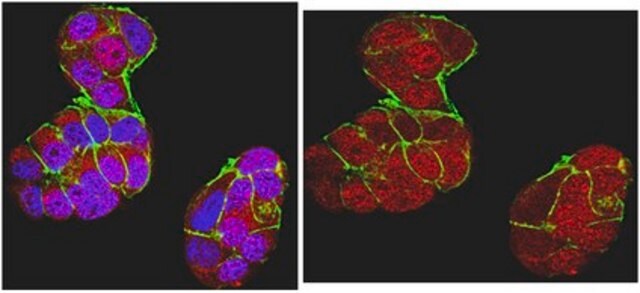
Immunocytochemistry Analysis: A 1:500 dilution of this antibody detected in BRCA1 in MCF7 cells.

Immunoprecipitation Analysis: A representative lot from an independent laboratory immunoprecipitated BRCA1 in IP (Wilson, C. A., et al. (1999). Nat Genet. 21(2):236-240.).

Immunohistochemistry Analysis: A representative lot from an independent laboratory detected BRCA in ovarian cancer and breast cancer tissues (Scully, R., et al. (1996). Science. 272(5258):123-126; Wilson, C. A., et al. (1999). Nat Genet. 21(2):236-240.).

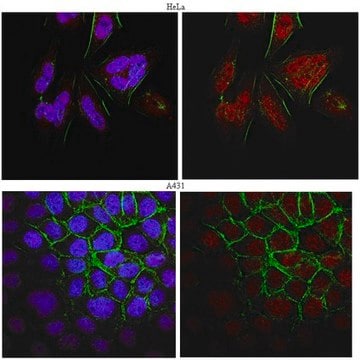
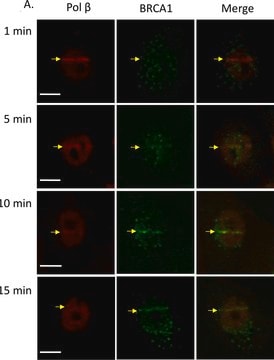
Immunofluorescence Analysis: A representative lot from an independent laboratory detected BRCA1 in a variety of certain cell lines (Scully, R., et al. (1996). Science. 272(5258):123-126.).
Research Category
Apoptosis & Cancer
Research Sub Category
Cell Cycle, DNA Replication & Repair

Biochem/physiol Actions

This antibody recognizes the N-terminus of BRCA1.

Physical form

Format: Purified
Protein G Purified
Purified mouse monoclonal IgG1κ in buffer containing 0.1 M Tris-Glycine (pH 7.4), 150 mM NaCl with 0.05% sodium azide.

Preparation Note

Stable for 1 year at 2-8°C from date of receipt.

Analysis Note

Control
HeLa nuclear extract
Evaluated by Western Blot in HeLa nuclear extract.

Western Blot Analysis: 1 µg/mL of this antibody detected BRCA1 in 10 µg of HeLa nuclear extract.

Other Notes

Concentration: Please refer to the Certificate of Analysis for the lot-specific concentration.

Disclaimer

Unless otherwise stated in our catalog or other company documentation accompanying the product(s), our products are intended for research use only and are not to be used for any other purpose, which includes but is not limited to, unauthorized commercial uses, in vitro diagnostic uses, ex vivo or in vivo therapeutic uses or any type of consumption or application to humans or animals.

Comparar elementos similares

Ver comparación completa

Mostrar Diferencias

1 of 1

Este artículo
MABC161SAB5700188OP92
biological source

mouse

biological source

mouse

biological source

rabbit

biological source

mouse

Gene Information

human ... BRCA1(672)

Gene Information

human ... BRCA1(672)

Gene Information

human ... BRCA1(672)

Gene Information

human ... BRCA1(672)

conjugate

unconjugated

conjugate

unconjugated

conjugate

unconjugated

conjugate

-

antibody form

purified immunoglobulin

antibody form

purified immunoglobulin

antibody form

affinity isolated antibody

antibody form

purified antibody

species reactivity

human

species reactivity

human

species reactivity

human, mouse

species reactivity

human

clone

MS110, monoclonal

clone

MS13, monoclonal

clone

polyclonal

clone

MS110, monoclonal


Still not finding the right product?

Pruebe nuestra Herramienta de selección de productos para limitar sus opciones


Clase de almacenamiento

12 - Non Combustible Liquids

wgk

WGK 1

flash_point_f

Not applicable

flash_point_c

Not applicable


Certificados de análisis (COA)

Busque Certificados de análisis (COA) introduciendo el número de lote del producto. Los números de lote se encuentran en la etiqueta del producto después de las palabras «Lot» o «Batch»

¿Ya tiene este producto?

Encuentre la documentación para los productos que ha comprado recientemente en la Biblioteca de documentos.

Visite la Librería de documentos


Giulia Partipilo et al.
International journal of cancer, 138(1), 110-120 (2015-07-25)
Understanding the expression of proteins involved in DNA damage response could improve knowledge of the pathways that contribute to familial and sporadic breast cancer (BC). We aimed to assess the different roles of BRCA1, poly(ADP-ribose) polymerase-1 (PARP1), BRCT-repeat inhibitor of
Yunlong Qin et al.
American journal of cancer research, 2(5), 540-548 (2012-09-08)
Mutation in the BRCA1 gene is associated with increased risk for hereditary breast and ovarian cancers. In sporadic ovarian tumors, BRCA1 dysfunction is thought to be common. BRCA1 is a nuclear-cytoplasm shuttling protein. Our group has previously reported that BRCA1
G Metro et al.
Cancer investigation, 28(2), 172-180 (2009-12-09)
Ribonucleotide reductase 1 (RRM1) is a determinant of gemcitabine efficacy in non-small-cell lung cancer and pancreatic cancer. We investigated the protein levels of RRM1 and two other DNA repair enzymes, ERCC1 and BRCA1, in 55 metastatic breast cancer (MBC) patients


Número de artículo de comercio global

SKUGTIN
MABC19904053252597022

Questions

Reviews

No rating value

Active Filters