Saltar al contenido
MilliporeSigma
Get up to 22% off for Pi Day through March 27.Save Now

ABE1024

Anti-Oligodendrocyte transcription factor 2 (OLIG2 Antibody)

serum, from guinea pig

Sinónimos:

Oligodendrocyte transcription factor 2, Oligo2

Iniciar sesión para ver los precios por organización y contrato.

Acerca de este artículo

UNSPSC Code:
12352203
NACRES:
NA.41
eCl@ss:
32160702
Conjugate:
unconjugated
Clone:
polyclonal
Application:
IHC, WB
Citations:
4

Saltar a

Servicio técnico
¿Necesita ayuda? Nuestro equipo de científicos experimentados está aquí para ayudarle.
Permítanos ayudarle

biological source

guinea pig

conjugate

unconjugated

antibody form

serum

antibody product type

primary antibodies

clone

polyclonal

species reactivity

mouse, human

technique(s)

immunohistochemistry: suitable (paraffin), western blot: suitable

NCBI accession no.

UniProt accession no.

shipped in

dry ice

target post-translational modification

unmodified

Comparar elementos similares

Ver comparación completa

Mostrar Diferencias

1 of 4

Este artículo
ABN899AV32753AV31464
antibody form

serum

antibody form

affinity isolated antibody

antibody form

affinity isolated antibody

antibody form

affinity isolated antibody

biological source

guinea pig

biological source

rabbit

biological source

rabbit

biological source

rabbit

Quality Level

100

Quality Level

100

Quality Level

100

Quality Level

100

shipped in

dry ice

shipped in

wet ice

shipped in

wet ice

shipped in

wet ice

clone

polyclonal

clone

polyclonal

clone

polyclonal

clone

polyclonal

UniProt accession no.

Q9EQW6

UniProt accession no.

Q9EQW6

UniProt accession no.

Q13516

UniProt accession no.

Q13516

General description

Oligodendrocyte transcription factor 2 (OLIG2), also known as Oligodendrocyte transcription factor 2 Oligo2, Class B basic helix-loop-helix protein 1 (bHLHb1), Class E basic helix-loop-helix protein 19 (bHLHe19), Protein kinase C-binding protein 2, Protein kinase C-binding protein RACK17, is encoded by the gene name OLIG2/ BHLHB1/ BHLHE19/ PRKCBP2/ RACK17. Olig2 is required for oligodendrocyte and motor neuron specification in the spinal cord, as well as for the development of somatic motor neurons in the hindbrain. It cooperates with OLIG1 to establish the pMN domain of the embryonic neural tube. Olig2 is an antagonist of V2 interneuron and of NKX2-2-induced V3 interneuron development. The restricted expression of Olig2 in oligodendrocytes makes AB9610 an excellent marker of oligodendroglia and oligodendrogliomas in development and mature systems. Olig2 is expressed in the brain and oligodendrocytes. Olig2 is strongly expressed in oligodendrogliomas, while expression is weak to moderate in astrocytomas. Expression in glioblastomas highly variable.
~37 kDa observed

Immunogen

Epitope: Unknown
KLH-conjugated linear peptide corresponding to mouse Oligodendrocyte transcription factor 2 (OLIG2).

Application

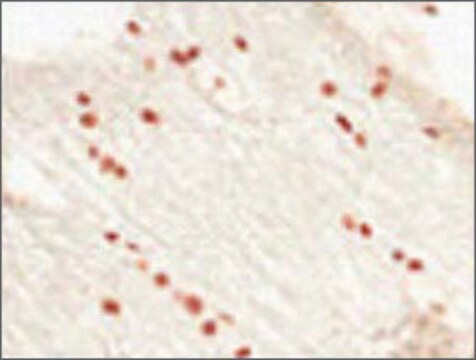
Immunohistochemistry Analysis: A 1:250 dilution from a representative lot detected Oligodendrocyte transcription factor 2 (OLIG2) in human cortical brain section tissue.
Research Category
Neuroscience
Research Sub Category
Developmental Signaling
This Anti-Oligodendrocyte transcription factor 2 (OLIG2 antibody is validated for use in WB, IH(P) for the detection of Oligodendrocyte transcription factor 2 (OLIG2.

Physical form

Guinea pig polyclonal serum with 0.05% sodium azide.
Unpurified

Preparation Note

Stable for 1 year at -20°C from date of receipt.
Handling Recommendations: Upon receipt and prior to removing the cap, centrifuge the vial and gently mix the solution. Aliquot into microcentrifuge tubes and store at -20°C. Avoid repeated freeze/thaw cycles, which may damage IgG and affect product performance.

Analysis Note

Evaluated by Western Blotting in mouse brain tissue lysate.

Western Blotting Analysis: A 1:1;000 dilution of this antibody detected Oligodendrocyte transcription factor 2 (OLIG2) in 10 µg of mouse brain tissue lysate.

Other Notes

Concentration: Please refer to lot specific datasheet.

Disclaimer

Unless otherwise stated in our catalog or other company documentation accompanying the product(s), our products are intended for research use only and are not to be used for any other purpose, which includes but is not limited to, unauthorized commercial uses, in vitro diagnostic uses, ex vivo or in vivo therapeutic uses or any type of consumption or application to humans or animals.

¿No encuentra el producto adecuado?  

Pruebe nuestro Herramienta de selección de productos.

Clase de almacenamiento

10 - Combustible liquids

wgk

WGK 1


Certificados de análisis (COA)

Busque Certificados de análisis (COA) introduciendo el número de lote del producto. Los números de lote se encuentran en la etiqueta del producto después de las palabras «Lot» o «Batch»

¿Ya tiene este producto?

Encuentre la documentación para los productos que ha comprado recientemente en la Biblioteca de documentos.

Visite la Librería de documentos

Michaela Fredrich et al.
Hippocampus, 27(5), 495-506 (2017-01-19)
The hippocampus is subjected to diurnal/circadian rhythms on both the morphological and molecular levels. Certain aspects of cell proliferation in the adult hippocampus are regulated by melatonin and accompanied by apoptosis to ensure proper tissue maintenance and function. The present
Timothy M O'Shea et al.
Nature neuroscience, 27(8), 1505-1521 (2024-06-22)
Central nervous system (CNS) lesions become surrounded by neuroprotective borders of newly proliferated reactive astrocytes; however, fundamental features of these cells are poorly understood. Here we show that following spinal cord injury or stroke, 90% and 10% of border-forming astrocytes
Marc Oria et al.
Frontiers in molecular neuroscience, 15, 888351-888351 (2022-07-06)
During embryonic spinal cord development, neural progenitor cells (NPCs) generate three major cell lines: neurons, oligodendrocytes, and astrocytes at precise times and locations within the spinal cord. Recent studies demonstrate early astrogenesis in animal models of spina bifida, which may
Marina Bershteyn et al.
Cell stem cell, 30(10), 1331-1350 (2023-10-07)
Mesial temporal lobe epilepsy (MTLE) is the most common focal epilepsy. One-third of patients have drug-refractory seizures and are left with suboptimal therapeutic options such as brain tissue-destructive surgery. Here, we report the development and characterization of a cell therapy

Número de artículo de comercio global

SKUGTIN
ABE102404055977121551

Questions

Reviews

No rating value

Active Filters

Nuestro equipo de científicos tiene experiencia en todas las áreas de investigación: Ciencias de la vida, Ciencia de los materiales, Síntesis química, Cromatografía, Analítica y muchas otras.

Póngase en contacto con el Servicio técnico