
Materials Science

We provide ready-to-use nanomaterials, including functionalized nanoparticles, quantum dots, carbon nanomaterials, boron nitride nanotubes, perovskites, and OLED materials. Our biomedical materials comprise degradable polymers, natural polymers, block copolymers, hydrogels, and PEGs. Our high-performance energy materials and electronics materials have advanced semiconducting capacity and power density. Our high-purity metal salts, deposition precursors, metals, alloys, oxides, monomers, polymers, initiators, and additional polymerization tools ensure the synthesis of high-quality materials.
Explore by Category

Biomedical Materials
Biomaterials are enabling tools for many advances in biomedical research. We offer a wide variety of biomedical materials for the synthesis of biocompatible scaffolds and devices.
Electronic Materials
Our products include unique photoluminescent polymers, liquid crystals, triplet emitters, and LEP. We provide materials for LED, OLED, and LEP display development and manufacturing.

Explore More Categories

We provide a variety of products for alternative fuel, solar energy, energy storage or fuel cell development and manufacturing.
Shop Products

Chitosan
low molecular weight
Chitosan
medium molecular weight

Polycaprolactone
average Mn 80,000

Alginic acid sodium salt
powder

Cellulose
microcrystalline, powder, 20 μm
Chitosan
high molecular weight

Poly(ethylene glycol)-block-poly(propylene glycol)-block-poly(ethylene glycol)
average Mn ~5,800

Lignin, alkali
powder
Cellulose
microcrystalline, powder

Sodium carboxymethyl cellulose
viscosity 50-200 cP , c=4% H2O at 25°C
Lignin, alkali
Polycaprolactone
average Mw ~14,000, average Mn ~10,000 by GPC

Cellulose acetate
average Mn ~30,000 by GPC
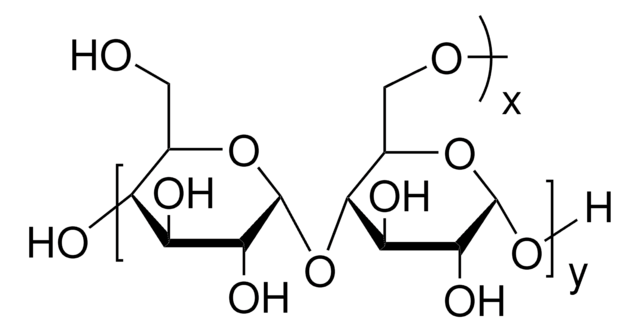
Maltodextrin

Polylactic acid
Mw ~60,000
Chitosan
from shrimp shells, practical grade
Sodium carboxymethyl cellulose
viscosity 2500-6000 cP

Resomer® RG 502 H, Poly(D,L-lactide-co-glycolide)
acid terminated, viscosity 0.16-0.24 dL/g
Sodium carboxymethyl cellulose
average Mw ~250,000, degree of substitution 0.9

Hydroxypropyl cellulose
average Mw ~100,000, powder, 20 mesh particle size (99% through)
To continue reading please sign in or create an account.
Don't Have An Account?