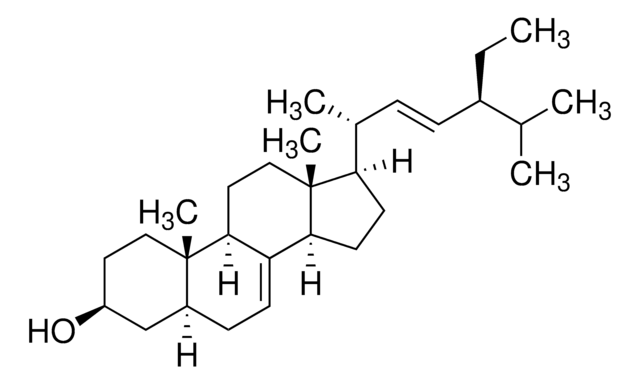
α-Spinasterol is a blood-brain barrier-permeable and orally active plant phytosterol with antioxidant, anticonvulsant (0.1-1 mg/kg i.p. in mice), antidepressant (1-2 mg/kg i.p. in mice) and anti-inflammatory (0.001-1 mg/kg, i.p. or 1-10 mg/kg, i.g. in mice) properties, as well as antinociceptive efficacy via dual actions against transient receptor potential vanilloid 1 (TrpV1; IC50/Emax = 1.4 μM/67% against 2 nM RTX for binding mouse spinal cord membranes; IC50/Emax = 40 μM/62% against 20 μM capsaicin-induced mouse spinal cord synaptosomes Ca2+ influx) and cyclooxygenases (IC50 = 16.17 μM/COX1 and 7.76μM/COX2). a-spinasterol can directly affect membrane structure and packing in a manner similar to cholesterol, both a-spinasterol and stitosterol are reported to lower plasma/liver cholesterol levels and increase fecal cholesterol excretion when supplemented in daily diet (1%) in mice in vivo.
Orally active phytosterol with anticonvulsant, antidepressant, anti-inflammatory, and antinociceptive efficacy via dual actions against TrpV1 and COX1/2.
α-Spinasterol is a constituent of argan oil. It regulates nuclear receptors expression and modulates mitochondrial function. It mimics natural cholesterol and its functionality. α-Spinastero lelicits cytoprotective and antiulcerogenic functionality. It has therapeutic potential towards diabetic nephropathy.
Journal of neural transmission (Vienna, Austria : 1996), 122(9), 1239-1247 (2015-03-13)
α-Spinasterol is a plant-derived compound which was reported to act as a selective antagonist for the transient receptor potential vanilloid 1 (TRPV1) receptor. Several studies revealed that the TRPV1 receptors might modulate seizure activity in animal models of seizures and
Evaluation of the antidepressant-and anxiolytic-like activity of alpha-spinasterol, a plant derivative with TRPV1 antagonistic effects, in mice