


The product is packaged in bottomless glass bottles with an inserted fused cone. The micro-vials contain the product within an inner cone, while the bottomless outer glass cylinder, serves as a stand. This design is intentional and not a defect.
B4875

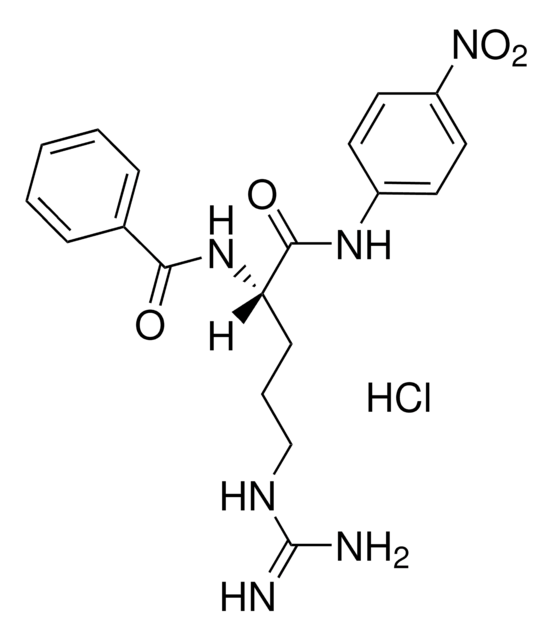
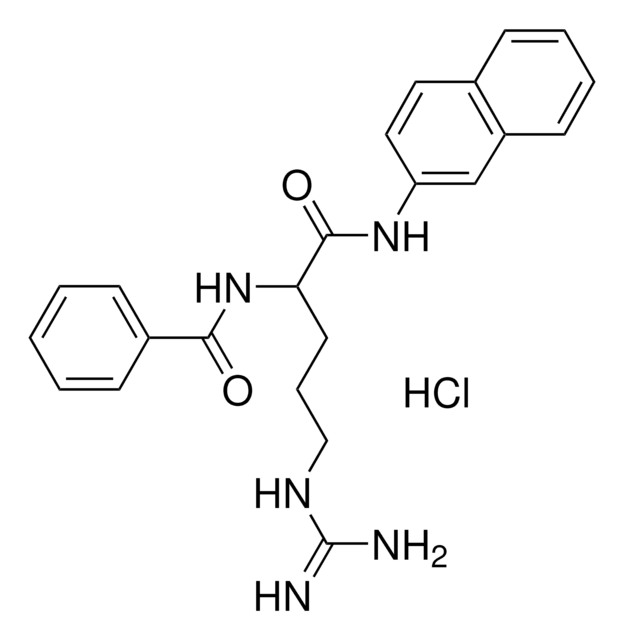
Nα-Benzoyl-DL-arginine 4-nitroanilide hydrochloride
trypsin substrate, chromogenic, elastase substrate, ≥98%, powder
Synonym(s):
Nα-Benzoyl-DL-arginine p-nitroanilide hydrochloride, BANI, BAPNA
Sign In to View Organizational & Contract Pricing.
Select a Size
Change View
| Size/SKU | Availability | Price |
|---|
About This Item
Empirical Formula (Hill Notation):
C19H22N6O4 · HCl
CAS Number:
Molecular Weight:
434.88
NACRES:
NA.32
PubChem Substance ID:
UNSPSC Code:
12352204
EC Number:
213-011-2
MDL number:
Beilstein/REAXYS Number:
4081878
Pricing and availability is not currently available.
Product Name
Nα-Benzoyl-DL-arginine 4-nitroanilide hydrochloride, ≥98%
Quality Segment
assay
≥98%
form
powder
color
, white to light yellow to light brown
solubility
DMSO: 50 mg/mL (colorless to dark green-yellow to dark brown-yellow)
storage temp.
−20°C
SMILES string
Cl[H].NC(=N)NCCCC(NC(=O)c1ccccc1)C(=O)Nc2ccc(cc2)[N+]([O-])=O
InChI
1S/C19H22N6O4.ClH/c20-19(21)22-12-4-7-16(24-17(26)13-5-2-1-3-6-13)18(27)23-14-8-10-15(11-9-14)25(28)29;/h1-3,5-6,8-11,16H,4,7,12H2,(H,23,27)(H,24,26)(H4,20,21,22);1H
InChI key
DEOKFPFLXFNAON-UHFFFAOYSA-N
General description
Nα-Benzoyl-DL-arginine 4-nitroanilide hydrochloride (DL-BAPNA) is a chromogenic substrate for proteolytic enzymes such as trypsin, amidase, and balterobin. Hydrolysis of DL-BAPNA at the bond between the arginine and the p-nitroaniline moieties releases the chromophore p-nitroaniline, which can be detected by colorimetric analysis.
A chromogenic trypsin substrate.
Application
Nα-Benzoyl-DL-arginine 4-nitroanilide hydrochloride has been used as a substrate for trypsin and elastase in enzyme analysis.
Packaging
Bottomless glass bottle. Contents are inside inserted fused cone.
1 of 1
This Item | |||
|---|---|---|---|
| assay ≥98% | assay ≥98% (HPLC) | assay ≥98% (TLC) | assay ≥98% (TLC) |
| solubility DMSO: 50 mg/mL (colorless to dark green-yellow to dark brown-yellow) | solubility acetone: water (1:1): 40.00-51.00 mg/mL, clear, colorless to yellow | solubility DMF: 50 mg/mL, clear, colorless to faintly yellow | solubility methanol: 20 mg/mL, clear, colorless to light yellow |
| Quality Level 200 | Quality Level 200 | Quality Level 200 | Quality Level 200 |
| form powder | form powder | form powder | form powder |
| storage temp. −20°C | storage temp. −20°C | storage temp. 2-8°C | storage temp. −20°C |
| color , white to light yellow to light brown | color - | color - | color - |
Storage Class
11 - Combustible Solids
flash_point_f
Not applicable
flash_point_c
Not applicable
ppe
Eyeshields, Gloves, type N95 (US)
Choose from one of the most recent versions:
Already Own This Product?
Find documentation for the products that you have recently purchased in the Document Library.
-
Why do the bottoms of the vials/bottles of product B4875-100MG (Nα-Benzoyl-DL-arginine 4-nitroanilide hydrochloride) appear to have no bottom? How is the product contained within the vials despite this unusual appearance? Is this a packaging defect?
1 answer-
Helpful?
-