

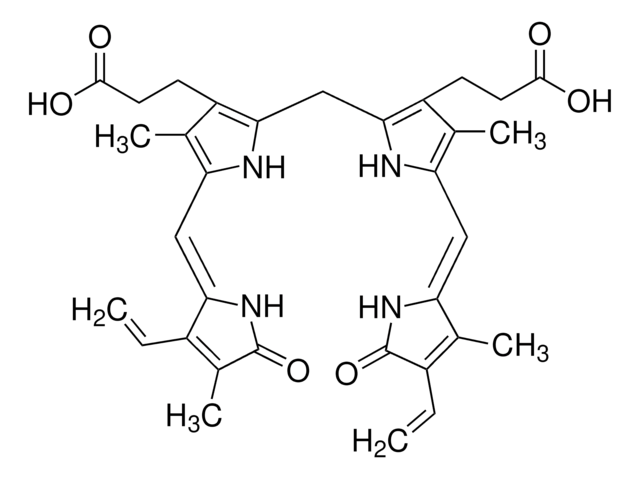


The stability of this product in solution has not been determined. However, freshly prepared biliverdin hydrochloride in DMSO is generally stable for immediate use when protected from light and air. Biliverdin is photosensitive and undergoes photodegradation upon exposure to visible or UV light; therefore, solutions should be stored in amber vials or wrapped in foil. This compound is also prone to oxidation in solution. Upon exposure to oxygen, slow degradation is indicated by a color change from green to brown. Aliquots in DMSO, at approximately 10–50 mM, may be stored at –20°C under argon or nitrogen and protected from light. Avoid repeated freeze–thaw cycles. Solutions are typically stable for several days at 4°C and up to 1 month at –20°C. Other sources indicate that solutions may be stable at -80 °C for up to 6 months.
30891

Biliverdin hydrochloride
≥97.0% (TLC)
Synonym(s):
Biliverdin
Select a Size
| Size/SKU | Availability | Price |
|---|
About This Item
Quality Segment
assay
≥97.0% (TLC)
form
powder or crystals
application(s)
metabolomics
vitamins, nutraceuticals, and natural products
storage temp.
−20°C
SMILES string
Cl.CC1=C(C=C)C(\NC1=O)=C\c2[nH]c(/C=C3\N=C(\C=C4/NC(=O)C(C=C)=C4C)C(C)=C3CCC(O)=O)c(CCC(O)=O)c2C
InChI
1S/C33H34N4O6.ClH/c1-7-20-19(6)32(42)37-27(20)14-25-18(5)23(10-12-31(40)41)29(35-25)15-28-22(9-11-30(38)39)17(4)24(34-28)13-26-16(3)21(8-2)33(43)36-26;/h7-8,13-15,35H,1-2,9-12H2,3-6H3,(H,36,43)(H,37,42)(H,38,39)(H,40,41);1H/b26-13-,27-14-,28-15-;
InChI key
KTRFJVRKVQROKS-UJCZHUFNSA-N
General description
Application
- as a treatment to J774A.1 cells to study its role in alternation of beta (β)-endorphins level[2]
- as a commercial standard for the detection of biliverdin in mouse unstable and stable plaques tissues using liquid chromatography-tandem mass spectrometry (LC-MS-MS)[3]
- to add to Fucci-containing cells to improve the mIFP signal
- to examine its impact on infrared fluorescent protein (iRFP) in some retinal preparations
Biochem/physiol Actions
Packaging
1 of 1
This Item | |||
|---|---|---|---|
| form powder or crystals | form powder | form buffered aqueous solution | form powder or crystals |
| assay ≥97.0% (TLC) | assay ≥95.0% (UV) | assay ≥90% (SDS-PAGE) | assay 98% (TLC) |
| application(s) metabolomics | application(s) - | application(s) - | application(s) - |
| Quality Level 100 | Quality Level 100 | Quality Level 200 | Quality Level 200 |
| storage temp. −20°C | storage temp. - | storage temp. −20°C | storage temp. −20°C |
signalword
Warning
hcodes
Hazard Classifications
Eye Irrit. 2 - Skin Irrit. 2 - STOT SE 3
target_organs
Respiratory system
Storage Class
11 - Combustible Solids
wgk
WGK 3
flash_point_f
Not applicable
flash_point_c
Not applicable
Choose from one of the most recent versions:
Already Own This Product?
Find documentation for the products that you have recently purchased in the Document Library.
-
How should Biliverdin hydrochloride (30891), dissolved in DMSO, be stored, and how long is the solution stable?
1 answer-
Helpful?
-
-
How can I determine the shelf life / expiration / retest date of this product?
1 answer-
If this product has an expiration or retest date, it will be shown on the Certificate of Analysis (COA, CofA). If there is no retest or expiration date listed on the product's COA, we do not have suitable stability data to determine a shelf life. For these products, the only date on the COA will be the release date; a retest, expiration, or use-by-date will not be displayed.
For all products, we recommend handling per defined conditions as printed in our product literature and website product descriptions. We recommend that products should be routinely inspected by customers to ensure they perform as expected.
For products without retest or expiration dates, our standard warranty of 1 year from the date of shipment is applicable.
For more information, please refer to the Product Dating Information document: https://www.sigmaaldrich.com/deepweb/assets/sigmaaldrich/marketing/global/documents/418/501/product-dating-information-06-25-mk.pdfHelpful?
-
-
How is shipping temperature determined? And how is it related to the product storage temperature?
1 answer-
Products may be shipped at a different temperature than the recommended long-term storage temperature. If the product quality is sensitive to short-term exposure to conditions other than the recommended long-term storage, it will be shipped on wet or dry-ice. If the product quality is NOT affected by short-term exposure to conditions other than the recommended long-term storage, it will be shipped at ambient temperature. As shipping routes are configured for minimum transit times, shipping at ambient temperature helps control shipping costs for our customers. For more information, please refer to the Storage and Transport Conditions document: https://www.sigmaaldrich.com/deepweb/assets/sigmaaldrich/marketing/global/documents/316/622/storage-transport-conditions-mk.pdf
Helpful?
-
-
What is the refractive index and absorption index of Biliverdin Hydrochloride (30891)?
1 answer-
There are no specific quality tests performed on this product to verify refractive or absorption properties. There are some details available in scientific literature for spectral properties with authors at the Chinese Academy of Science describing bilverdin as a NIR absorbing pigment. Please see the citation below for more details and refer specifically to figure 1B on page 2 of the publication.
R. R. Xing, Q. L. Zou, C. Q. Yuan, L. Y. Zhao, R. Chang, X. H. Yan, Advanced Materials 2019, 31, 1900822. https://doi.org/10.1002/adma.201900822
Helpful?
-
-
Is Biliverdin hydrochloride #30891 suitable for preparing a Biliverdin solution?
1 answer-
Product 30891 is a solid and can be reconstituted to make a solution. Biliverdin (hydrochloride) can be dissolved in organic solvents such as DMSO and dimethyl formamide (DMF) that should be purged with an inert gas, with a solubility of approximately 20 mg/ml. However, it is sparingly soluble in aqueous buffers.
Helpful?
-