
P2949

PIPES sodium salt
≥99% (titration)
Synonym(s):
Na-PIPES, Piperazine-1,4-diethanesulfonate sodium salt, 1,4-Piperazinediethanesulfonic acid sodium salt, Piperazine-N,N′-bis(2-ethanesulfonic acid) sodium salt
Select a Size
| Size/SKU | Availability | Price |
|---|
About This Item
Quality Segment
assay
≥99% (titration)
form
crystalline powder
pH
4.5-4.7
useful pH range
6.1-7.5
pKa (25 °C)
6.8
solubility
0.1 M NaOH: 250 mg/mL, clear, colorless
application(s)
diagnostic assay manufacturing
storage temp.
room temp
SMILES string
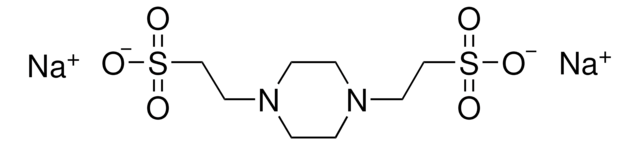
[Na+].OS(=O)(=O)CCN1CCN(CC1)CCS([O-])(=O)=O
InChI
1S/C8H18N2O6S2.Na/c11-17(12,13)7-5-9-1-2-10(4-3-9)6-8-18(14,15)16;/h1-8H2,(H,11,12,13)(H,14,15,16);/q;+1/p-1
InChI key
OGGAIRCLBMGXCZ-UHFFFAOYSA-M
General description
Application
Features and Benefits
- Non-toxic
- Easy to use
- Thermally stable
- Easy to handle and store
1 of 1
This Item | |||
|---|---|---|---|
| assay ≥99% (titration) | assay ≥99% (titration) | assay ≥99.0% (titration) | assay ≥99% (titration) |
| Quality Level 200 | Quality Level 200 | Quality Level 400 | Quality Level 400 |
| form crystalline powder | form crystalline powder | form powder | form crystalline powder |
| application(s) diagnostic assay manufacturing | application(s) diagnostic assay manufacturing | application(s) diagnostic assay manufacturing | application(s) diagnostic assay manufacturing |
| pH 4.5-4.7 | pH - | pH 10-12 (1 M in water) | pH - |
| solubility 0.1 M NaOH: 250 mg/mL, clear, colorless | solubility water: 0.5 g/mL, clear, colorless | solubility water: 0.1 M, clear, colorless | solubility 1 M NaOH: 20 + 80 mL g, clear, colorless |



Storage Class
11 - Combustible Solids
wgk
WGK 3
flash_point_f
Not applicable
flash_point_c
Not applicable
Choose from one of the most recent versions:
Already Own This Product?
Find documentation for the products that you have recently purchased in the Document Library.