


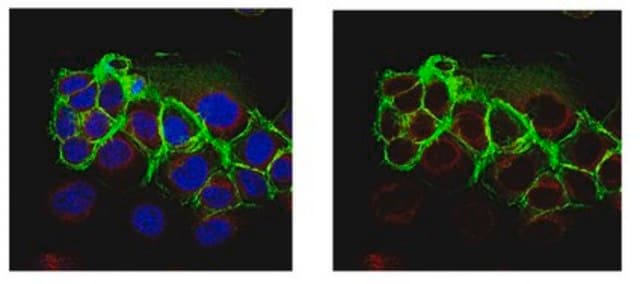
Compare the use of Proteinase K for 5 and 10 minutes, which should be sufficient. There's no need to run HIER or antigen retrieval, as the Enzyme should effectively open the epitope sites for this antibody.
248M-9

Ep-CAM/Epithelial Specific Antigen (Ber-EP4) Mouse Monoclonal Antibody
Sign In to View Organizational & Contract Pricing.
Select a Size
Change View
| Size/SKU | Availability | Price |
|---|
About This Item
NACRES:
NA.41
UNSPSC Code:
12352203
Conjugate:
unconjugated
Clone:
Ber-EP4, monoclonal
Application:
IHC (p)
Citations:
7
Pricing and availability is not currently available.
biological source
mouse
conjugate
unconjugated
antibody form
culture supernatant
antibody product type
primary antibodies
clone
Ber-EP4, monoclonal
description
For In Vitro Diagnostic Use in Select Regions (See Chart)
form
buffered aqueous solution
species reactivity
human
packaging
vial of 0.1 mL concentrate (248M-94), vial of 0.5 mL concentrate (248M-95), bottle of 1.0 mL predilute (248M-97), vial of 1.0 mL concentrate (248M-96), bottle of 7.0 mL predilute (248M-98)
manufacturer/tradename
Cell Marque®
technique(s)
immunohistochemistry (formalin-fixed, paraffin-embedded sections): 1:50-1:200
isotype
IgG1κ
control
colon carcinoma
shipped in
wet ice
storage temp.
2-8°C
visualization
cytoplasmic
Gene Information
human ... EPCAM(4072)
General description
Epithelial cell adhesion molecule (Ep-CAM) is a transmembrane glycoprotein localized on the membrane of cells in most epithelial tissues. Immunoreactivity with the antibody to E-CAM has been seen in the majority of epithelial neoplasms, whereas most non-epithelial neoplasms do not show Ep-CAM expression.[1] Ep-CAM is not expressed in mesothelial cells, hepatocytes, and lymphocytes.[1] In conjunction with other markers, Ep-CAM can be used as an aid in determining the epithelial origin of neoplasms such as lung adenocarcinoma.[1] [2]
Physical form
Solution in Tris Buffer, pH 7.3-7.7, with 1% BSA and <0.1% Sodium Azide
Preparation Note
Download the IFU specific to your product lot and formatNote: This requires a keycode which can be found on your packaging or product label.
Analysis Note
 IVD |  IVD |  IVD |  RUO |
Other Notes
Ep-CAM Positive Control Slides, Product No. 248S, are available for immunohistochemistry (formalin-fixed, paraffin-embedded sections).
For Technical Service please contact: 800-665-7284 or email: [email protected]
Legal Information
Cell Marque is a registered trademark of Merck KGaA, Darmstadt, Germany
1 of 1
This Item | |||
|---|---|---|---|
| antibody form culture supernatant | antibody form culture supernatant | antibody form culture supernatant | antibody form purified immunoglobulin |
| biological source mouse | biological source mouse | biological source mouse | biological source mouse |
| species reactivity human | species reactivity human | species reactivity human | species reactivity human |
| clone Ber-EP4, monoclonal | clone MOC-31, monoclonal | clone Ber-EP4, monoclonal | clone VU-1D9, monoclonal |
| conjugate unconjugated | conjugate unconjugated | conjugate unconjugated | conjugate unconjugated |
| technique(s) immunohistochemistry (formalin-fixed, paraffin-embedded sections): 1:50-1:200 | technique(s) immunohistochemistry (formalin-fixed, paraffin-embedded sections): 1:50-1:200 | technique(s) immunofluorescence: 1:500-1:1,000 using human breast adenocarcinoma MCF-7 cell line. , immunohistochemistry: 1:250-1:500 using heat-retrieved formalin-fixed, paraffin-embedded human colon carcinoma sections., immunoprecipitation (IP): suitable | technique(s) immunocytochemistry: suitable, immunohistochemistry: suitable, western blot: suitable |
Still not finding the right product?
Try our Product Selector Tool to narrow your options
Choose from one of the most recent versions:
Already Own This Product?
Find documentation for the products that you have recently purchased in the Document Library.
-
how to use Proteinase K for the Ber-ep4?
1 answer-
Helpful?
-