
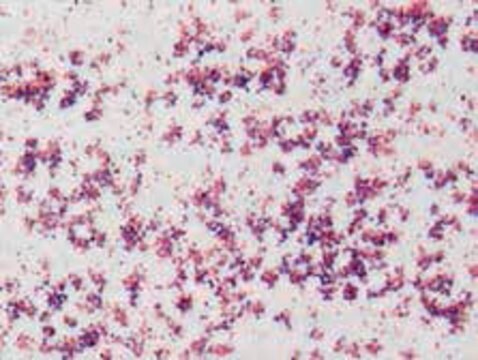


The product is a 2% (w/v) crystal violet solution prepared in 20 mL ethanol (95%) and 80 mL deionized water with 0.8 g of Ammonium oxalate.
94448

Gram′s crystal violet solution
suitable for microscopy
Synonym(s):
Basic violet 3; gentian violet; hexamethyl pararosaniline; methyl violet 10B
Sign In to View Organizational & Contract Pricing.
Select a Size
Change View
| Size/SKU | Availability | Price |
|---|
About This Item
NACRES:
MA.02
UNSPSC Code:
12171500
Pricing and availability is not currently available.
product line
BioChemika
Quality Segment
form
liquid
shelf life
limited shelf life, expiry date on the label
technique(s)
microbe id | staining: suitable
color
purple to very dark purple
density
0.981 g/mL at 20 °C
εmax
33.8 at 585-595 nm in water
suitability
suitable for microscopy
antibiotic activity spectrum
Gram-negative bacteria, Gram-positive bacteria
application(s)
diagnostic assay manufacturing
hematology
histology
storage temp.
room temp
General description
Gram’s crystal violet solution, also known as gentian violet or hexamethyl pararosaniline, is a basic, cationic, acidotropic aminoarylmethane dye. It is a hexa-N-methylated triaminotriphenylmethane with a moderately sized lipophilic cation and a slightly nonplanar conjugated system. It is used in bacteriology as the primary stain in Gram staining to differentiate Gram-positive and Gram-negative bacteria. It is known to possess antibacterial and antifungal properties.[1]
Application
- Crystal violet is routinely used for Gram staining and its variants, staining amyloid, bacterial components, and vascular plant tissues.
- It is used in polychrome staining of epoxy resin sections, viability staining of cultured neurons, and confocal optical sectioning to analyze meiotic structures.
- It is also employed in the acridine orange-crystal violet staining of intracellular bacteria, microsporidian spores, and cytological smears.
Biochem/physiol Actions
Crystal violet is the primary stain in Gram staining. It infiltrates the peptidoglycan-rich cell wall of Gram-positive bacteria, and forms complexes with Gram’s iodine that are entrapped and retain the purple color even after decolorization. Thus, Gram-positive bacteria can be differentiated from Gram-negative bacteria whose peptidoglycan layer is considerably thinner and does not retain crystal violet.
The antimicrobial effects of crystal violet are caused by free radical generation and the formation of unionized dye-bacteria complexes. It also inhibits bacterial protein synthesis and cell wall formation and is especially effective against Gram-positive bacteria.[1]
1 of 1
This Item | |||
|---|---|---|---|
| technique(s) microbe id | staining: suitable | technique(s) microbe id | staining: suitable | technique(s) microbe id | staining: suitable | technique(s) microbe id | staining: suitable |
| suitability suitable for microscopy | suitability - | suitability - | suitability - |
| color purple to very dark purple | color brown to very dark brown | color - | color red to very dark red |
| application(s) diagnostic assay manufacturing | application(s) diagnostic assay manufacturing | application(s) diagnostic assay manufacturing | application(s) diagnostic assay manufacturing |
| form liquid | form liquid | form liquid | form liquid |
| storage temp. room temp | storage temp. room temp | storage temp. room temp | storage temp. room temp |
Still not finding the right product?
Explore all of our products under Gram′s crystal violet solution
signalword
Warning
hcodes
Hazard Classifications
Aquatic Chronic 3 - Carc. 2 - Eye Irrit. 2 - Flam. Liq. 3
Storage Class
3 - Flammable liquids
flash_point_f
93.2 °F
flash_point_c
34 °C
ppe
Eyeshields, Faceshields, Gloves, type ABEK (EN14387) respirator filter
Choose from one of the most recent versions:
Already Own This Product?
Find documentation for the products that you have recently purchased in the Document Library.
-
WHAT IS THE ACTUAL CONCENTRATION
1 answer-
Helpful?
-
-
Is this product # 94448 is suitable for use in Body fluid cell counting microscopically, to lyse RBC and enumerate WBC cells clearly?
1 answer-
No. Gram's Crystal Violet solution is not intended for counting cells from body fluid or blood. With the 10-20% ethanol present, the red cells would not be properly lysed. There are suitable solutions sold as Tuerk's reagent/solution which intended for counting white blood cells microscopically. With Tuerk's solution the red blood cells would be properly lysed. The catalog numbers for Tuerk's solution/reagent are 93770 and 1.09277
Helpful?
-
-
If the concentration of a solution is 2% and a final concentration of 0.01%, should water or ethanol be added to further dilute it?
1 answer-
Product 94448 is intended for use in a Gram Stain procedure. If you are diluting it down to 0.01%, you are not using the product as intended for staining bacteria in a Gram Stain procedure. If the concentration is a 0.01% solution, this brings attention towards the use of Turk's solution for counting cells using a hemacytometer. Turk's solution can be formulated with or without acetic acid. Using 10 to 20% ethanol or a higher concentration effectively kills the cells, causing the entire cell to stain and making it impossible to identify cells by the shape of their nuclei.
If it is for a migration assay or some other use, it would be advisable to check the literature. In some instances, the standard procedure is to dilute the Crystal Violet in methanol. Crystal Violet has many and varied uses, so it is best to try different solvents and determine which is most appropriate for your use. A 2 percent solution can be diluted to a 0.1 percent solution with a 1:20 dilution in an appropriate solvent, such as water, 15% ethanol, or 100% methanol.
Helpful?
-