Przejdź do zawartości
Merck

Przejdź do

ZRB1546

Anti-Phospho-AKT1-(Ser473) Antibody, clone 1O14 ZooMAb® Rabbit Monoclonal

recombinant, expressed in HEK 293 cells

greener alternative

Bardziej ekologiczna alternatywa

enhanced validation

Ulepszona walidacja

Synonim(y):

RAC-alpha serine/threonine-protein kinase;EC:2.7.11.1;Protein kinase B;PKB;Protein kinase B alpha;PKB alpha;Proto-oncogene c-Akt;RAC-PK-alpha;Akt alpha

Zaloguj się, aby wyświetlić ceny organizacyjne i kontraktowe.

Wybierz wielkość

Zmień widok
Rozmiar/SKUDostępnośćCena netto
25 μL
Skontaktuj się z Obsługą Klienta, aby uzyskać informacje na temat dostępności
955,00 zł
4 x 25 μL
Skontaktuj się z Obsługą Klienta, aby uzyskać informacje na temat dostępności
1970,00 zł

Informacje o tej pozycji

NACRES:
NA.41
UNSPSC Code:
12352203
Conjugate:
unconjugated
Clone:
1O14, recombinant monoclonal
Application:
IHC (p), affinity binding assay
Citations:
-

955,00 zł


Skontaktuj się z Obsługą Klienta, aby uzyskać informacje na temat dostępności

​
Złóż zamówienie na produkt na zamówienie
Pomoc techniczna
Potrzebujesz pomocy? Nasz zespół doświadczonych naukowców chętnie Ci pomoże.
Pozwól nam pomóc


biological source

rabbit

Quality Segment

recombinant

expressed in HEK 293 cells

conjugate

unconjugated

antibody form

purified antibody

antibody product type

primary antibodies

clone

1O14, recombinant monoclonal

description

recombinant, expressed in HEK 293 cells

product line

ZooMAb® learn more

form

lyophilized

mol wt

calculated mol wt 55.69 kDa, observed mol wt ~66 kDa

purified by

using Protein A

species reactivity

human, mouse

species reactivity (predicted by homology)

feline, rat, bovine, monkey, canine, zebrafish, porcine

packaging

antibody small pack of 25 μL

greener alternative product characteristics

Waste Prevention
Designing Safer Chemicals
Design for Energy Efficiency
Learn more about the Principles of Green Chemistry.

enhanced validation

recombinant expression
Learn more about Antibody Enhanced Validation

sustainability

Greener Alternative Product

technique(s)

affinity binding assay: suitable, immunohistochemistry (formalin-fixed, paraffin-embedded sections): suitable

isotype

IgG

epitope sequence

C-terminus

Protein ID accession no.

UniProt accession no.

greener alternative category

shipped in

ambient

storage temp.

2-8°C

target post-translational modification

phosphorylation (pSer473/pSer473)

General description

RAC-alpha serine/threonine-protein kinase (UniProt: P31749; also known as EC:2.7.11.1, Protein kinase B, PKB, Protein kinase B alpha, PKB alpha, Proto-oncogene c-Akt, RAC-PK-alpha, Akt alpha, Akt1) is encoded by the AKT1 (also known as PKB, RAC) gene (Gene ID: 207) in human. AKT, a serine/threonine kinase, is a critical enzyme in several signal transduction pathways involved in cell proliferation, apoptosis, angiogenesis, and diabetes. In mammals three isoforms of Akt have been reported (AKT 1, 2, 3) that exhibit a high degree of homology, but differ slightly in the localization of their regulatory phosphorylation sites. AKT1 plays an important role in growth and anti-apoptosis; AKT2 acts primarily as a regulator of glucose metabolism. Although AKT3 does not contribute significantly to the maintenance of normal metabolism in tissues, it is essential for the attainment of normal organ size, probably influencing both cell size and number via mTOR activation. Each AKT isoform is composed of three functionally distinct regions: An N-terminal pleckstrin homology (PH) domain that provides a lipid-binding module to direct AKT to PIP2 and PIP3, a central catalytic domain, and a C-terminal hydrophobic motif. Activation of AKT involves growth factor binding to a receptor tyrosine kinase and activation of PI 3-kinase that phosphorylates membrane bound PIP2 to generate PIP3. The binding of PIP3 to the PH domain anchors AKT to the plasma membrane. AKT is activated following its phosphorylation at Thr308 on the kinase domain by PDK1 and on Ser473 in the hydrophobic motif by mTORC2. The principal role of AKT is to facilitate growth factor-mediated cell survival and to block apoptotic cell death. AKT achieves this by phosphorylating a variety of substrates, such as Bad, Caspase-9, Forkhead transcription factors, and GSK-3. This ZooMAb® recombinant monoclonal antibody, generated by our propriety technology, offers significantly enhanced specificity, affinity, reproducibility, and stability over conventional monoclonals.
We are committed to bringing you greener alternative products, which adhere to one or more of The 12 Principles of Green Chemistry.This antibody is Preservative-free, produced without the harm or sacrifice of animals and exceptionally stable to allow for ambient shipping and storage if needed and thus aligns with "Waste Prevention", "Designing Safer Chemicals" and "Design for Energy Efficiency". Click here for more information.
ZooMAb® antibodies represent an entirely new generation of recombinant monoclonal antibodies.Each ZooMAb® antibody is manufactured using our proprietary recombinant expression system, purified to homogeneity, and precisely dispensed to produce robust and highly reproducible lot-to-lot consistency. Only top-performing clones are released for use by researchers. Each antibody is validated for high specificity and affinity across multiple applications, including its most commonly used application. ZooMAb® antibodies are reliably available and ready to ship when you need them.

Immunogen

KLH-conjugated linear peptide corresponding to 11 amino acids surrounding phosphoserine 473 from the C-terminal region of human AKT1.

Application

Quality Control Testing

Evaluated by Western Blotting in lysate from NIH3T3 cells treated with platelet derived growth factor (PDGF).

Western Blotting Analysis (WB): A 1:10,000 dilution of this antibody detected AKT1 in lysate from NIH3T3 cells serum starved overnight and treated with PDGF (100 ng/mL; 20 min).

Tested applications

Western Blotting Analysis (WB): A 1:1,000 dilution of this antibody detected AKT1 in lysate from HEK293 cells serum starved overnight and treated with Insulin (500 nM; 10 min).

Peptide Inhibition Assay: Target band detection in a lysate from HEK293 cells treated with insulin was prevented by preblocking of a representative lot with the immunogen phosphopeptide, but not the corresponding non-phosphopeptide.

Affinity Binding Assay: A representative lot of this antibody bound AKT1 peptide with a KD of 1.1 x 10⁻⁸ in an affinity binding assay.

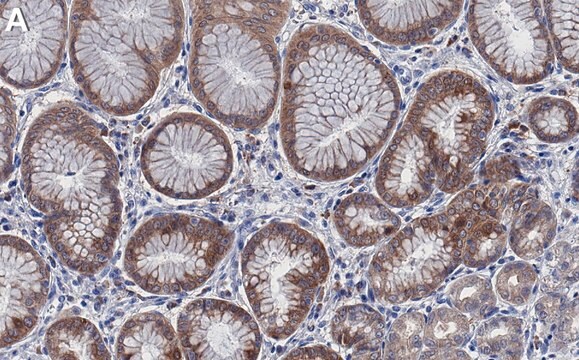
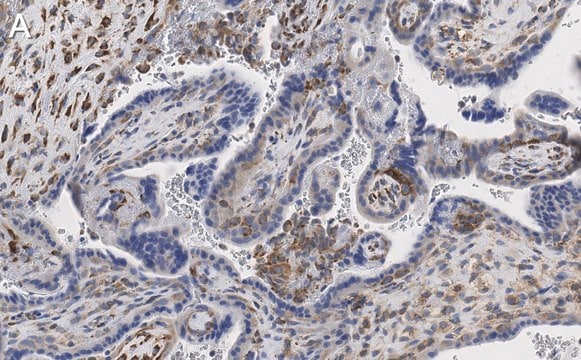
Immunohistochemistry (Paraffin) Analysis: A 1:100 dilution from a representative lot detected Phospho-AKT1-(Ser473) in human breast cancer and human melanoma tissue sections.

Note: Actual optimal working dilutions must be determined by end user as specimens, and experimental conditions may vary with the end user

Biochem/physiol Actions

Clone 1O14 is a ZooMAb® Rabbit recombinant monoclonal antibody that specifically detects AKT1 phosphorylated on serine 473.

Physical form

Purified recombinant rabbit monoclonal antibody IgG, lyophilized in PBS, 5% Trehalose, normal appearance a coarse or translucent resin. The PBS/trehalose components in the ZooMAb formulation can have the appearance of a semi-solid (bead like gel) after lyophilization. This is a normal phenomenon. Please follow the recommended reconstitution procedure in the data sheet to dissolve the semi-solid, bead-like, gel-appearing material. The resulting antibody solution is completely stable and functional as proven by full functional testing. Contains no biocide or preservatives, such as azide, or any animal by-products. Larger pack sizes provided as multiples of 25 μL.

Preparation Note

Recommend storage of lyophilized product at 2-8°C; Before reconstitution, micro-centrifuge vials briefly to spin down material to bottom of the vial; Reconstitute each vial by adding 25 μL of filtered lab grade water or PBS; Reconstituted antibodies can be stored at 2-8°C, or -20°C for long term storage. Avoid repeated freeze-thaws.
Reconstitute lyophilized antibody pellet with 25μL of ultrapure water or Phosphate Buffered Saline (PBS). Please refer to our reconstitution protocol and the specific application guidance on the suggested starting dilutions and sample type.

Legal Information

ZooMAb is a registered trademark of Merck KGaA, Darmstadt, Germany

Disclaimer

Unless otherwise stated in our catalog or other company documentation accompanying the product(s), our products are intended for research use only and are not to be used for any other purpose, which includes but is not limited to, unauthorized commercial uses, in vitro diagnostic uses, ex vivo or in vivo therapeutic uses or any type of consumption or application to humans or animals.
Ta strona może zawierać tekst przetłumaczony maszynowo.

Porównaj podobne pozycje

Wyświetl pełne porównanie

Pokaż różnice

1 of 1

Ta pozycja
ZRB1912ZRB1744ZRB2012
description

recombinant, expressed in HEK 293 cells

description

recombinant, expressed in HEK 293 cells

description

recombinant, expressed in HEK 293 cells

description

recombinant, expressed in HEK 293 cells

clone

1O14, recombinant monoclonal

clone

1H5, recombinant monoclonal

clone

1C14, recombinant monoclonal

clone

1E13, recombinant monoclonal

antibody form

purified antibody

antibody form

purified antibody

antibody form

purified antibody

antibody form

purified antibody

conjugate

unconjugated

conjugate

unconjugated

conjugate

unconjugated

conjugate

unconjugated

species reactivity

human, mouse

species reactivity

rat, human

species reactivity

human

species reactivity

human, monkey

biological source

rabbit

biological source

rabbit

biological source

rabbit

biological source

rabbit

UniProt accession no.

P31749

UniProt accession no.

Q13153

UniProt accession no.

P13674

UniProt accession no.

P23443


Still not finding the right product?

Wypróbuj nasze narzędzie Narzędzie selektora produktów, aby zawęzić opcje.


Klasa składowania

13 - Non Combustible Solids

Co się dzieje?

WGK 1

Temperatura zapłonu (°F)

Not applicable

Temperatura zapłonu (°C)

Not applicable


Wybierz jedną z najnowszych wersji:

Certyfikaty analizy (CoA)

Lot/Batch Number

It looks like we've run into a problem, but you can still download Certificates of Analysis from our Dokumenty section.

Proszę o kontakt, jeśli potrzebna jest pomoc Obsługa Klienta

Masz już ten produkt?

Dokumenty związane z niedawno zakupionymi produktami zostały zamieszczone w Bibliotece dokumentów.

Odwiedź Bibliotekę dokumentów


Questions

Reviews

No rating value

Active Filters