

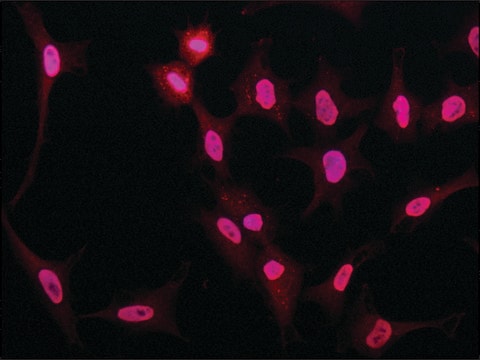
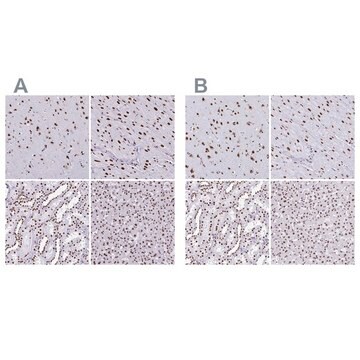
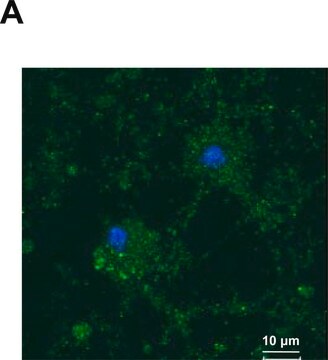
The immunogen is a synthetic peptide corresponding to a sequence at the C-terminal of human NONO (GeneID: 4841) conjugated to KLH. The exact immunogen sequence is proprietary.
Przejdź do
N8664

Anti-NONO (C-terminal) antibody produced in rabbit
~1.0 mg/mL, affinity isolated antibody, buffered aqueous solution
Synonim(y):
Anti-NMT55, Anti-NRB54, Anti-Non-pou domain-containing octamer-binding protein, Anti-Nuclear RNA-binding protein, 54-KD, Anti-p54nrb
Zaloguj się, aby wyświetlić ceny organizacyjne i kontraktowe.
Wybierz wielkość
Zmień widok
| Do Państwa/SKU | Dostępność | Cena netto |
|---|---|---|
200 μL | Skontaktuj się z Obsługą Klienta, aby uzyskać informacje na temat dostępności | 2510,00 zł |
Informacje o tej pozycji
NACRES:
NA.41
UNSPSC Code:
12352203
Conjugate:
unconjugated
Clone:
polyclonal
Application:
IF, IP, WB
Citations:
11
2510,00 zł
Skontaktuj się z Obsługą Klienta, aby uzyskać informacje na temat dostępności
Pomoc techniczna
Potrzebujesz pomocy? Nasz zespół doświadczonych naukowców chętnie Ci pomoże.
Pozwól nam pomócbiological source
rabbit
Quality Segment
conjugate
unconjugated
antibody form
affinity isolated antibody
antibody product type
primary antibodies
clone
polyclonal
form
buffered aqueous solution
mol wt
antigen ~55 kDa
species reactivity
human
concentration
~1.0 mg/mL
technique(s)
immunoprecipitation (IP): 2.5-5 μg using HeLa cell lysates, indirect immunofluorescence: 2-5 μg/mL using paraformaldehyde fixed HeLa cells, western blot: 1-2 μg/mL using NIH-3T3 cell lysates
UniProt accession no.
shipped in
dry ice
storage temp.
−20°C
target post-translational modification
unmodified
Gene Information
human ... NONO(4841)
General description
Non-POU domain containing octamer binding (NONO) is ubiquitously expressed and comprises of two tandem RNP-type RNA- recognition motifs and a putative helix-turn-helix domain followed by a highly charged region. It is enriched in paraspeckles, a nucleoplasmic compartment and relocalizes to cap structures at the nucleolar periphery when transcription is inhibited.
Non-POU domain containing octamer binding protein (NONO) is part of the Drosophila behavior/human splicing (DBHS) protein family. It has a molecular weight of 54kDa and the gene encoding it is localized on human chromosome Xq13.1.
Application
Anti-NONO (C-terminal) antibody produced in rabbit has been used in immunoblotting and immunofluorescence.
Anti-NONO (N-terminal) antibody produced in rabbit has been used in immunoprecipitation.
Biochem/physiol Actions
NONO (also termed as p54nrb) is a nuclear protein implicated in numerous processes including transcription, pre-mRNA processing, nuclear retention of edited RNA and DNA relaxation. NONO was suspected to be involved in pre-mRNA splicing. Later it was found that NONO and PSF mediate different functions depending on their intracellular location.
Non-POU domain containing octamer binding protein (NONO) modulates transcription. Loss-of-function of the protein has been linked to human intellectual disability. The protein also has a role in synaptic transcription and regulation of the circadian clock. NONO also has a function in DNA damage response.
Physical form
Solution in 0.01 M phosphate buffered saline, pH 7.4, containing 15 mM sodium azide.
Disclaimer
Unless otherwise stated in our catalog or other company documentation accompanying the product(s), our products are intended for research use only and are not to be used for any other purpose, which includes but is not limited to, unauthorized commercial uses, in vitro diagnostic uses, ex vivo or in vivo therapeutic uses or any type of consumption or application to humans or animals.
Ta strona może zawierać tekst przetłumaczony maszynowo.
1 of 1
Ta pozycja | |||
|---|---|---|---|
| conjugate unconjugated | conjugate unconjugated | conjugate unconjugated | conjugate unconjugated |
| Quality Level 200 | Quality Level 200 | Quality Level 100 | Quality Level 200 |
| antibody form affinity isolated antibody | antibody form affinity isolated antibody | antibody form affinity isolated antibody | antibody form affinity isolated antibody |
| biological source rabbit | biological source rabbit | biological source rabbit | biological source rabbit |
| technique(s) immunoprecipitation (IP): 2.5-5 μg using HeLa cell lysates, western blot: 1-2 μg/mL using NIH-3T3 cell lysates, indirect immunofluorescence: 2-5 μg/mL using paraformaldehyde fixed HeLa cells | technique(s) immunoprecipitation (IP): 2.5-5 μg using HeLa cell lysates, indirect immunofluorescence: 2-5 μg/mL using paraformaldehyde fixed HeLa cells, western blot: 1-2 μg/mL using NIH-3T3 lysate | technique(s) immunoblotting: 0.04-0.4 μg/mL, immunofluorescence: 0.25-2 μg/mL, immunohistochemistry: 1:50-1:200 | technique(s) immunoprecipitation (IP): 5-10 μg using HEK-293T cell lysates, indirect immunofluorescence: 2-5 μg/mL using paraformaldehyde-fixed NIH-3T3 cells, western blot: 0.5-1 μg/mL using PC12 cell lysates |
| storage temp. −20°C | storage temp. −20°C | storage temp. −20°C | storage temp. −20°C |
Still not finding the right product?
Wypróbuj nasze narzędzie Narzędzie selektora produktów, aby zawęzić opcje.
Klasa składowania
10 - Combustible liquids
wgk
nwg
flash_point_f
Not applicable
flash_point_c
Not applicable
Wybierz jedną z najnowszych wersji:
Masz już ten produkt?
Dokumenty związane z niedawno zakupionymi produktami zostały zamieszczone w Bibliotece dokumentów.
-
Can I get information about the epitope (exact C-terminal region) that was used to generate this antibody? Thanks
1 answer-
Helpful?
-