
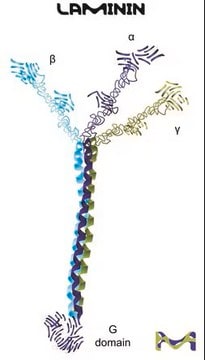

It is Laminin-1.
Przejdź do
L4544

Human Laminin
from human fibroblasts, cell culture derived, liquid, 0.5 mg/mL, suitable for cell culture
Zaloguj się, aby wyświetlić ceny organizacyjne i kontraktowe.
Wybierz wielkość
Zmień widok
| Do Państwa/SKU | Dostępność | Cena netto |
|---|---|---|
100 μL | Skontaktuj się z Obsługą Klienta, aby uzyskać informacje na temat dostępności | 1590,00 zł |
Informacje o tej pozycji
Biological source:
human fibroblasts
Form:
liquid
Technique(s):
cell culture | mammalian: suitable
1590,00 zł
Skontaktuj się z Obsługą Klienta, aby uzyskać informacje na temat dostępności
Pomoc techniczna
Potrzebujesz pomocy? Nasz zespół doświadczonych naukowców chętnie Ci pomoże.
Pozwól nam pomócNazwa produktu
Laminin from human fibroblasts, cell culture derived, liquid, sterile-filtered
biological source
human fibroblasts
Quality Segment
sterility
sterile-filtered
form
liquid
packaging
pkg of 100 μL
technique(s)
cell culture | mammalian: suitable
surface coverage
1‑2 μg/cm2
UniProt accession no.
binding specificity
Peptide Source: Collagen
shipped in
dry ice
storage temp.
−70°C
Gene Information
human ... LAMB1(3912)
Application
Laminin from human fibroblasts has been used:
Laminin from human fibroblasts is recommended for use as a cell culture substratum at 1-2 μg/cm2. The optimal concentration does depend on cell type as well as the application or research objectives.
- in coating six-well plates for wound healing assay
- as a substrate in cell adhesion and spreading assay
- for differentiation of human embryonic stem cells (hESCs) and human induced pluripotent stem cells (hiPSCs) toward dopaminergic neurons
- in corneal endothelial cell wound healing (migration) assay and corneal endothelial cell barrier assay
Laminin from human fibroblasts is recommended for use as a cell culture substratum at 1-2 μg/cm2. The optimal concentration does depend on cell type as well as the application or research objectives.
Biochem/physiol Actions
Laminin proteins are integral components of structural scaffolding in animal tissues. They associate with type IV collagen via entactin and perlecan and bind to cell membranes through integrin receptors, dystroglycan glycoprotein complexes and Lutheran blood group glycoproteins. Laminin has active domains for collagen binding, cell adhesion, heparin binding, and neurite outgrowth fragment. Laminin supports growth and differentiation of many cell types including epithelial, endothelial, neural, muscle and liver cells.
Preparation Note
This product is supplied at a concentration of 0.5 mg/mL in TBS. Thaw this solution slowly before use at 2-8°C to avoid gel formation. If at any time prior to that, the laminin is allowed to warm up prematurely, gelling can occur. Moreover, even allowing it to be stored at -20C can induce gelling or significantly reduce its activity or both." For use as a coating, dilute in a HBSS, coat culture surface with a minimal volume and incubate at 37°C for 1-2 hours. Wash 3 times with HBBS before plating cells. Laminin coatings can be stored for one month at 2-8°C.
Other Notes
Laminin is an extracellular matrix multidomain trimeric glycoprotein, and is the main non-collagenous component of basal lamina that supports adhesion, proliferation and differentiation. Laminin is composed of both A, B1 and B2 chains, which are connected by many disulfide bonds. This laminin product is produced by human fibroblasts and epithelial cells in a co-culture system and then purified biochemically.
Disclaimer
It is recommended to store this product at -70°C, where it will remain stable for two years.
Ta strona może zawierać tekst przetłumaczony maszynowo.
1 of 1
Ta pozycja | |||
|---|---|---|---|
| sterility sterile-filtered | sterility - | sterility - | sterility sterile-filtered |
| technique(s) cell culture | mammalian: suitable | technique(s) cell culture | mammalian: suitable | technique(s) cell culture | mammalian: suitable | technique(s) cell culture | mammalian: suitable |
| biological source human fibroblasts | biological source human placenta | biological source mouse (Engelbreth-Holm-Swarm mouse sarcoma basement membrane) | biological source human fibroblasts |
| Quality Level 200 | Quality Level 300 | Quality Level 300 | Quality Level 100 |
| form liquid | form liquid | form aqueous solution | form solution |
| Gene Information human ... LAMB1(3912) | Gene Information human ... LAMB1(3912) | Gene Information mouse ... Lama1(16772), Lamb1(16777), Lamc1(226519), Lamc2(16782) | Gene Information - |
Klasa składowania
10 - Combustible liquids
wgk
WGK 2
flash_point_f
Not applicable
flash_point_c
Not applicable
Wybierz jedną z najnowszych wersji:
Masz już ten produkt?
Dokumenty związane z niedawno zakupionymi produktami zostały zamieszczone w Bibliotece dokumentów.
-
Hi! Do you know what is the predominant laminin isoform in the preparation? Thank you!
1 answer-
Helpful?
-