Przejdź do zawartości
Merck

E7521

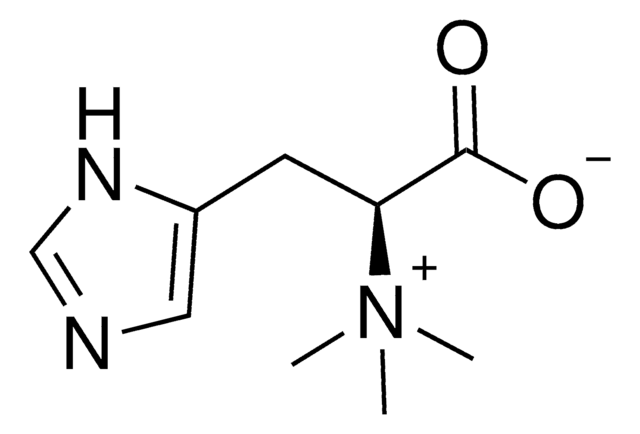
L-(+)-Ergothioneine

Synonim(y):

2-mercaptohistidine trimethyl betaine, Ergothioneine, Sympectothion, Thiasine, Thiolhistidine-betaine, Thioneine, (S)-α-Carboxy-N,N,N-trimethyl-2-mercapto-1H-imidazole-4-ethanaminium inner salt

Zaloguj się, aby wyświetlić ceny organizacyjne i kontraktowe.

Wybierz wielkość

5 MG

1580,00 zł

25 MG

6100,00 zł

1580,00 zł


Skontaktuj się z Obsługą Klienta, aby uzyskać informacje na temat dostępności

Zamów zamówienie zbiorcze

Informacje o tej pozycji

Wzór empiryczny (zapis Hilla):
C9H15N3O2S
Numer CAS:
Masa cząsteczkowa:
229.30
NACRES:
NA.32
PubChem Substance ID:
UNSPSC Code:
12352209
EC Number:
207-843-5
MDL number:

Przejdź do

Pomoc techniczna
Potrzebujesz pomocy? Nasz zespół doświadczonych naukowców chętnie Ci pomoże.
Pozwól nam pomóc

Quality Level

biological source

fungus (Actinomycetales), fungus (Ascomycota), fungus (Basidiomycota)

assay

≥98.0%

form

powder

mol wt

229.30

storage condition

(Keep container tightly closed in a dry and well-ventilated place)

technique(s)

protein quantification: suitable

solubility

water: 50 mg/mL, clear, colorless

storage temp.

−20°C

SMILES string

C[N+](C)(C)[C@@H](Cc1c[nH]c(S)n1)C([O-])=O

InChI

1S/C9H15N3O2S/c1-12(2,3)7(8(13)14)4-6-5-10-9(15)11-6/h5,7H,4H2,1-3H3,(H2-,10,11,13,14,15)/t7-/m0/s1

InChI key

SSISHJJTAXXQAX-ZETCQYMHSA-N

Porównaj podobne pozycje

Wyświetl pełne porównanie

Pokaż różnice

1 of 4

Ta pozycja
B0390SMB00978G1149
technique(s)

protein quantification: suitable

technique(s)

toxicology assay: suitable

technique(s)

-

technique(s)

cell culture | insect: suitable

biological source

fungus (Actinomycetales), fungus (Basidiomycota), fungus (Ascomycota)

biological source

fungus (Myrothecium verrucaria)

biological source

-

biological source

-

assay

≥98.0%

assay

-

assay

≥95% (HPLC)

assay

≥99% (HPLC)

Quality Level

200

Quality Level

200

Quality Level

200

Quality Level

200

form

powder

form

lyophilized powder

form

solid

form

powder

mol wt

229.30

mol wt

-

mol wt

-

mol wt

-

General description

L-(+)-Ergothioneine (ET) is a sulfur-containing amino acid, which is only produced by Actinomycetales bacteria and non-yeast like fungi belonging to the division Basidiomycota and Ascomycota. It was originally isolated from Claviceps purpurea or rye ergot. It is obtained from L-histidine, which is converted into betaine form called hercynine. It is found in both animals and plants, and mammals usually obtain it from their diet, e.g. through mushrooms or oats. It is tautomeric in nature, and in neutral aqueous solution exists in thione form.[1]

Research area: Apoptosis

Application

L-(+)-Ergothioneine is suitable for use in the study of its reactivity with 2,2′- and 4,4′-dipyridyl disulphide (2-Py-S-S-2-Py and 4-Py-S-S-4-Py).[2] It may also be used for the incubation of experimental cells while performing in vitro kinase activity assays for ATM (Ataxia telangiectasia mutated) or ATR (ATM- and RAD3-related).[3]
L-(+)-Ergothioneine has been used:
  • as a component of the maturation medium for cumulus-oocyte complexes (COCs) to test protective function on lipid peroxide formation
  • as an antioxidant compound to test type 2 diabetes patients
  • as a positive control in solute carrier protein 22 A4 (SLC22A4) transport assay

Biochem/physiol Actions

L-(+)-Ergothioneine (ET) has the maximum concentrations in tissues subjected to oxidative stress, with the highest being in blood, eye lens, bone marrow, semen and liver. It acts as an anti-oxidant and prevents apoptosis, by scavenging reactive oxygen and nitrogen species. The anti-oxidant activity is attributable to sulfhydryl groups. It acts as a substrate for SLC22A4 (solute carrier family 22, member 4) transporter. In alveolar macrophages, it prevents the release of interleukin-8 (IL-8) by tumor necrosis factor (TNF)α. IL-8 is an inflammatory cytokine.[1] It also regulates the oxidative damage in liver and kidneys, and has a protective action against lipid peroxidation. It is also responsible for the conservation of endogenous glutathione and α-tocopherol.[4] ET being an antioxidant, protects against γ and UV radiation. In UV-irradiated human dermal fibroblasts, it scavenges reactive oxygen species (ROS), and suppresses matrix metalloproteinases 1 (MMP1) expression. It might also have anti-ageing effects on skin caused by UV-radiation.[5]

Packaging

Bottomless glass bottle. Contents are inside inserted fused cone.

Other Notes

Natural amino acid found in the fungus Claviceps purpurea
Ta strona może zawierać tekst przetłumaczony maszynowo.

Klasa składowania

11 - Combustible Solids

flash_point_f

Not applicable

flash_point_c

Not applicable

ppe

Eyeshields, Gloves, type N95 (US)


Wybierz jedną z najnowszych wersji:

Certyfikaty analizy (CoA)

Lot/Batch Number

Nie widzisz odpowiedniej wersji?

Jeśli potrzebujesz konkretnej wersji, możesz wyszukać konkretny certyfikat według numeru partii lub serii.

Masz już ten produkt?

Dokumenty związane z niedawno zakupionymi produktami zostały zamieszczone w Bibliotece dokumentów.

Odwiedź Bibliotekę dokumentów

Akshamal M Gamage et al.
FASEB journal : official publication of the Federation of American Societies for Experimental Biology, fj201800716-fj201800716 (2018-06-12)
Bacteria use various endogenous antioxidants for protection against oxidative stress associated with environmental survival or host infection. Although glutathione (GSH) is the most abundant and widely used antioxidant in Proteobacteria, ergothioneine (EGT) is another microbial antioxidant, mainly produced by fungi
Ling-Zhi Wang et al.
Journal of mass spectrometry : JMS, 48(3), 406-412 (2013-03-16)
A sensitive analytical method has been developed and validated for the quantification of L-ergothioneine in human plasma and erythrocytes by liquid chromatography-tandem mass spectrometry. A commercially available isotope-labeled L-ergothioneine-d9 is used as the internal standard. A simple protein precipitation with
B D Paul et al.
Cell death and differentiation, 17(7), 1134-1140 (2009-11-17)
Ergothioneine (ET) is an unusual sulfur-containing derivative of the amino acid, histidine, which is derived exclusively through the diet. Although ET was isolated a century ago, its physiologic function has not been clearly established. Recently, a highly specific transporter for
L-Ergothioneine improves the developmental potential of in vitro sheep embryos without influencing OCTN1-mediated cross-membrane transcript expression
Mishra A, et al.
Zygote, 26(2), 149-161 (2018)
Irwin K Cheah et al.
Antioxidants (Basel, Switzerland), 9(7) (2020-07-11)
Infection with SARS-CoV-2 causes the coronavirus infectious disease 2019 (COVID-19), a pandemic that has, at present, infected more than 11 million people globally. Some COVID-19 patients develop a severe and critical illness, spurred on by excessive inflammation that can lead

Numer pozycji handlu globalnego

SKUNUMER GTIN
E7521-25MG04061833261576
E7521-5MG04061833605165

Questions

Reviews

No rating value

Active Filters

Nasz zespół naukowców ma doświadczenie we wszystkich obszarach badań, w tym w naukach przyrodniczych, materiałoznawstwie, syntezie chemicznej, chromatografii, analityce i wielu innych dziedzinach.

Skontaktuj się z zespołem ds. pomocy technicznej