


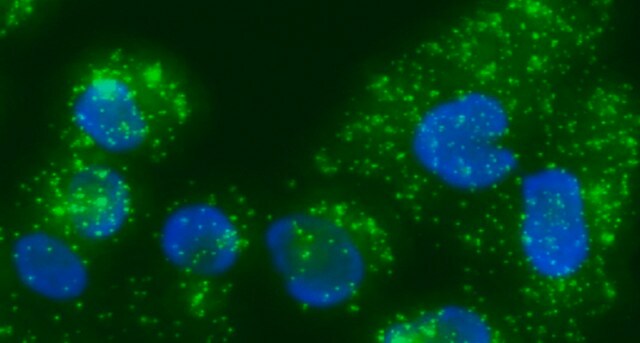


The fluorophore in this kit has an excitation maximum at 554 nm and an emission maximum at 576 nm. This fluorophore can be visualized using the same filter as Cy3, Rhodamine, AlexaFluor 550, and Atto 550.
Przejdź do
DUO92007

Duolink® In Situ Detection Reagents Orange
Synonim(y):
in situ Proximity Ligation Assay reagent, Protein Protein Interaction Assay reagent
, aby wyświetlić ceny organizacyjne i kontraktowe.
Wybierz wielkość
Zmień widok
| Do Państwa/SKU | Dostępność | Cena netto |
|---|---|---|
30 reactions | Skontaktuj się z Obsługą Klienta, aby uzyskać informacje na temat dostępności | 2090,00 zł |
100 reactions | Skontaktuj się z Obsługą Klienta, aby uzyskać informacje na temat dostępności | 3410,00 zł |
Informacje o tej pozycji
NACRES:
NA.32
UNSPSC Code:
12352200
2090,00 zł
Skontaktuj się z Obsługą Klienta, aby uzyskać informacje na temat dostępności
Pomoc techniczna
Potrzebujesz pomocy? Nasz zespół doświadczonych naukowców chętnie Ci pomoże.
Pozwól nam pomócproduct line
Duolink®
Quality Segment
technique(s)
proximity ligation assay: suitable
fluorescence
λex 554 nm; λem 576 nm (Cyanine 3; Zeiss Filter set 20)
suitability
suitable for fluorescence
shipped in
dry ice
storage temp.
−20°C
Application
Duolink®proximity ligation assay(PLA®) allows for endogenous detection of protein interactions, post translational modifications, and protein expression levels at the single molecule level in fixed cells and tissue samples.
Follow the Duolink® In Situ Fluorescence Protocolto use this product. A set of short instructionsis also available.
Visit our Duolink® PLA Resource Center for information on how to run a Duolink® experiment, applications, troubleshooting, and more.
To perform a complete Duolink® PLA in situ experiment you will need two primary antibodies (PLA, IHC, ICC or IF validated) that recognize two target epitopes. Other necessary reagents include a pair of PLA probes from different species (one PLUS and one MINUS), detection reagents, wash buffers, and mounting medium. Note that the primary antibodies must come from the same species as the Duolink® PLA probes. Analysis is carried out using standard immunofluorescence assay equipment.
Follow the Duolink® In Situ Fluorescence Protocolto use this product. A set of short instructionsis also available.
Visit our Duolink® PLA Resource Center for information on how to run a Duolink® experiment, applications, troubleshooting, and more.
To perform a complete Duolink® PLA in situ experiment you will need two primary antibodies (PLA, IHC, ICC or IF validated) that recognize two target epitopes. Other necessary reagents include a pair of PLA probes from different species (one PLUS and one MINUS), detection reagents, wash buffers, and mounting medium. Note that the primary antibodies must come from the same species as the Duolink® PLA probes. Analysis is carried out using standard immunofluorescence assay equipment.
Specificity
Orange fluorescence detection reagents are often used with Cyanine 3 filter.
Application Note
Two primary antibodies raised in different species are needed. Test your primary antibodies (IgG-class, mono- or polyclonal) in a standard immunofluorescence (IF), immunohistochemistry (IHC) or immunocytochemistry (ICC) assay to determine the optimal fixation, blocking, and titer conditions. Duolink® in situ reagents are suitable for use on fixed cells, cytospin cells, cells grown on slide, formalin-fixed, paraffin embedded (FFPE), or tissue (fresh or frozen). No minimum number of cells is required.
Let us do the work for you, learn more about our Custom Service Program to accelerate your Duolink® projects
View full Duolink® product list
Orange fluorescence detection reagents are often used with Cyanine 3 filter.
Application Note
Two primary antibodies raised in different species are needed. Test your primary antibodies (IgG-class, mono- or polyclonal) in a standard immunofluorescence (IF), immunohistochemistry (IHC) or immunocytochemistry (ICC) assay to determine the optimal fixation, blocking, and titer conditions. Duolink® in situ reagents are suitable for use on fixed cells, cytospin cells, cells grown on slide, formalin-fixed, paraffin embedded (FFPE), or tissue (fresh or frozen). No minimum number of cells is required.
Let us do the work for you, learn more about our Custom Service Program to accelerate your Duolink® projects
View full Duolink® product list
Features and Benefits
- No overexpression or genetic manipulation required
- High specificity (fewer false positives)
- Single molecule sensitivity due to rolling circle amplification
- Relative quantification possible
- No special equipment needed
- Quicker and simpler than FRET
- Increased accuracy compared to co-IP
- Publication-ready results
Other Notes
This product is comprised of the following:
Not included in Detection kit:
Primary antibodies, PLA probes, wash buffers, mounting medium
- 5x Ligation - Contains oligonucleotides that hybridize to the PLA probes and all components needed for ligation except the Ligase
- 1x Ligase (1 unit/μL)
- 1x Polymerase (10 units/μL)
- 5x Amplification Orange - Contains all components needed for Rolling Circle Amplification (RCA) except the Polymerase. It also contains oligonucleotide probes labeled with a fluorophore that hybridize to the RCA product.
Not included in Detection kit:
Primary antibodies, PLA probes, wash buffers, mounting medium
Legal Information
Duolink is a registered trademark of Merck KGaA, Darmstadt, Germany
PLA is a registered trademark of Merck KGaA, Darmstadt, Germany
Ta strona może zawierać tekst przetłumaczony maszynowo.
1 of 1
Ta pozycja | |||
|---|---|---|---|
| technique(s) proximity ligation assay: suitable | technique(s) proximity ligation assay: suitable | technique(s) proximity ligation assay: suitable | technique(s) proximity ligation assay: suitable |
| suitability suitable for fluorescence | suitability suitable for fluorescence | suitability suitable for fluorescence | suitability suitable for fluorescence-detection automated sequencing, suitable for microtiter plates |
| fluorescence λex 554 nm; λem 576 nm (Cyanine 3; Zeiss Filter set 20) | fluorescence λex 594 nm; λem 624 nm (Texas Red®, Zeiss Filter set 31) | fluorescence λex 495 nm; λem 527 nm (green) (FITC (Cyanine 2), Zeiss Filter set 38) | fluorescence λex 360 nm; λem 460 nm |
| shipped in dry ice | shipped in dry ice | shipped in dry ice | shipped in dry ice |
| storage temp. −20°C | storage temp. −20°C | storage temp. −20°C | storage temp. −20°C |
| product line Duolink® | product line Duolink® | product line Duolink® | product line Duolink® |
signalword
Danger
Klasa składowania
10 - Combustible liquids
hcodes
Hazard Classifications
Aquatic Chronic 2 - ED ENV 1 - Resp. Sens. 1
Wybierz jedną z najnowszych wersji:
Masz już ten produkt?
Dokumenty związane z niedawno zakupionymi produktami zostały zamieszczone w Bibliotece dokumentów.
-
What is the emission and excitation of the orange kit?
1 answer-
Helpful?
-
-
Will repeated thawing and freezing affect the quality of the 5x amplification buffer included in the kit?
1 answer-
It is generally acceptable to subject the amplification buffer to a few freeze-thaw cycles. However, it is advised to avoid exceeding 10 cycles, as this could potentially compromise its effectiveness.
Helpful?
-